
OpenAI 'Spud' (GPT-6): Release Date, Features & What We Know So Far
OpenAI's next major model — codenamed 'Spud,' likely GPT-5.5 or GPT-6 — completed pretraining March 24. Here's every confirmed detail, the release window, and what it means if you use ChatGPT.
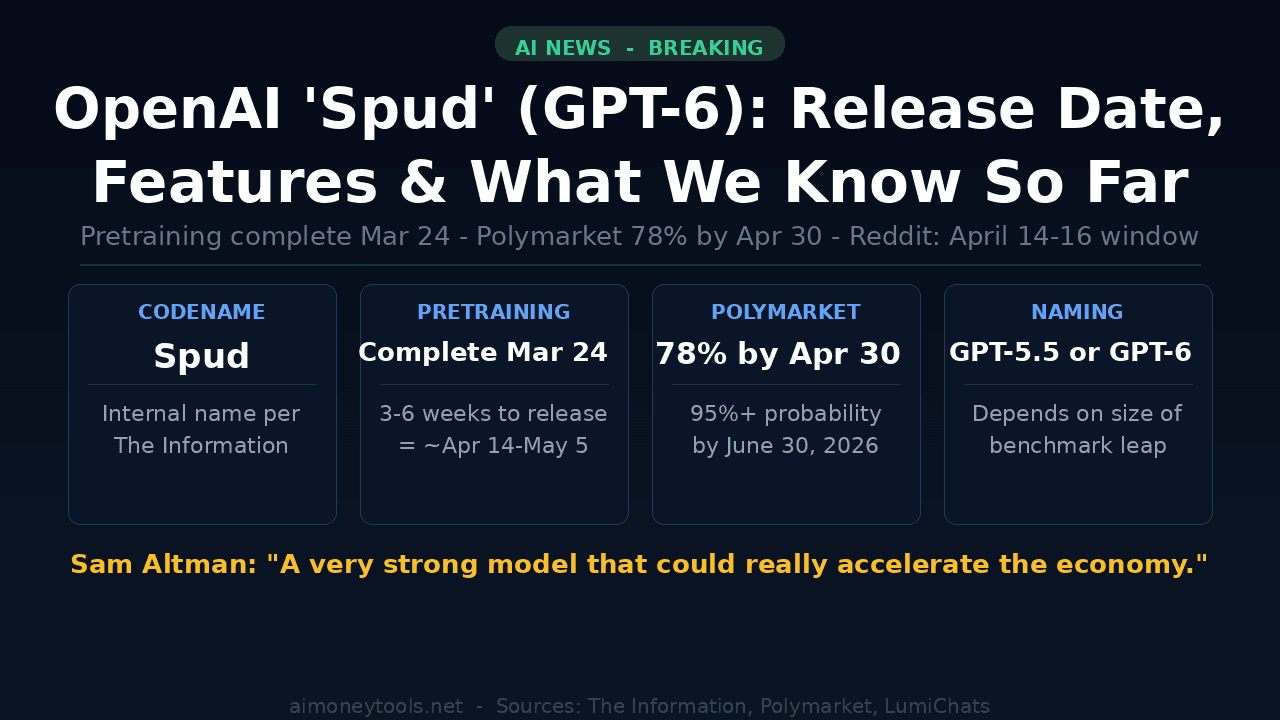
OpenAI's next major model has a codename: Spud.
The Information first reported pretraining completion around March 24, 2026. Sam Altman told employees it is "a very strong model that could really accelerate the economy." Greg Brockman, in a public interview on the Big Technology podcast, described it as representing "two years of research" with a "big model feel — it's not an incremental improvement, it's a significant change in the way we think about model development."
Polymarket currently gives 78% probability of release by April 30, and 95%+ by June 30. A Reddit thread in r/ChatGPTcomplaints, which has been tracking OpenAI signals closely, put the launch window at April 14–16 — just two to four days from today.
Here's everything confirmed, what's still unverified, and what it means for you.
What Is "Spud"?
Spud is an internal OpenAI codename — the kind of placeholder name used before official product naming is finalized. It was first reported by The Information on March 24, 2026, consistent with how OpenAI has named internal projects before formal branding is settled.
The model is expected to ship publicly as either GPT-5.5 or GPT-6. OpenAI has not committed to either name publicly. According to sources, the final decision depends on the magnitude of the performance leap over the current flagship, GPT-5.4: if benchmarks show a generational improvement, expect GPT-6. If it's a strong but more incremental advance, GPT-5.5.
What's clear is that this is not a minor update. Brockman's language — "two years of research," "big model feel," "a significant change in the way we think about model development" — is the most aggressive pre-release framing OpenAI has used since the original GPT-5 launch.
The Release Timeline: Where Are We Now?
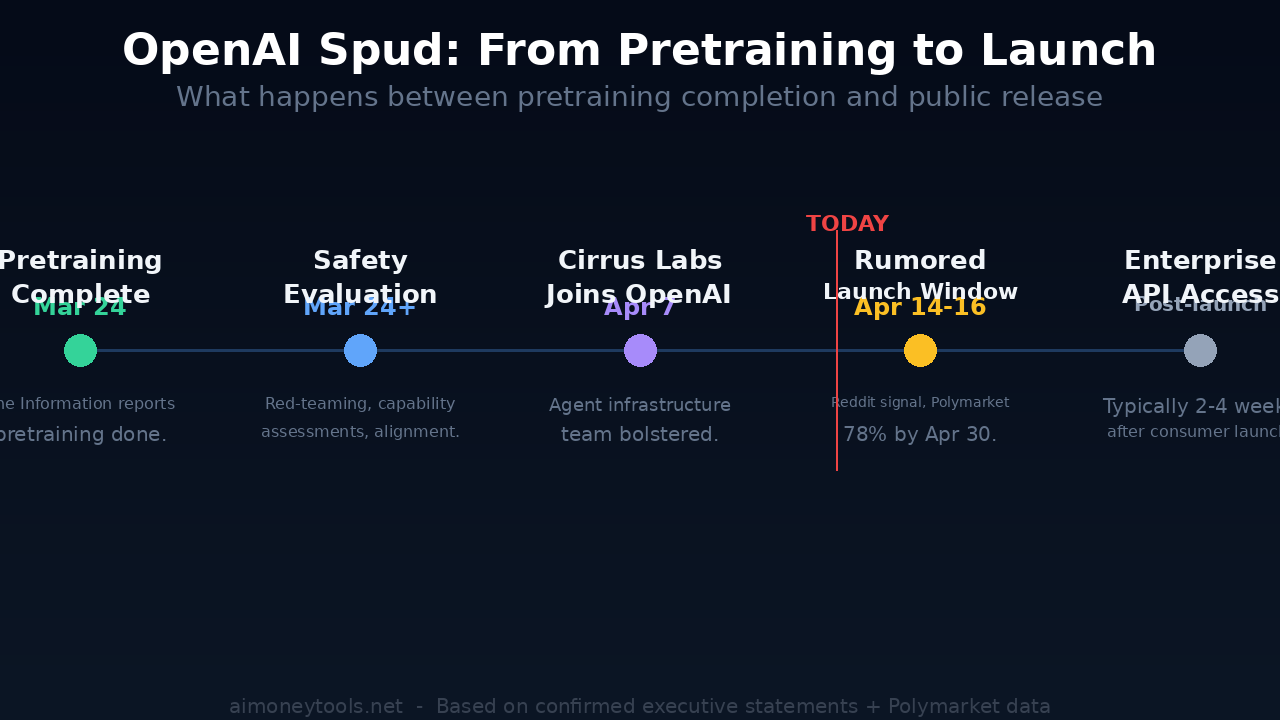
For context on timing, look at how OpenAI handled recent releases. For GPT-5.4 (released March 5, 2026), the gap between pretraining completion and public launch was approximately four weeks. The pattern has been consistent across recent models: pretraining → 3–6 weeks of safety evaluation and red-teaming → consumer launch → enterprise API access 2–4 weeks later.
With pretraining completing around March 24:
- April 14–May 5 is the likely consumer launch window
- Polymarket consensus: 78% by April 30
- Social signal: Reddit thread tracking OpenAI blog and X posts narrowed it to April 14–16
- Cirrus Labs joined OpenAI's Agent Infrastructure team on April 7 — reinforcing that agentic infrastructure work is actively ramping ahead of a major release
The "Code Red" posture that sources describe at OpenAI — driven by Google's Gemini 3.1 Pro leading 13 of 16 major benchmarks and Claude Opus 4.6 outperforming GPT-5.4 on real-world coding evaluations — adds urgency to the timeline. This is not a release OpenAI wants to delay.
What GPT-5.4 Currently Does (And Where Spud Needs to Beat It)
To understand what Spud represents, you need to understand what it is trying to surpass.
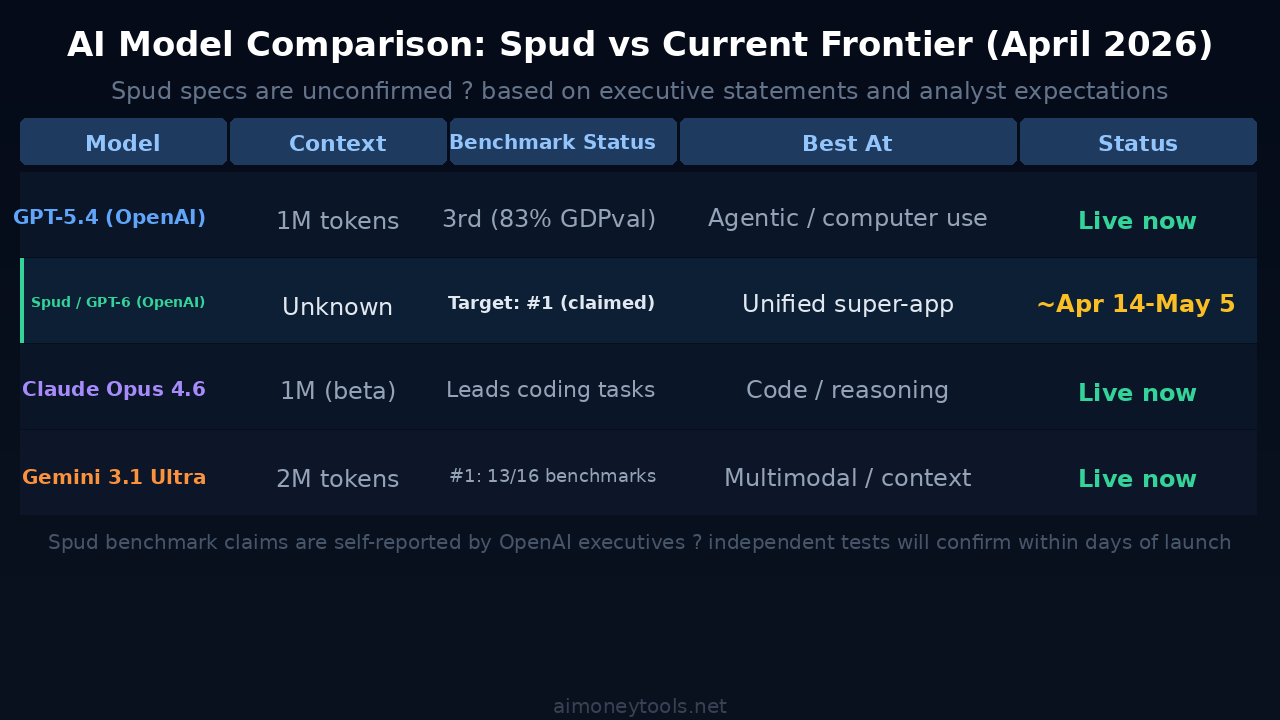
GPT-5.4, released March 5, 2026, is a genuinely strong model. It brought OpenAI's largest context window to date: 1 million tokens, competitive with Claude Opus 4.6's 1M context (in beta) and behind Gemini 3.1 Ultra's 2 million token window. It introduced native computer-use capabilities to the API — agents that can operate computers and execute complex workflows across applications. It scored 83% on GDPval (real-world knowledge work across 44 professions) and 75% on OSWorld (computer use benchmark). And it reduced factual errors in individual claims by 33% compared to GPT-5.2.
The limitations that remain: GPT-5.4 did not recapture benchmark leadership over Gemini 3.1 Pro or coding dominance over Claude Opus 4.6. In extended agentic tasks — multi-hour autonomous workflows — GPT-5.4 shows reliability gaps that enterprise deployments have flagged in Q1 2026. And the product experience is still fragmented: separate models for coding (GPT-5.3-Codex), reasoning (GPT-5.4 Thinking), and instant responses (GPT-5.3 Instant) create model-switching overhead.
Spud, as designed, would collapse those into a single model at a higher ceiling than any current version.
The Unified Super-App Strategy
Spud is not just a model upgrade. It is being designed as the backbone of what OpenAI calls its "unified super-app" — a product strategy that collapses ChatGPT, Codex, deep research, memory, and agent capabilities into a single platform.
The rapid Codex CLI updates in early April 2026 — including first-class plugins and multi-agent workflows — are widely interpreted as infrastructure preparation for Spud's deployment. The File Library launched in Q1 2026 moved ChatGPT toward a persistent workspace. Apple CarPlay integration brought it into 100 million vehicles. Shopping and product comparison tools pushed it toward commercial decision-making.
Each of these features becomes more valuable with a more capable underlying model. Spud is the engine that makes the platform coherent rather than fragmented.
Cirrus Labs' April 7 announcement that it is joining OpenAI's Agent Infrastructure team fits this pattern precisely. Cirrus CI, their continuous integration product, is shutting down June 1 — the team is moving entirely into OpenAI's infrastructure work. The timing, one week before the rumored Spud launch window, is not a coincidence.
If you're thinking about how to actually use more capable AI agents in your workflow, Ampere is worth exploring — it's built specifically for AI agent deployment and is already designed for the kind of multi-step autonomous work that Spud appears to be targeting.
What This Means Depending on How You Use AI
If you use ChatGPT for everyday work tasks (writing, research, email, summaries): Spud will likely arrive as a transparent upgrade — improved response quality, fewer factual errors, better tool integration without changing anything you do. The unified architecture means less model-switching overhead.
If you're using Claude Opus 4.6 for coding and you're considering switching: This is the head-to-head that matters most for developers. Spud is explicitly targeting the coding gap. If Brockman's "not incremental" framing holds up in independent benchmarks, this could be the first model since GPT-4 where OpenAI genuinely competes with Anthropic's best on code generation and debugging. If it doesn't, Claude Opus 4.6 remains the clear developer choice. Wait for the benchmarks.
If you're using Gemini 3.1 Ultra: Google's 2M token context window and 13/16 benchmark leadership position are the current standard. Spud needs to demonstrate real performance gains to shift that. Google is not standing still — Gemini 3.2 is in development, and the competitive pressure from Spud will accelerate Google's timeline.
If you're a business evaluating enterprise AI contracts: Enterprise API access for Spud will likely lag the consumer launch by 2–4 weeks, consistent with GPT-5.4's rollout. If your team is deciding between ChatGPT Team and Claude Team right now, waiting until post-Spud benchmarks publish (likely by late April or early May) will give you a significantly clearer picture than anything available today.
If you don't currently pay for any AI subscription: Spud will almost certainly reach free ChatGPT users within 2–4 weeks of the paid launch, consistent with OpenAI's recent pattern of using free-tier flagship access as a user acquisition tool.
The Competitive Context: Why This Release Matters
The past six months have been OpenAI's most competitive period. Gemini 3.1 Pro leads 13 of 16 major AI benchmarks per Google's own model card data (March 2026). Claude Opus 4.6, released by Anthropic in February, consistently outperforms GPT-5.4 on real-world coding in head-to-head developer testing. GPT-5.4 is excellent and leads on specific categories — knowledge work, computer use — but it did not recapture the top position across all benchmarks that matter to enterprise buyers.
The internal pressure at OpenAI created what sources describe as a "Code Red" posture starting in December 2025. Spud is the direct response.
The IPO context matters here too. OpenAI, despite removing its nonprofit governance structure and generating significant revenue, has not gone public. The extraordinary executive framing around Spud — "two years of research," "macro-economic event," "big model feel" — arrives at a moment when the company has every incentive to release something that re-establishes technological leadership before any public market valuation event.
That doesn't mean Spud is hype. It means the benchmarks — when they publish, within days of release — matter more than Altman's internal framing. The AI community has been burned by pre-release language before. Claude Mythos generated similar expectations and delivered on them. DeepSeek V4 is still approaching. The frontier is genuinely moving, and Spud appears to be a real step rather than a marketing event — but the independent evaluation will tell us within 48 hours of launch.
Key Takeaways
- OpenAI's "Spud" model completed pretraining around March 24, 2026 — confirmed by The Information and Sam Altman
- Expected to ship as GPT-5.5 or GPT-6 depending on benchmark performance vs. GPT-5.4
- Release window: April 14 – May 5, 2026. Polymarket at 78% by April 30. Reddit signal: April 14–16
- Greg Brockman: "two years of research" / "not an incremental improvement" — the strongest pre-release executive language since GPT-5
- Core design: unified super-app backbone collapsing ChatGPT, Codex, agents, memory into a single model
- Cirrus Labs joined OpenAI's Agent Infrastructure team April 7 — agentic infrastructure ramping ahead of launch
- Competitive target: recapture benchmark leadership from Gemini 3.1 Pro (13/16 benchmarks) and Claude Opus 4.6 (coding)
- Enterprise API access will lag consumer launch by 2–4 weeks
- Benchmarks, not executive statements, will confirm capabilities within 48 hours of release
For context on how the current AI agent landscape works before Spud arrives, read why you might need your own AI agent.
Frequently Asked Questions
Is Spud actually GPT-6 or GPT-5.5? OpenAI hasn't decided publicly. The naming will depend on how large the benchmark leap over GPT-5.4 is. If benchmarks show a generational shift, expect GPT-6. If it's a strong but more incremental improvement, expect GPT-5.5. Internally it's still "Spud."
What is the confirmed Spud release date? No official date has been announced by OpenAI. Based on pretraining completion (March 24) and typical 3–6 week safety evaluation windows, the consumer launch window is approximately April 14 – May 5, 2026. Polymarket's crowd consensus puts 78% probability on release by April 30.
What new features will Spud have? The only confirmed strategic details are (a) Spud is designed to be the backbone of a unified super-app collapsing multiple ChatGPT products into one platform, and (b) executive framing positions it as a major improvement over GPT-5.4 targeting benchmark leadership over Gemini 3.1 Pro and Claude Opus 4.6. Specific feature details — context window size, architecture, modalities — have not been confirmed. Claims circulating about "40% performance leap" or "2M token context" are unverified analyst speculation, not official statements.
Will Spud be available for free? Based on OpenAI's recent pattern, free ChatGPT users will get access to Spud within 2–4 weeks of the paid (Plus/Pro) launch. Expect Plus subscribers to get access first, with free tier following.
Should I wait for Spud before choosing an AI subscription? If you're deciding between ChatGPT Team and Claude Team enterprise contracts right now, yes — waiting 2–3 weeks for post-launch benchmarks will give you meaningful additional data. If you're on a monthly individual plan, there's no downside to signing up now and reassessing once Spud benchmarks are public.
What happened to Sora — did OpenAI cancel it for Spud? Multiple sources have reported that OpenAI redirected compute resources away from Sora video generation to prioritize Spud training. Sora remains available but has not seen major updates since late 2025.
Who are Cirrus Labs and why does it matter? Cirrus Labs built Cirrus CI, a cloud-based continuous integration platform. On April 7, 2026, they announced joining OpenAI's Agent Infrastructure team — their CI product is shutting down June 1. The team brings deep infrastructure expertise for building reliable automated pipelines. Their arrival one week before the Spud launch window signals that OpenAI is actively scaling the infrastructure needed to support large-scale agentic workloads, which Spud is designed to power.

Alex the Engineer
•Founder & AI ArchitectSenior software engineer turned AI Agency owner. I build massive, scalable AI workflows and share the exact blueprints, financial models, and code I use to generate automated revenue in 2026.
Related Articles
How to Start an AI-Assisted Resume Writing Side Hustle in 2026 (Beginner's Guide)
A step-by-step guide to using AI resume tools to offer a paid resume and cover letter writing service — what to charge, which tools to use, and how to find your first clients.
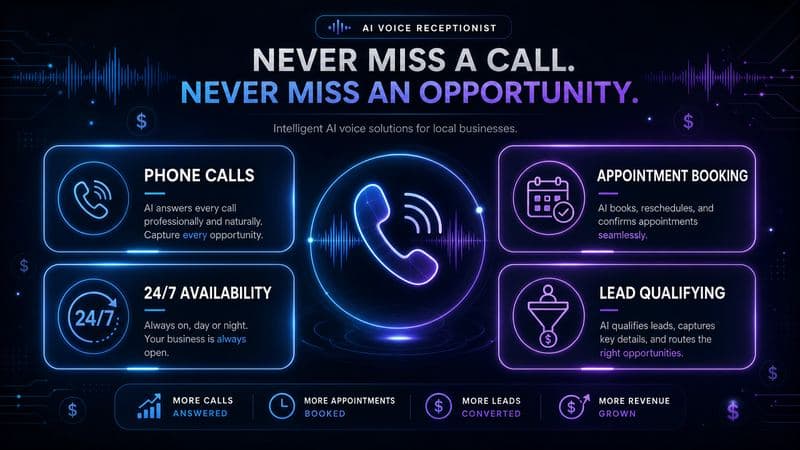
How to Build and Sell AI Voice Receptionists to Local Businesses in 2026
A beginner's guide to building AI voice agents that answer business phone calls — the tools to use, what to charge, and how to find your first client.
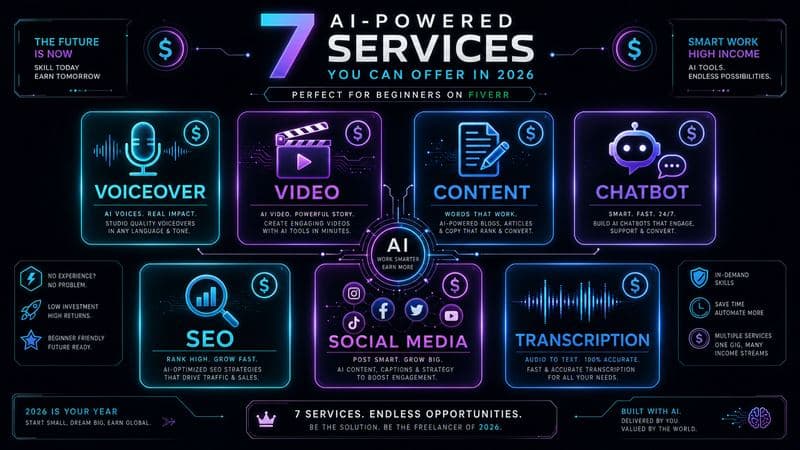
How to Make Money on Fiverr with AI Tools in 2026: 7 Gigs You Can Start This Week
Discover 7 real Fiverr gigs you can launch using free and low-cost AI tools in 2026 — no experience required. Real pricing data, step-by-step setup, and tools that actually work.