
How to Start an AI Automation Agency in 2026 (From Zero, No Experience Needed)
A complete beginner's guide to starting an AI automation agency in 2026. Learn what services to offer, how to get your first clients, and which tools to use — including how to host your AI builds.
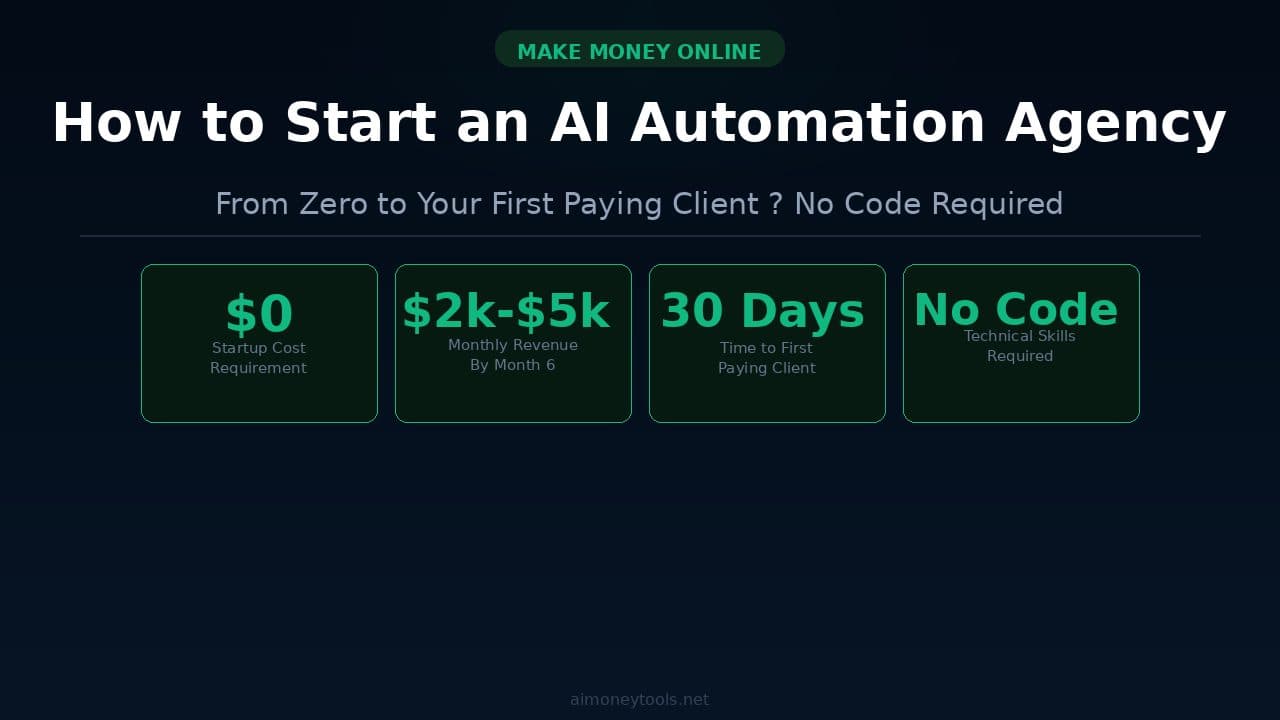
One of the most practical ways to earn money with AI right now is to become the person who builds AI tools for businesses that cannot build them on their own. That is the core idea behind an AI automation agency.
You do not need a computer science degree. You do not need to train your own models. You need to understand what AI tools exist, which ones solve real business problems, and how to connect them into something useful for a paying client.
This guide is for complete beginners. By the end, you will know what an AI automation agency actually is, what services you can realistically offer in your first few months, how to land your first client, and what tools you need to get started.
What Is an AI Automation Agency?
An AI automation agency is a service business. You charge companies — typically small and medium-sized businesses — to build, configure, and maintain AI-powered systems for them.
Those systems might be:
- A chatbot that answers customer questions on their website 24/7
- An automated pipeline that reads incoming emails and routes them to the right person
- A tool that takes meeting notes and automatically generates action items
- A content workflow that drafts social media posts from a product database
The businesses that hire you are not tech companies. They are dentist offices, law firms, e-commerce stores, local service businesses, real estate agents, and marketing agencies. They know AI exists. They have heard it could save them time and money. They do not know how to implement it. That is the gap you fill.
This is genuinely a real market. According to McKinsey, over 70 percent of small businesses report they lack in-house technical expertise to implement AI tools, even when they want to. You do not need to convince clients that AI matters — you need to convince them you can build something that actually works for their specific situation.
Is This Realistic for a Beginner?
Yes — but with realistic expectations.
In your first 30 days, you will probably not close a $5,000 contract. You will likely land one or two small projects at $300–$800 each, learn an enormous amount about what clients actually want versus what you thought they wanted, and build your first portfolio piece.
By month three, if you are consistent, closing $1,500–$3,000/month in project revenue is achievable. By month six, you can aim for $5,000–$8,000/month with a mix of one-time builds and small retainer clients.
The people who fail at this either try to charge too much too fast (before they have proof) or take on projects they cannot deliver (promising custom software when they should be offering no-code tools). Start small, deliver well, charge more later.
What Services Should a Beginner Offer?
Start with one of these three. All of them require no code and are solvable with tools that exist today.
1. AI Chatbot for Small Business Websites
A business that gets 100+ website visitors per month and has repetitive customer questions — hours, pricing, booking, FAQs — is a candidate for a chatbot. You build a custom AI chatbot trained on their business information, embedded on their site.
Tools: CustomGPT is built exactly for this. You upload the client's website content, PDFs, FAQs, and pricing docs, and it builds a custom GPT that knows their business. Clients without a tech team can manage it themselves after setup.
What to charge: $500–$1,500 setup fee + $100–$300/month maintenance. The maintenance is where recurring income comes from.
2. Workflow Automation
Businesses waste enormous amounts of time on repetitive manual tasks: copying data between systems, sending follow-up emails, sorting incoming leads. Automation tools like n8n, Make (formerly Integromat), and Zapier can connect these systems without code.
Your job is to map the client's current manual workflow, identify where automation can replace human time, and build the connection. A law firm that manually routes intake forms to different paralegals based on case type is a classic example.
What to charge: $300–$1,200 per workflow built. You can offer a monthly retainer for monitoring and adjustments.
3. AI Content Pipelines
Businesses that need consistent content — blog posts, social media updates, email newsletters, product descriptions — can benefit enormously from a structured AI workflow. You build the template, the prompts, and the production system. They fill in the inputs; the AI does the drafting.
What to charge: $500–$2,000 to set up the system. Monthly retainer for running it on their behalf.
How to Get Your First Client
The biggest mistake beginners make is building a website and waiting. Nobody will find you. You need to go to where clients are.
Start with one local industry and go deep. Pick a vertical — say, real estate agents or local marketing agencies — and reach out directly. You are not cold-pitching a random business. You are offering to solve a specific problem they already have.
Your outreach message should follow this structure:
- Identify a specific pain (e.g., "Most real estate agents I talk to spend 3–5 hours a week answering the same property inquiry questions manually")
- Offer a specific solution ("I build AI assistants that answer these automatically, so agents focus on closings")
- Low-commitment ask ("Could I show you a 10-minute demo with your own listings?")
Do not charge your first client full price. Offer to build it at 50% discount in exchange for a testimonial and permission to use it as a portfolio piece. That portfolio piece is worth more than the extra $300.
Where to find clients:
- Local business Facebook groups
- LinkedIn (search your target industry + location)
- Reddit communities for your target industry (e.g., r/realestateinvesting, r/smallbusiness)
- Upwork — yes, competition is high, but early clients prove your ability to close
- Referrals from your own network — tell 20 people what you are building
Tools You Need to Get Started
You do not need a complex stack. Here is a minimal starting setup:
For building AI chatbots: CustomGPT — the fastest way to go from a client's documents to a live AI assistant. Free plan available to test with clients before you charge.
For workflow automation: n8n is the most powerful free option and one of the most in-demand skills for automation agencies. If you want to offer n8n as a managed service to clients, you will need to host it somewhere reliable. Ampere is built for this — it provides the compute infrastructure to run n8n (and other self-hosted tools) without the complexity of managing servers yourself. It is how you scale from "I built this locally" to "here is the URL for your live automation."
For client management: A simple Notion workspace or Google Workspace is enough at the start. Do not buy CRM software until you have paying clients.
For contracts and payments: Wave or FreshBooks for invoicing (both free to start). Use a simple one-page contract template — Google "freelance service agreement template" for something you can adapt.
Pricing Your Services
The most common mistake is charging hourly. Hourly billing punishes you for getting faster.
Package your services into fixed outcomes:
| Package | What It Includes | Price |
|---|---|---|
| Starter Chatbot | Custom AI chatbot for your website (trained on your docs, 1 revision) | $597 |
| Business Automation Bundle | One automated workflow + chatbot setup | $997 |
| Monthly Maintenance | Monitoring, updates, new FAQ additions | $197/mo |
Once you have delivered three projects successfully, raise your prices by 20–30%. Clients who found you at lower rates stay if you do good work. New clients get higher-rate quotes.
How to Scale Beyond Your First Few Clients
Once you have 3–5 portfolio examples and $2,000+/month in project revenue, a few things open up:
Productize one service. Instead of custom-quoting everything, turn your best-performing service into a repeatable package. "AI chatbot setup for law firms: $797, delivered in 5 business days." When you can deliver the same thing repeatedly, you can market it, test conversion, and eventually bring in help to deliver it.
Add a retainer tier. One-time projects are income; retainers are a business. Offer a monthly option for clients to have you on call for new automations, updates, and improvements. Even $200/month from 10 clients is $2,000 in recurring revenue that does not require new sales.
Partner with web designers. Web designers build sites for businesses that need chatbots. They do not want to learn how to build chatbots. You build chatbots. This is a natural referral partnership — offer a 15–20% referral fee for every client they send you.
Frequently Asked Questions
Do I need to know how to code to start an AI automation agency?
No. The tools available in 2026 — CustomGPT, n8n with visual flow editors, Make, Zapier — are designed to be used without writing code. Basic familiarity with technology helps, but no coding background is required.
How long does it take to land the first client?
Most beginners land their first client within 4–8 weeks of consistent outreach. The key variable is how many conversations you start. Five emails a day to targeted businesses is a realistic daily goal.
What industries are easiest to get started in?
Local service businesses (law firms, dental offices, real estate, home services) are the most accessible. They have clear pain points, repeat customer inquiries, and budget for tools that save staff time. They are also less likely to have in-house tech teams, so they genuinely need outside help.
How much money can I make in my first year?
A realistic first year: $0 in months 1–2 (learning, building, outreach), $500–$2,000/month by month 3–4, $3,000–$6,000/month by month 6–12 if you focus. Your first year income depends almost entirely on how aggressively you pursue clients, not on your technical skills.
Do I need a business registration to start?
In most countries, you can freelance as a sole proprietor without formal business registration. Check local rules for your jurisdiction. Once you hit $2,000–$3,000/month in revenue, registering as a formal entity makes sense for tax and liability reasons.
What is the difference between an AI automation agency and a freelancer?
Framing. A freelancer offers their time. An agency offers a service with a defined deliverable. Both can be one person. "Agency" framing allows you to charge for outcomes rather than hours and positions you as a business partner rather than a contractor.
Can I do this part-time while working a full-time job?
Yes. Most people who start AI automation agencies in 2026 are doing so on evenings and weekends. The first $1,000–$2,000/month is achievable with 10–15 hours per week of focused work.
The Fastest Path to Your First Dollar
Here is the 30-day plan:
- Week 1: Pick one vertical (e.g., local law firms). Learn what their biggest pain points are by reading Reddit, LinkedIn posts, and talking to 3 people in that industry. Set up a free CustomGPT account and build a demo chatbot using a fake law firm's FAQ.
- Week 2: Write 10 outreach messages tailored to your vertical. Send them. Follow up once. Aim for 1 discovery call.
- Week 3: If you get a call, listen more than you talk. Identify their biggest time sink. Propose a simple fix. Quote $400–$600 to start.
- Week 4: Deliver the project. Ask for a written testimonial. Use it everywhere.
One paid project in 30 days is proof it works. Build on that.
AI automation agencies are one of the clearest paths from zero technical background to a real income stream in 2026. The tools exist, the demand is real, and the barrier to entry is lower than it has ever been. The only actual requirement is that you start.

Alex the Engineer
•Founder & AI ArchitectSenior software engineer turned AI Agency owner. I build massive, scalable AI workflows and share the exact blueprints, financial models, and code I use to generate automated revenue in 2026.
Related Articles
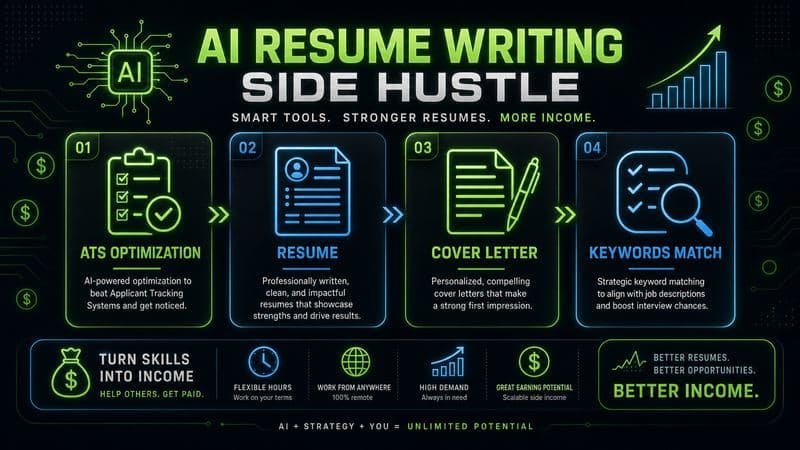
How to Start an AI-Assisted Resume Writing Side Hustle in 2026 (Beginner's Guide)
A step-by-step guide to using AI resume tools to offer a paid resume and cover letter writing service — what to charge, which tools to use, and how to find your first clients.
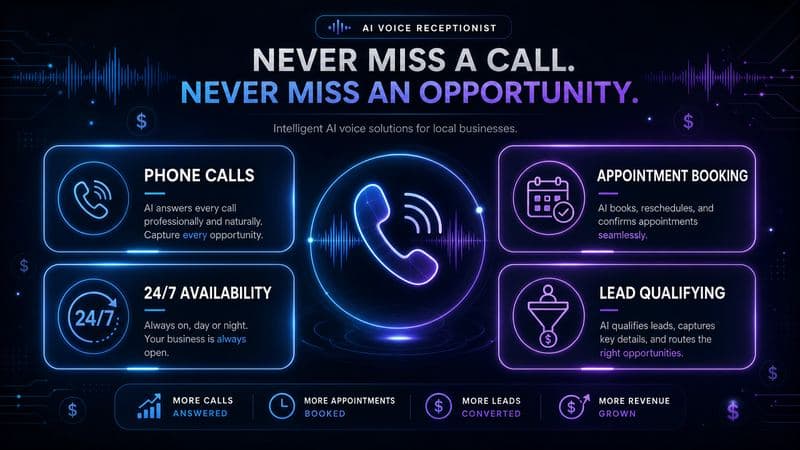
How to Build and Sell AI Voice Receptionists to Local Businesses in 2026
A beginner's guide to building AI voice agents that answer business phone calls — the tools to use, what to charge, and how to find your first client.
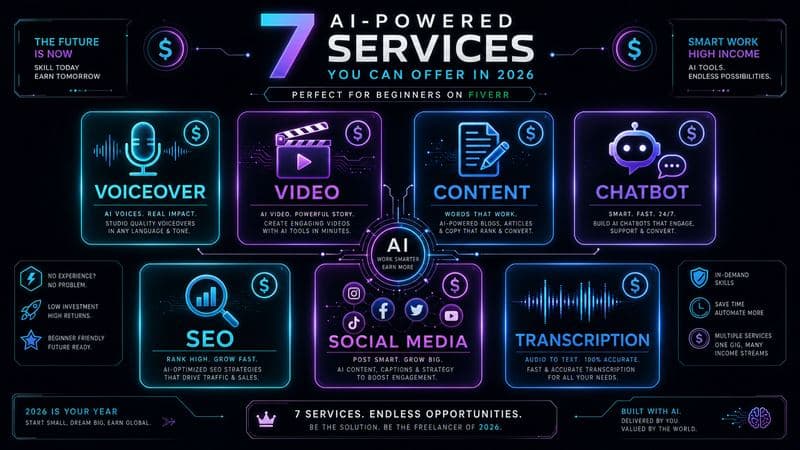
How to Make Money on Fiverr with AI Tools in 2026: 7 Gigs You Can Start This Week
Discover 7 real Fiverr gigs you can launch using free and low-cost AI tools in 2026 — no experience required. Real pricing data, step-by-step setup, and tools that actually work.