
Best AI Tools for Content Creators in 2026 (Tested)
The 7 best AI tools for content creators in 2026, tested for writing, video, images, and voice. Honest breakdown of what each does, what it costs, and who it is actually for.
Some links in this article are affiliate links. We may earn a commission if you sign up — at no extra cost to you.
Content creation in 2026 runs on AI tools. The question is no longer whether to use them — it is which tools are worth paying for and which ones are overhyped. This guide covers 7 tools that have been tested hands-on across writing, video, images, voice, and scheduling. Each entry includes the honest use case, price, and whether it is a good fit for beginners.
What AI Tools Can Actually Do for Content Creators
Before diving into the list: AI tools are not magic buttons. They are time multipliers. A task that takes you 3 hours still requires your judgment — but AI can compress the execution time to 30 minutes.
Where they reliably save time:
- First drafts (blogs, scripts, captions, email newsletters)
- Visual asset creation (thumbnails, cover images, social graphics)
- Voiceover and audio production
- Repurposing existing content across formats
Where they do not replace you: strategy, genuine audience insight, brand voice development, and anything that requires lived experience.
The tools below cover all five functional areas.
The 7 Best AI Tools for Content Creators in 2026
1. ChatGPT (Best All-Purpose Writing Assistant)
ChatGPT remains the most versatile AI writing tool in 2026. For content creators, it is most useful for first drafts, outline generation, repurposing long-form content into short-form, and ideation at scale.
The GPT-4o model, included in the Plus plan, handles long-context tasks well — you can paste a 5,000-word article and ask it to turn it into 10 LinkedIn posts, a thread, and a newsletter section. The output is almost always usable with light editing.
Best for: Blog writers, newsletter creators, social media managers handling multiple platforms.
Price: Free tier available (GPT-4o Mini) · Plus at $20/month (GPT-4o full access).
Limitation: Cannot be trained on your specific content or client information. Every session starts fresh unless you use the custom instructions or Projects feature.
2. CustomGPT (Best for Building Content Assistants Trained on Your Own Material)
CustomGPT (affiliate) solves the biggest limitation of standard ChatGPT: it can be trained on your own content. You upload your blog posts, brand guides, product documentation, client FAQs, and style guides. The AI then answers questions and generates content based specifically on your source material.
For content creators, this means you can build a writing assistant that knows your brand voice, uses your terminology, and does not hallucinate facts about your products or clients. For freelancers, it means you can build a client-specific assistant for each account you manage.
Setup takes 10–15 minutes for a basic agent. You paste your website URL or upload PDFs, and the assistant indexes and learns from your content automatically.
Best for: Content agencies, freelancers managing multiple clients, anyone with an established content library they want to reuse systematically.
Price: Starts at $89/month (Basic plan — 1 custom AI agent, 5,000 pages of training data).
Why it stands out: The ability to train on your own documents separates CustomGPT from every generic writing AI. If your content depends on accurate brand voice and specific knowledge, this is the tool that makes that possible at scale.
3. Canva AI (Best for Visual Content)
Canva's AI features — Magic Design, Magic Write, and the text-to-image generator built into the platform — have made it the default visual content tool for non-designers in 2026.
The relevant features for content creators: AI-generated social media templates, automatic resizing across platforms (one design → Instagram, LinkedIn, Twitter/X sizes in one click), and background removal on images. The text-to-image generator is not as powerful as Midjourney, but it is good enough for thumbnails, blog cover images, and social graphics where you need speed over artistic precision.
Best for: Social media creators, bloggers who need cover images, course creators, coaches.
Price: Free tier is genuinely functional. Pro at $15/month adds brand kits, premium templates, and bulk export.
4. Descript (Best for Video and Podcast Creators)
Descript is the most efficient AI-powered video and audio editor for content creators who are not professional editors. The core feature: it transcribes your recording and lets you edit the video by editing the text transcript. Delete a word from the transcript, and the video cut is made automatically.
The AI features that save the most time: Overdub (AI voice correction that matches your voice for fixing mistakes), background noise removal, automatic filler word removal ("um", "uh"), and eye contact correction that makes you appear to look at the camera even if you were reading notes.
For YouTubers, podcast hosts, and course creators, Descript compresses edit time by 60–70% on standard recordings.
Best for: YouTubers, podcast creators, course builders, video marketers.
Price: Free tier available. Creator plan at $12/month includes all AI features.
5. Murf.ai (Best for AI Voiceover)
Murf.ai (affiliate) is the leading AI voiceover tool for content creators who need professional-quality narration without recording it themselves. It offers 200+ AI voices across 20+ languages, with controls for tone, pacing, and emphasis.
The practical use cases: faceless YouTube videos, explainer videos, e-learning courses, product demos, podcast intros, and any content where you want consistent narration without recording every take.
What separates Murf from basic text-to-speech: voice quality is genuinely production-ready. The Studio quality voices are indistinguishable from professional voice actors in most use cases. You can also add background music tracks and sync voiceover timing to video slides inside the platform.
Best for: Faceless YouTube channels, e-learning creators, marketing video producers.
Price: Free tier (10 minutes of voice generation, no downloads). Basic at $23/month. Pro at $66/month includes commercial rights and team collaboration.
6. Copy.ai (Best for Short-Form Marketing Copy)
Copy.ai specializes in high-conversion short-form copy: email subject lines, ad headlines, product descriptions, landing page sections, and social media captions. It is faster than ChatGPT for these specific use cases because it has pre-built templates designed for conversion copywriting.
The Workflows feature (Pro plan) lets you automate repetitive copy tasks — for example, automatically generate 10 product description variations from a CSV of product specs. For e-commerce content teams and affiliate marketers with large product catalogs, this is a significant time saver.
Best for: Affiliate marketers, e-commerce content teams, email marketers, ad copywriters.
Price: Free tier (2,000 words/month). Starter at $36/month. Pro at $186/month includes Workflows.
7. Midjourney (Best for AI Image Generation)
Midjourney remains the highest-quality AI image generator for content creators who need original, distinctive visuals. Version 6 produces photorealistic images, illustrations, and conceptual visuals that consistently outperform other image generators on quality benchmarks.
For content creators, the main use cases are blog hero images, YouTube thumbnail backgrounds, course cover art, and social media visuals that need to stand out. The learning curve is steeper than Canva — Midjourney uses Discord-based prompting — but the output quality justifies the effort for visual-heavy content strategies.
Best for: Creators who need custom, original images at scale (blog thumbnails, course visuals, social graphics).
Price: Basic plan at $10/month (200 image generations). Standard at $30/month (unlimited relaxed generations).
How to Choose the Right Tool

The answer depends on your content type:
| Content type | Primary tool | Secondary |
|---|---|---|
| Blog + newsletter | ChatGPT or CustomGPT | Midjourney for images |
| YouTube / video | Descript | Murf.ai for voiceover |
| Social media | Canva AI | ChatGPT for captions |
| E-learning / courses | Descript | Murf.ai + Canva AI |
| Marketing copy | Copy.ai | ChatGPT for longer pieces |
| Client management | CustomGPT | Any for execution |
Do not buy all seven at once. Pick one based on your primary bottleneck, run it for 30 days, and add the next tool when you can measure the value.
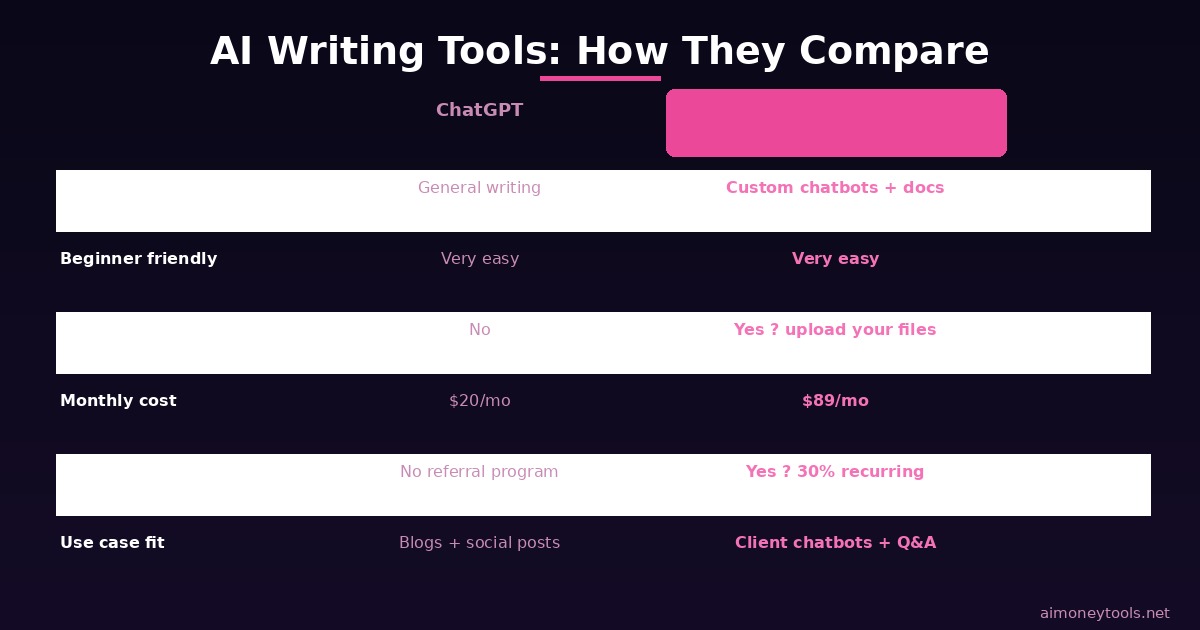
AI Writing Tools Head-to-Head
Frequently Asked Questions
Are AI content tools worth the cost for beginners?
Yes, if you are producing content regularly. If you publish 3+ pieces per week, the time saved by a $20–$40/month AI writing tool pays for itself within a few days of use. If you publish once a month, the free tiers of most tools are sufficient.
Can AI tools write a blog post I can publish without editing?
Almost never. AI drafts are starting points. They require fact-checking, personal anecdotes, and a pass for brand voice and accuracy before publishing. Plan for 20–30 minutes of editing on a 1,000-word AI draft. That is still significantly faster than writing from scratch.
Which tool is best if I only want to pay for one?
For most content creators, ChatGPT Plus at $20/month covers the widest range of tasks. If you manage content for clients or run a content-heavy business, CustomGPT is the better long-term investment because it can be trained on specific knowledge.
Do I need Midjourney if I already have Canva AI?
Not necessarily. Canva AI is faster and more integrated if you are designing within Canva anyway. Midjourney produces higher-quality and more unique images, which matters if visual differentiation is part of your brand. Use Canva AI first; upgrade to Midjourney when you hit its quality ceiling.
Can I use AI tools to run a content agency as a one-person team?
Yes. With ChatGPT or CustomGPT for writing, Canva AI for visuals, and Descript for video, one person can produce what used to require a 3–4 person team. The main constraint is client communication and strategy — AI does not replace the relationship or judgment, but it handles execution.
Are there free alternatives to these tools?
Yes. ChatGPT's free tier (GPT-4o Mini), Canva's free plan, and Descript's free tier together cover the core writing, visual, and video editing use cases. They have limits, but for testing and light use they are fully functional. The paid plans are worth it once you are producing content at scale.

Alex the Engineer
•Founder & AI ArchitectSenior software engineer turned AI Agency owner. I build massive, scalable AI workflows and share the exact blueprints, financial models, and code I use to generate automated revenue in 2026.
Related Articles
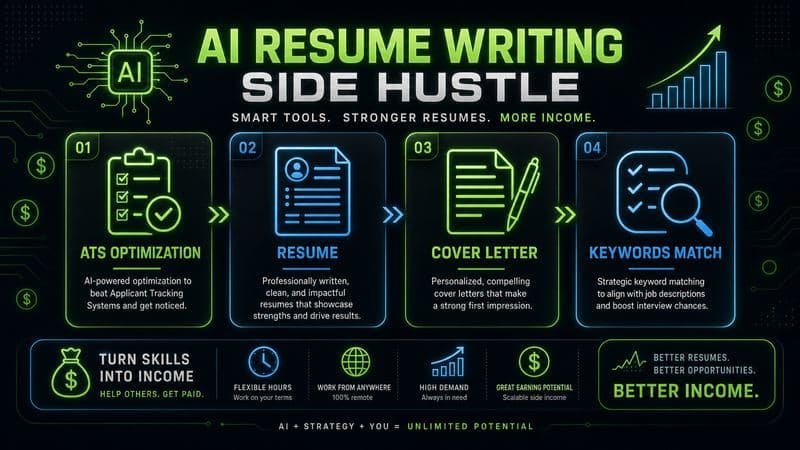
How to Start an AI-Assisted Resume Writing Side Hustle in 2026 (Beginner's Guide)
A step-by-step guide to using AI resume tools to offer a paid resume and cover letter writing service — what to charge, which tools to use, and how to find your first clients.
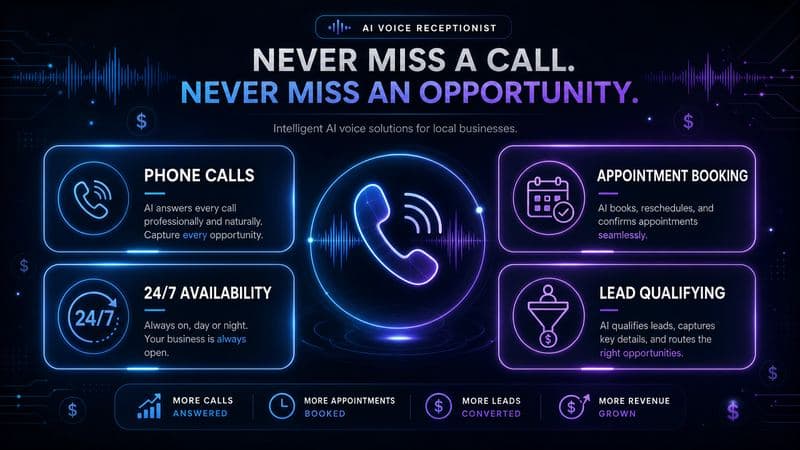
How to Build and Sell AI Voice Receptionists to Local Businesses in 2026
A beginner's guide to building AI voice agents that answer business phone calls — the tools to use, what to charge, and how to find your first client.
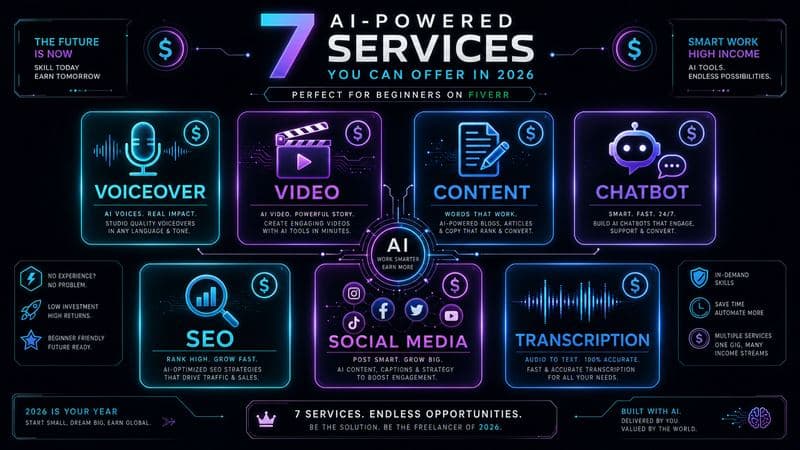
How to Make Money on Fiverr with AI Tools in 2026: 7 Gigs You Can Start This Week
Discover 7 real Fiverr gigs you can launch using free and low-cost AI tools in 2026 — no experience required. Real pricing data, step-by-step setup, and tools that actually work.