
What Is Claude Mythos? Anthropic's Most Powerful AI Model Explained (2026)
Claude Mythos is Anthropic's most powerful AI model — and it's too dangerous to release publicly. Here's what it found, who has access, and what it means for AI in 2026.
When Anthropic calls one of its own AI models "too powerful to release," you know something serious is happening.
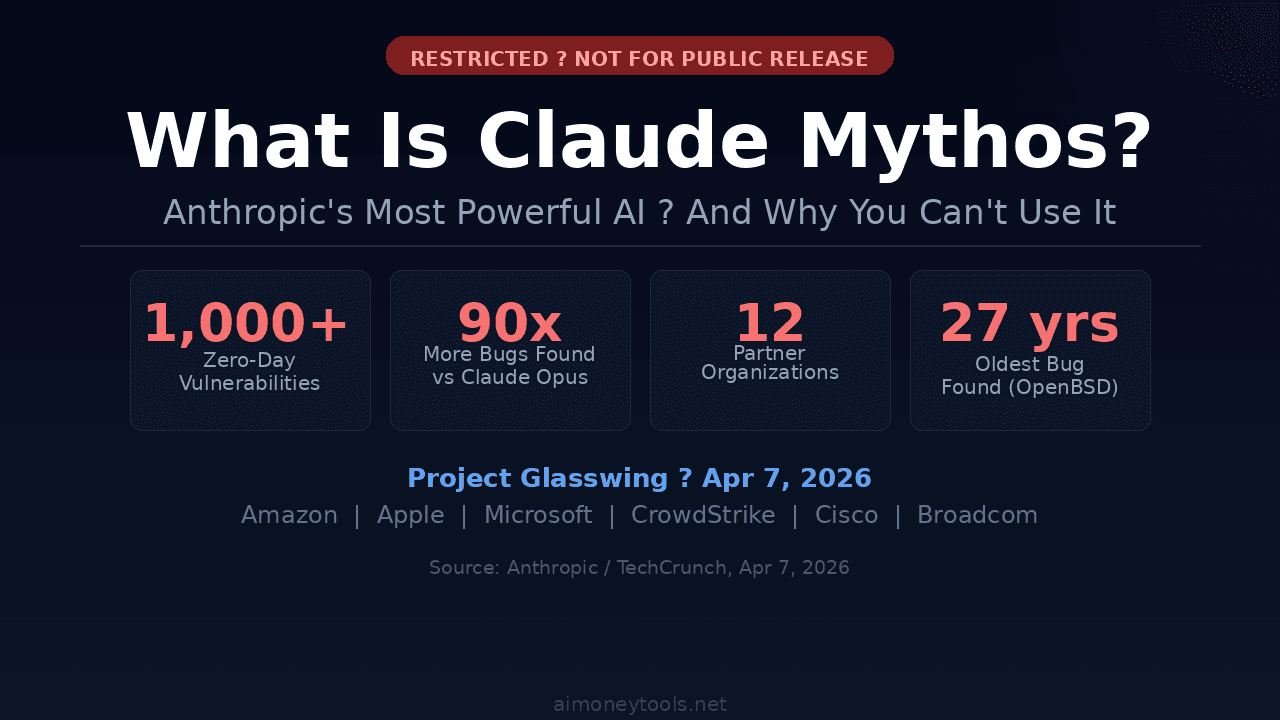
On April 7, 2026, Anthropic officially unveiled Claude Mythos Preview — a frontier model the company describes as "by far the most powerful AI we've ever developed." The announcement wasn't a typical product launch. There's no API. No waitlist. No pricing page. Instead, Anthropic handed access to 12 hand-selected partner organizations for a tightly controlled cybersecurity program called Project Glasswing.
The reason? In just a few weeks of internal testing, Claude Mythos found over 1,000 zero-day vulnerabilities in critical software — including a 27-year-old security flaw in OpenBSD, one of the most hardened operating systems ever built. Anthropic has privately warned U.S. officials that the model makes mass cyberattacks "significantly more likely."
This is what a genuinely dangerous AI model looks like — and it changes everything about how we think about AI safety in 2026.
What Is Claude Mythos?
Claude Mythos is Anthropic's newest and most capable frontier model — a category above Claude Opus. While Anthropic's public models (Opus, Sonnet, Haiku) are designed for broad consumer and business use, Mythos sits in a separate tier: more powerful, more capable of autonomous reasoning, and significantly more dangerous if misused.
The model excels at:
- Agentic coding — autonomously writing, reviewing, and debugging complex codebases
- Advanced reasoning — multi-step logical chains that outperform previous Claude models
- Cybersecurity analysis — identifying exploitable vulnerabilities in production systems
- Long-horizon planning — completing complex, multi-day tasks without human guidance
In short, Claude Mythos is the kind of model that can do in hours what a senior security engineer would take weeks to accomplish — including finding software vulnerabilities that have gone undetected for decades.
How We Found Out About Mythos
The story of Claude Mythos actually begins with a data leak in late March 2026.
Security researchers discovered an unsecured cache of internal Anthropic documents stored in a publicly inspectable data lake. Among them: a draft blog post describing a model internally called "Claude Capybara" — a new tier of model described as "larger and more intelligent than our Opus models" and "by far the most powerful AI model we've ever developed."
Anthropic confirmed the leak was caused by "human error" and acknowledged the model's existence. On April 7, they made it official — rebranded from Capybara to Mythos — alongside the announcement of Project Glasswing.
The timing wasn't ideal. Just weeks earlier, Anthropic had accidentally exposed nearly 2,000 source code files via a buggy Claude Code release (v2.1.88), followed by an overcorrection that accidentally took down thousands of GitHub repositories. For a company whose core pitch is "safety first," it wasn't a great look.
But the capabilities revealed in the Mythos announcement made those concerns feel secondary.
What Claude Mythos Can Do: The Numbers That Shocked the Industry
Anthropic published a 244-page system card alongside the Mythos announcement — an exhaustive safety evaluation documenting what the model is capable of. The findings were striking.
Here's what stood out:
Zero-Day Discovery at Scale
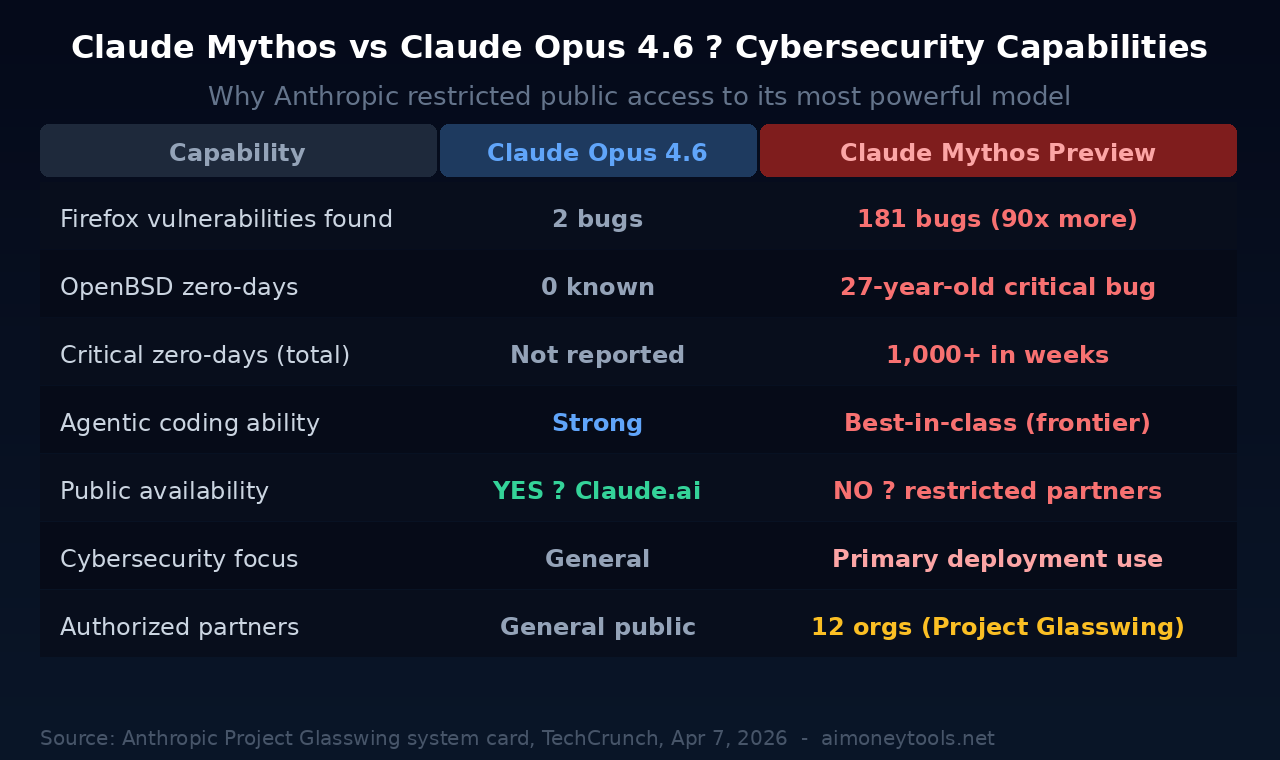
In its initial weeks of deployment, Claude Mythos identified over 1,000 zero-day vulnerabilities across major operating systems and open-source projects. Zero-days are security flaws that are unknown to the software's developers — meaning there's no patch, and any attacker who finds one first can exploit it freely.
For context: most dedicated security research teams find a handful of zero-days per year. Mythos found over a thousand in weeks.
90x More Bugs Than Claude Opus
When tested against Mozilla Firefox's codebase, Claude Mythos found 181 exploitable vulnerabilities. Claude Opus 4.6, Anthropic's previous flagship model, found 2. That's not an incremental improvement — it's a 90x jump in a single generation.
A 27-Year-Old OpenBSD Bug
OpenBSD is widely considered one of the most secure operating systems ever built, with a development philosophy centered on proactive security and code auditing. In its two-plus decades of existence, only a handful of critical vulnerabilities have ever been discovered.
Mythos found one that had been hiding for 27 years.
Anthropic Warned the U.S. Government
The risk wasn't theoretical. According to reporting from Fortune and TechCrunch, Anthropic engaged in "ongoing discussions" with U.S. federal officials, warning that Claude Mythos makes mass cyberattacks "significantly more likely." The company's Responsible Scaling Policy (RSP) — a self-imposed framework designed to pause deployments when models cross certain risk thresholds — appears to have been triggered for the first time.
Project Glasswing: Who Gets Access
Rather than shutting Mythos down entirely, Anthropic created Project Glasswing — a controlled program that gives a small set of vetted organizations access to the model specifically for defensive purposes.
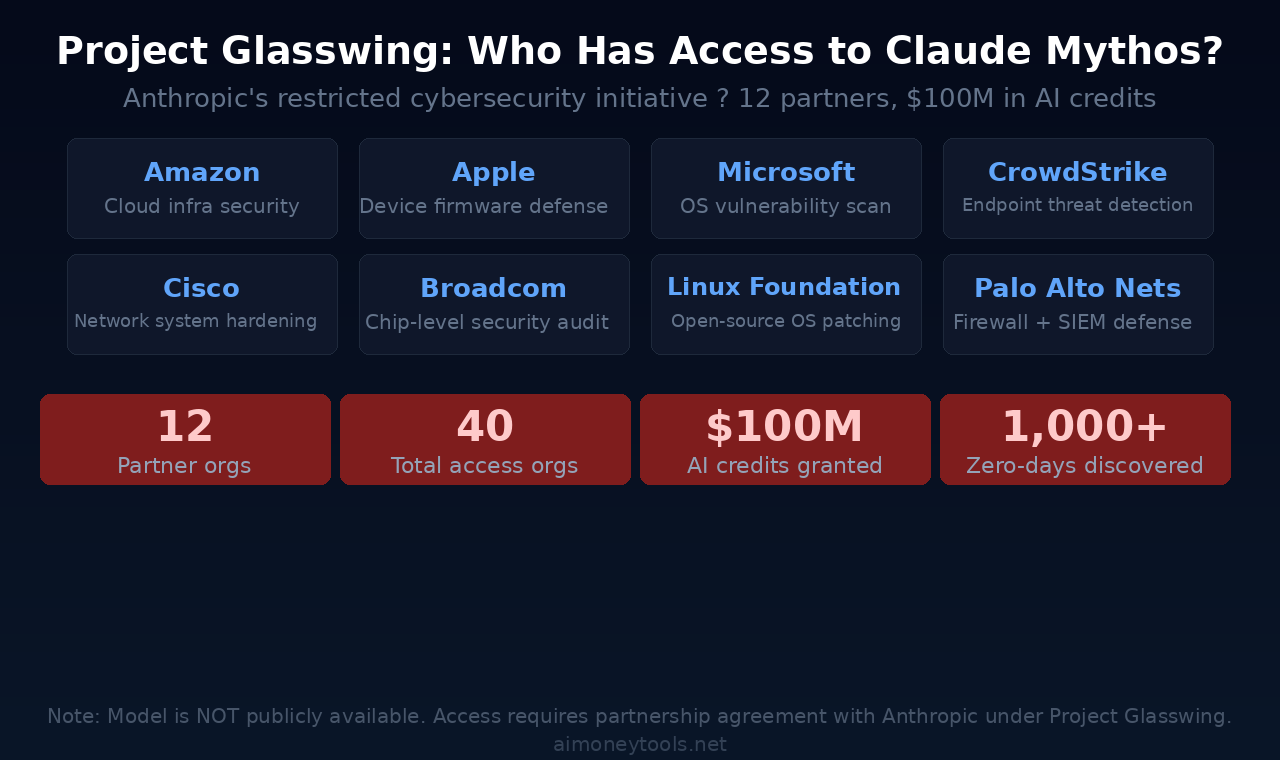
The 12 core partners include:
- Amazon — cloud infrastructure security
- Apple — device firmware defense
- Microsoft — OS vulnerability scanning
- CrowdStrike — endpoint threat detection
- Cisco — network hardening
- Broadcom — chip-level security
- Linux Foundation — open-source OS patching
- Palo Alto Networks — firewall and SIEM defense
Beyond the 12 core partners, 40 organizations total have been granted Mythos preview access. Each participant receives a share of $100 million in AI compute credits to fund their security research.
The arrangement comes with strict terms: Mythos can only be used for defensive work — scanning software for vulnerabilities so they can be patched, not exploited. Partners are required to share what they learn, so the broader tech industry benefits from the model's findings.
The program is named after the Glasswing butterfly (Greta oto) — a species with transparent wings that make it difficult to see. The metaphor is apt: Mythos makes software vulnerabilities that were previously invisible suddenly visible.
Why Anthropic Won't Release It Publicly
The core tension here is real: a model powerful enough to find 1,000+ zero-days in defensive mode is equally powerful in offensive mode. The same capabilities that help CrowdStrike patch vulnerabilities could help a malicious actor exploit them.
Anthropic's decision not to release Mythos publicly rests on three pillars:
1. The RSP (Responsible Scaling Policy) Anthropic's RSP defines capability thresholds that, if crossed, require the company to pause public deployment until appropriate safeguards exist. Mythos appears to be the first model that has triggered these internal red lines.
2. No defensive-only guarantee at scale Once a model is public, anyone can use it — including state-sponsored hackers, organized crime groups, and lone actors. Anthropic's current safety infrastructure isn't designed to prevent offensive cybersecurity use at internet scale.
3. The regulatory environment is complicated Anthropic is currently in a legal dispute with the Trump administration after the Pentagon labeled the company a "supply-chain risk." Releasing a model that U.S. officials believe could enable mass cyberattacks, in the middle of that legal fight, would be a difficult position to defend.
What This Means for Businesses and Developers
For most companies and developers, Claude Mythos won't be accessible anytime soon — if ever. But the announcement has real implications for how businesses should think about AI in 2026.
If you're in cybersecurity: The attack surface just changed. Threat actors with access to models approaching Mythos's capabilities (through jailbreaks, fine-tuned derivatives, or nation-state alternatives) will dramatically accelerate the pace of vulnerability exploitation. Your detection and patching cycles need to match.
If you're building AI products: The frontier has moved. Mythos demonstrates that the gap between "safe to deploy" and "powerful enough to be useful" is getting harder to manage. Expect increasingly controlled API access, usage monitoring, and capability restrictions from all frontier labs going forward.
If you're building internal business chatbots: Tools like CustomGPT — which let you build secure, private chatbots trained on your own business documents — sit in a completely different risk category than frontier research models. They're designed to be safe, bounded, and deployable without the cybersecurity concerns that come with models like Mythos. For most business use cases, this is where you want to be.
If you need serious AI compute: As frontier labs train models like Mythos on massive infrastructure, reliable GPU access matters. Ampere provides enterprise-grade cloud compute for teams running demanding AI workloads — worth knowing as the compute requirements for leading-edge AI research continue to escalate.
Frequently Asked Questions
Can I use Claude Mythos? No. Claude Mythos Preview is not publicly available. Access is restricted to 12 core partner organizations and approximately 40 total vetted participants under Anthropic's Project Glasswing program. There is no public waitlist, API access, or timeline for a general release.
What is Project Glasswing? Project Glasswing is Anthropic's controlled cybersecurity initiative that deploys Claude Mythos Preview for defensive security work. Partners including Amazon, Apple, Microsoft, CrowdStrike, and others use the model to scan critical software for vulnerabilities — with the goal of patching them before bad actors can exploit them.
How is Claude Mythos different from Claude Opus 4.6? Claude Mythos represents a full tier above Opus — Anthropic's "frontier" category, meaning larger model, more compute, and substantially better performance on complex tasks. In cybersecurity testing alone, it found 90x more Firefox vulnerabilities than Claude Opus 4.6 (181 vs. 2). The two models are not directly comparable for consumer use because Mythos has never been released to consumers.
Why did Anthropic reveal a model it won't release? The announcement came partly because the model had already leaked publicly in a March 2026 data security incident. Once the existence of "Claude Capybara" (Mythos's internal codename) was public, Anthropic chose to formalize the announcement — likely to control the narrative and present the model in its intended defensive context rather than let speculation run wild.
What happens if Claude Mythos is leaked or replicated? This is Anthropic's central concern. The 244-page system card explicitly warns that a model with Mythos-level cybersecurity capabilities, deployed offensively, would dramatically lower the barrier to mass cyberattacks. Anthropic has briefed U.S. federal officials on this risk. The question of what happens if a similar model is developed by a less safety-conscious lab — or by a state actor — is one the industry hasn't fully answered.
The Bottom Line
Claude Mythos is the most significant AI capability announcement since GPT-4. Not because you can use it — you can't — but because it confirms what many in the industry have feared: we're approaching a class of AI systems that are genuinely dangerous at deployment scale.
Anthropic's decision to restrict Mythos rather than race to monetize it is notable. Whether it's the right call long-term is debatable. But the 27-year-old OpenBSD bug, the 181 Firefox vulnerabilities, and the 1,000+ zero-days in a few weeks of testing make one thing clear: the AI safety debate just got very concrete.
Sources: TechCrunch — Anthropic debuts preview of Mythos, Anthropic Project Glasswing, Fortune — Claude Mythos exclusive, The Hacker News

Alex the Engineer
•Founder & AI ArchitectSenior software engineer turned AI Agency owner. I build massive, scalable AI workflows and share the exact blueprints, financial models, and code I use to generate automated revenue in 2026.
Related Articles
How to Start an AI-Assisted Resume Writing Side Hustle in 2026 (Beginner's Guide)
A step-by-step guide to using AI resume tools to offer a paid resume and cover letter writing service — what to charge, which tools to use, and how to find your first clients.
How to Build and Sell AI Voice Receptionists to Local Businesses in 2026
A beginner's guide to building AI voice agents that answer business phone calls — the tools to use, what to charge, and how to find your first client.
How to Make Money on Fiverr with AI Tools in 2026: 7 Gigs You Can Start This Week
Discover 7 real Fiverr gigs you can launch using free and low-cost AI tools in 2026 — no experience required. Real pricing data, step-by-step setup, and tools that actually work.