
CustomGPT vs ChatGPT: Which Is Better for Business?
CustomGPT trained on your own data vs ChatGPT's general intelligence — a practical feature breakdown to help business owners and freelancers pick the right tool.
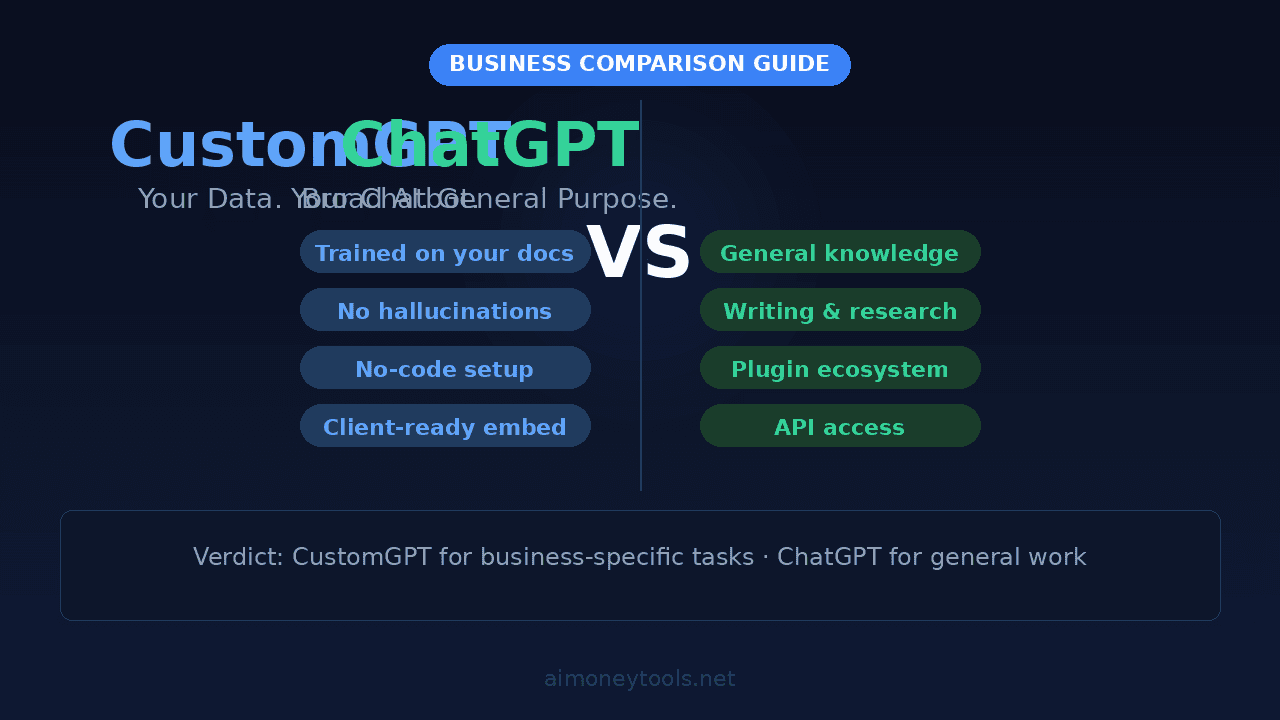
Both claim to be your AI business assistant. But CustomGPT and ChatGPT are solving different problems — and picking the wrong one wastes time and money.
This guide breaks down where each actually wins, which use cases belong to which tool, and how to decide without second-guessing yourself.
The Core Difference
ChatGPT is a general-purpose AI assistant. It knows a lot about a lot — writing, coding, research, math, summarizing. It doesn't know anything specific about your business unless you paste it in during the conversation.
CustomGPT is purpose-built for creating chatbots trained on your content. You upload your PDFs, documentation, website, or video transcripts, and the chatbot answers questions based only on that material. It cites the source of every answer.
That single distinction — general knowledge vs your knowledge — determines which tool is right for each job.
Feature Breakdown
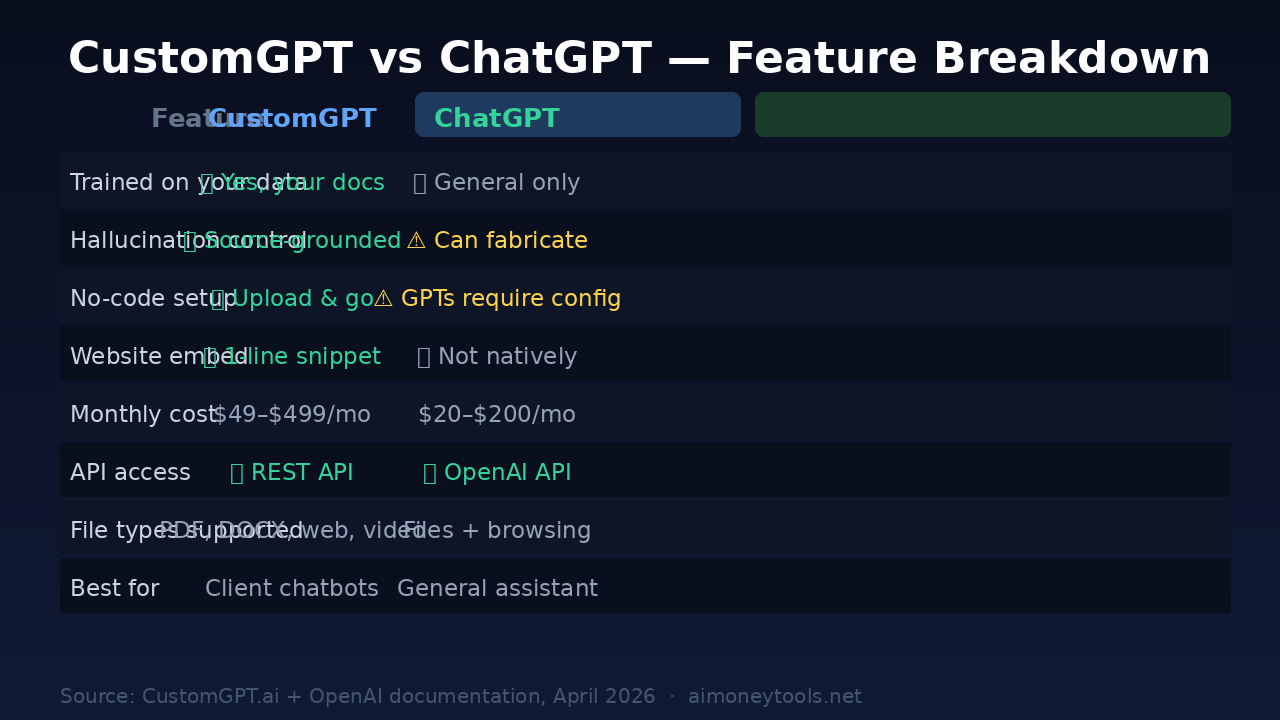
| Feature | CustomGPT | ChatGPT |
|---|---|---|
| Trained on your content | ✅ Yes | ❌ General only |
| Prevents hallucination | ✅ Source-cited answers | ⚠️ Can fabricate |
| No-code setup | ✅ Upload & go | ⚠️ GPTs require config |
| Website embed widget | ✅ One-line snippet | ❌ Not natively |
| White-label option | ✅ Higher plans | ❌ |
| REST API | ✅ Available | ✅ OpenAI API |
| Starting price | ~$49/month | $20/month (Plus) |
| Best for | Client chatbots, support bots | General writing, research, coding |
Sources: CustomGPT.ai pricing page + OpenAI pricing page, April 2026
The pricing gap matters less than it looks. CustomGPT's value isn't in conversation quality — it's in the fact that it won't make things up about your business. If you have a 200-page product manual and a customer asks a detailed question, CustomGPT will pull the exact answer and tell the user which page it came from. ChatGPT will give a confident, plausible-sounding answer that may not match your actual policies.
When CustomGPT Wins
Client-facing support bots: Any business that gets repetitive questions — pricing, hours, returns, product specs — benefits from a chatbot trained on their own docs. CustomGPT handles this cleanly without any custom coding.
Selling AI services to local businesses: If you're building custom AI chatbots for local businesses, CustomGPT is the operational backbone. Upload the client's content, configure the tone, embed on their site. Most clients go live within a day. (See also: how to start an AI automation agency)
Internal knowledge bases: Teams drowning in PDFs, SOPs, and policy documents can build an internal-only bot that answers "what does our refund policy say for enterprise accounts?" with a direct citation. Reduces the "can you find the doc for me?" Slack messages significantly.
Accuracy-critical contexts: Legal, medical, financial, or technical content where a wrong answer has consequences. CustomGPT's source-grounded responses reduce liability risk from AI-generated misinformation.
CustomGPT also supports website crawling — you point it at your URL and it indexes the content automatically. No manual PDF uploads needed for most sites.
When ChatGPT Wins
General writing and research: Drafting emails, summarizing articles, writing copy, explaining concepts, research briefs — ChatGPT's broad training makes it faster and more flexible than a domain-specific bot.
Software development: ChatGPT's coding ability (and GitHub Copilot integration for Plus users) is stronger than CustomGPT for debugging, generating functions, and code review.
Exploratory work: When you don't know exactly what you're looking for and need the AI to help you figure it out — brainstorming, strategy, ideation — ChatGPT's general knowledge base is the right tool.
Lower upfront investment: At $20/month for Plus, ChatGPT is accessible for individuals and early-stage freelancers who aren't yet billing clients for AI work. CustomGPT makes financial sense once you're charging for the output.
The "Can't ChatGPT Do That?" Objection
ChatGPT has a "GPTs" feature that lets you create custom AI agents with instructions and uploaded files. It's free to build. But there are real limitations:
- GPTs are only accessible to other ChatGPT users with Plus subscriptions — you can't embed one on a client's website for general visitors.
- File context has size limits and doesn't persist the same way as CustomGPT's indexed knowledge base.
- No source citations by default — answers pull from the upload but won't tell users exactly where the information came from.
- No white-label option — the interface says "ChatGPT."
For personal use or internal team tools where everyone has Plus, ChatGPT GPTs work. For client deliverables or public-facing chatbots, they fall short.
Decision Guide
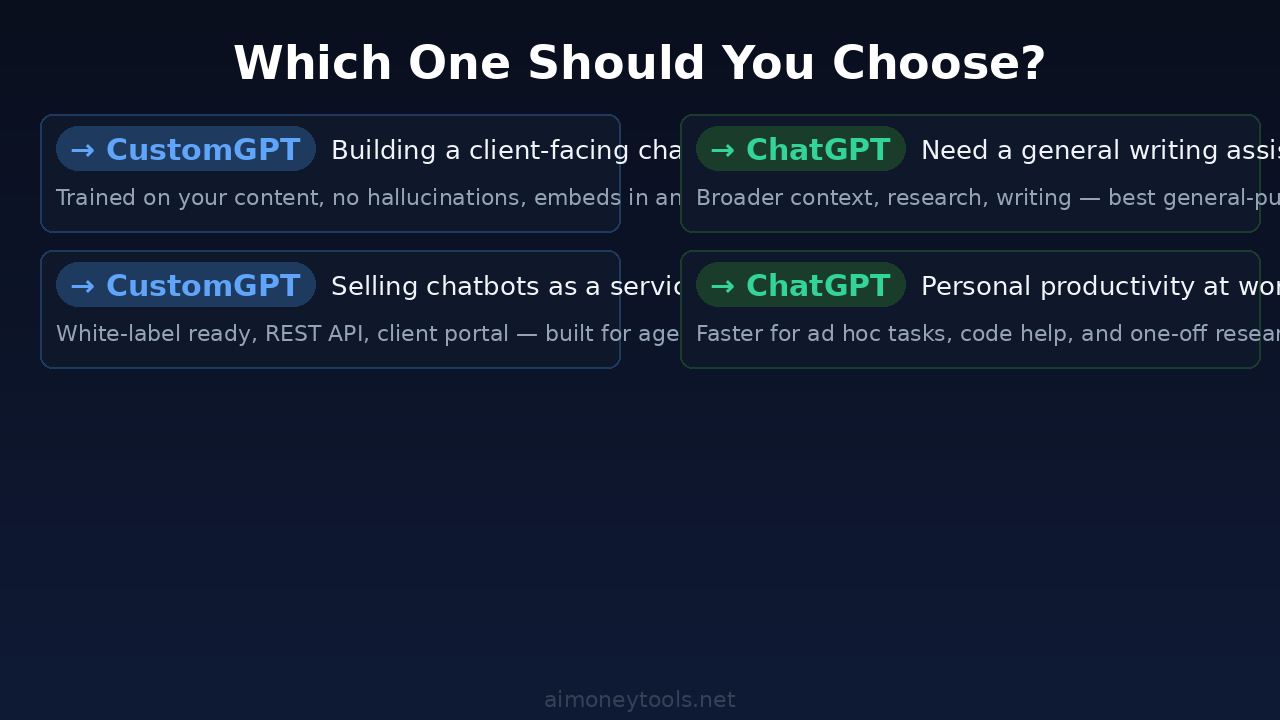
Use CustomGPT if you're:
- Building a customer-facing support bot for a business
- Offering AI chatbot services as a side hustle or agency service
- Deploying a bot that needs to cite sources and stay on-topic
- White-labeling AI for clients
Use ChatGPT if you're:
- Doing general research, writing, or coding tasks
- Looking for a personal productivity tool under $25/month
- Building internal tools for a team that already uses ChatGPT
- Need broad AI capability without a specific content domain
Use both if you're running an agency: ChatGPT for your own workflow (writing, proposals, research) and CustomGPT for client-facing deliverables. That's the most common setup among serious AI service providers.
Frequently Asked Questions
Q: Can I use CustomGPT without any coding experience?
A: Yes. CustomGPT is designed for non-developers. You upload your content (PDF, URL, or document), set a few configuration options, and get an embed code. Most setups take under an hour.
Q: Does CustomGPT use ChatGPT under the hood?
A: CustomGPT is built on top of OpenAI's API (GPT-4 class models) but adds its own retrieval layer that grounds responses in your uploaded content. You're using the same underlying language model but with source-restricted answers.
Q: What happens when I ask CustomGPT something not in my documents?
A: It tells you it doesn't have that information in the provided content — rather than inventing an answer. This is the core reliability feature for business use cases.
Q: Can ChatGPT be embedded on a website for public visitors?
A: Not natively. You'd need to use the OpenAI API and build a custom interface, which requires development work. CustomGPT provides a ready-made embed widget.
Q: Is CustomGPT worth the price difference from ChatGPT?
A: Depends on the use case. For personal productivity, probably not. For building client deliverables where accuracy and professional branding matter, the premium pays for itself quickly — especially if you're billing clients for the setup.
Sources: CustomGPT.ai product documentation + pricing (April 2026) · OpenAI ChatGPT pricing and GPTs feature documentation (April 2026)

Alex the Engineer
•Founder & AI ArchitectSenior software engineer turned AI Agency owner. I build massive, scalable AI workflows and share the exact blueprints, financial models, and code I use to generate automated revenue in 2026.
Related Articles
How to Start an AI-Assisted Resume Writing Side Hustle in 2026 (Beginner's Guide)
A step-by-step guide to using AI resume tools to offer a paid resume and cover letter writing service — what to charge, which tools to use, and how to find your first clients.
How to Build and Sell AI Voice Receptionists to Local Businesses in 2026
A beginner's guide to building AI voice agents that answer business phone calls — the tools to use, what to charge, and how to find your first client.
How to Make Money on Fiverr with AI Tools in 2026: 7 Gigs You Can Start This Week
Discover 7 real Fiverr gigs you can launch using free and low-cost AI tools in 2026 — no experience required. Real pricing data, step-by-step setup, and tools that actually work.