
15 Profitable AI Side Hustle Ideas for 2026 (Start With Zero Experience)
15 profitable AI side hustle ideas for 2026. Start with no tech experience using free tools — content automation, chatbots, voiceovers, and more beginner-friendly income streams.
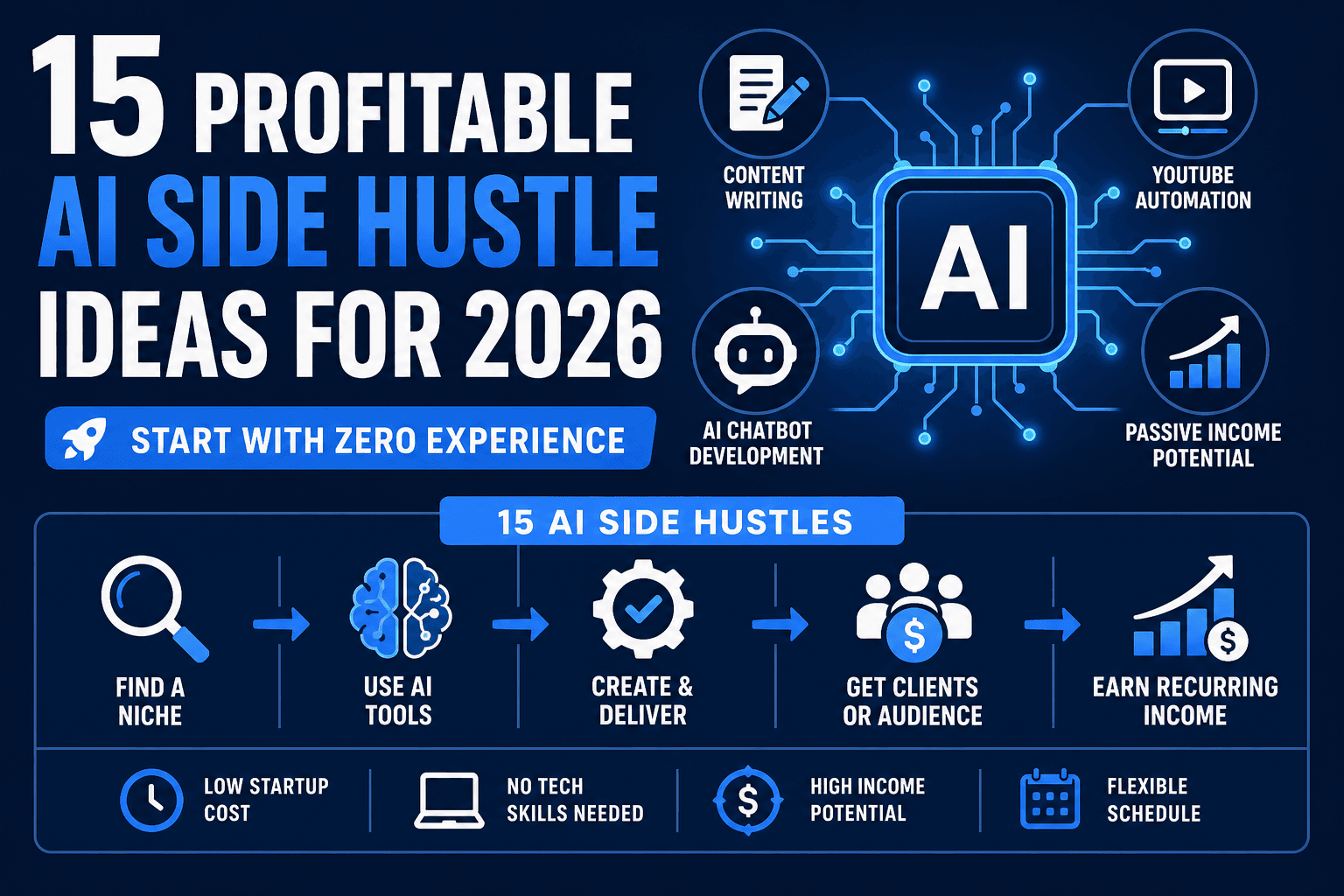
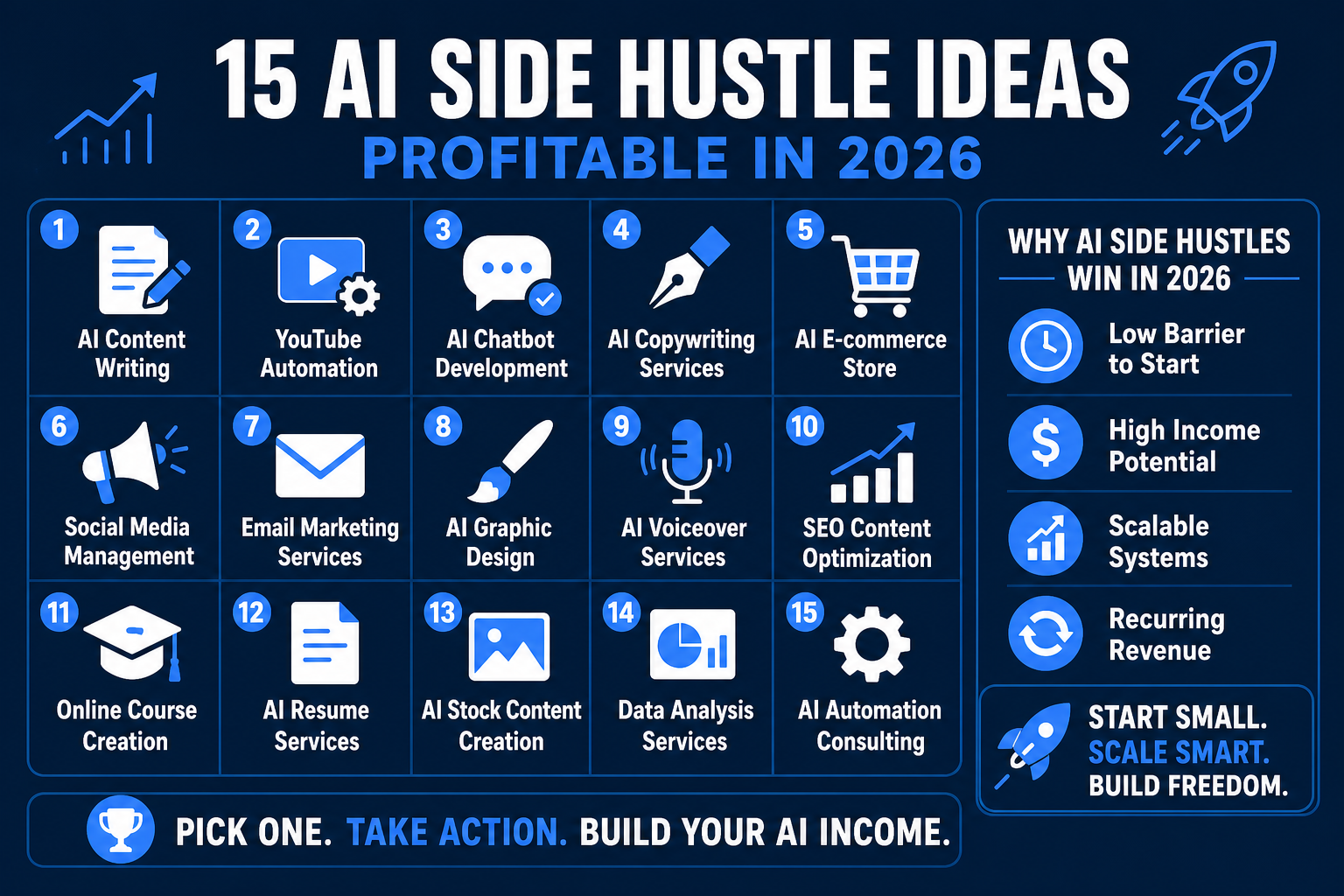
AI has removed the skill barriers that used to gatekeep most digital income streams. You no longer need to be a programmer to build software, a designer to create professional visuals, or a voice actor to produce narration. This guide covers 15 specific AI side hustles that are generating income for real people in 2026 — with honest expectations for each one.
1. AI-Assisted Content Writing Services
Businesses consistently need more content than their internal teams can produce. Blog posts, email sequences, case studies, LinkedIn articles — the demand is structural and ongoing. AI writing tools like Jasper or Claude handle first-draft generation; your job is editing, fact-checking, and brand alignment.
How to start: Build a sample portfolio of 3–5 polished posts in a specific niche (SaaS, finance, real estate). Pitch marketing managers directly on LinkedIn or apply to content agencies looking for white-label writers.
Realistic income: $2,500–$7,000/month with 5–10 retainer clients at $100–$300 per article.
2. Faceless YouTube Channel Automation
A faceless YouTube channel requires no camera, no studio, and no on-screen presence. You write a script (AI-assisted), generate voiceover (Murf.ai or ElevenLabs), source stock footage, and publish. Once a channel hits YouTube Partner threshold, it earns ad revenue indefinitely.
Best niches: Finance, AI tools, personal development, real estate. These command $15–$40 CPM — much higher than entertainment niches.
How to start: Pick one niche, publish 3 videos per week for 90 days. Most channels reach monetization threshold within 6–12 months of consistent output.
Realistic income: $500–$3,000/month passive (after monetization); $300–$600 per video if offering this as a client service.
3. Custom AI Chatbot Development
Most small businesses have no AI implementation at all. A chatbot trained on a company's actual documents and FAQs — one that answers customer questions without hallucinating off-topic responses — is a product businesses will pay monthly for.
CustomGPT.ai builds deployable chatbots from uploaded documents in under 60 seconds. No coding required. You handle sales, setup, and ongoing maintenance.
How to start: Build a demo bot using a local business's website content. Use it as a proof-of-concept when pitching service businesses (dental offices, law firms, real estate agents).
Realistic income: $2,000–$6,000/month managing 10–20 clients at $99–$300/month retainer each.
4. AI Voiceover Production
AI voice tools have reached the quality level where they're commercially viable for e-learning, explainer videos, YouTube, and corporate presentations. The business model: clients provide scripts, you deliver polished audio files.
Murf.ai covers most commercial use cases. ElevenLabs is the right choice for voice cloning or multilingual output (29 languages with native-quality pronunciation).
How to start: Set up a Fiverr profile in the voiceover category. Create 3 sample audio clips in different styles (corporate, casual, narration). Speed of delivery is your main competitive advantage — AI lets you deliver a 10-minute script in under 30 minutes.
Realistic income: $1,500–$4,000/month with consistent client volume.
5. Selling AI-Generated Art on Etsy and Print-on-Demand Sites
Midjourney V6 produces images that are genuinely difficult to distinguish from professional photography or illustration. Etsy sellers who use it to produce printable wall art, sticker packs, and digital downloads report consistent passive income once their shops have 100+ listings.
Best-selling styles: Botanical prints, minimalist line art, vintage maps, watercolor portraits, celestial illustrations.
How to start: Create 30–50 listings with distinct styles and clear descriptions. Use Pinterest for traffic — it drives high buyer intent and is underused for Etsy shops. Print-on-demand platforms (Printful, Printify) let you sell physical products without holding inventory.
Realistic income: $300–$2,000/month passive after building a catalog.
6. Social Media Content Packages for Small Businesses
Small businesses know they should be posting on social media — but most don't have the bandwidth or skill to produce consistent content. You deliver: monthly graphics, caption copy, and a content calendar. AI handles drafting and design; you handle strategy and quality control.
Tools: Canva (visuals, brand kit, AI image generation) + ChatGPT or Claude (captions, hooks, hashtag research) + Buffer or Later (scheduling).
How to start: Pick one vertical (restaurants, real estate, fitness coaches). Create a sample content pack in that niche. Pitch 10 local businesses on LinkedIn or via cold email. Charge $500–$1,500/month per client.
Realistic income: $3,000–$8,000/month with 5–8 clients.
7. AI Resume Writing and Career Coaching
Job seekers pay for results — a resume that gets interviews. AI tools make it possible to produce ATS-optimized resumes, tailored cover letters, and LinkedIn rewrites significantly faster than doing it by hand. Your value is in positioning: knowing what hiring managers actually look for and how to reframe experience for specific industries.
How to start: Offer packages (resume rewrite $150–$300, cover letter $75, full package $400–$600). Find clients on LinkedIn (post about job search tips to attract inbound) or Fiverr (high-demand category with consistent search volume).
Realistic income: $2,000–$5,000/month working 20–25 hours per week.
8. AI-Powered SEO Consulting
Search engine optimization in 2026 includes generative search optimization — getting cited in AI Overviews and ChatGPT answers. Most small businesses and bloggers have no strategy for this. Consultants who understand both traditional SEO and how AI search tools have changed the game are in genuine demand.
What the service includes: Site audit, keyword research, topical authority planning, content brief creation, on-page optimization, GSC monitoring. AI tools (SurferSEO, Ahrefs, Claude for briefs) handle the time-intensive parts.
How to start: Offer a one-time audit ($300–$500) as a lead-in to a monthly retainer ($1,500–$4,000). Clients come from blogging communities, LinkedIn, and referrals from web designers who don't offer SEO.
Realistic income: $3,000–$8,000/month with 3–6 retainer clients.
9. Building Automation Workflows for Businesses
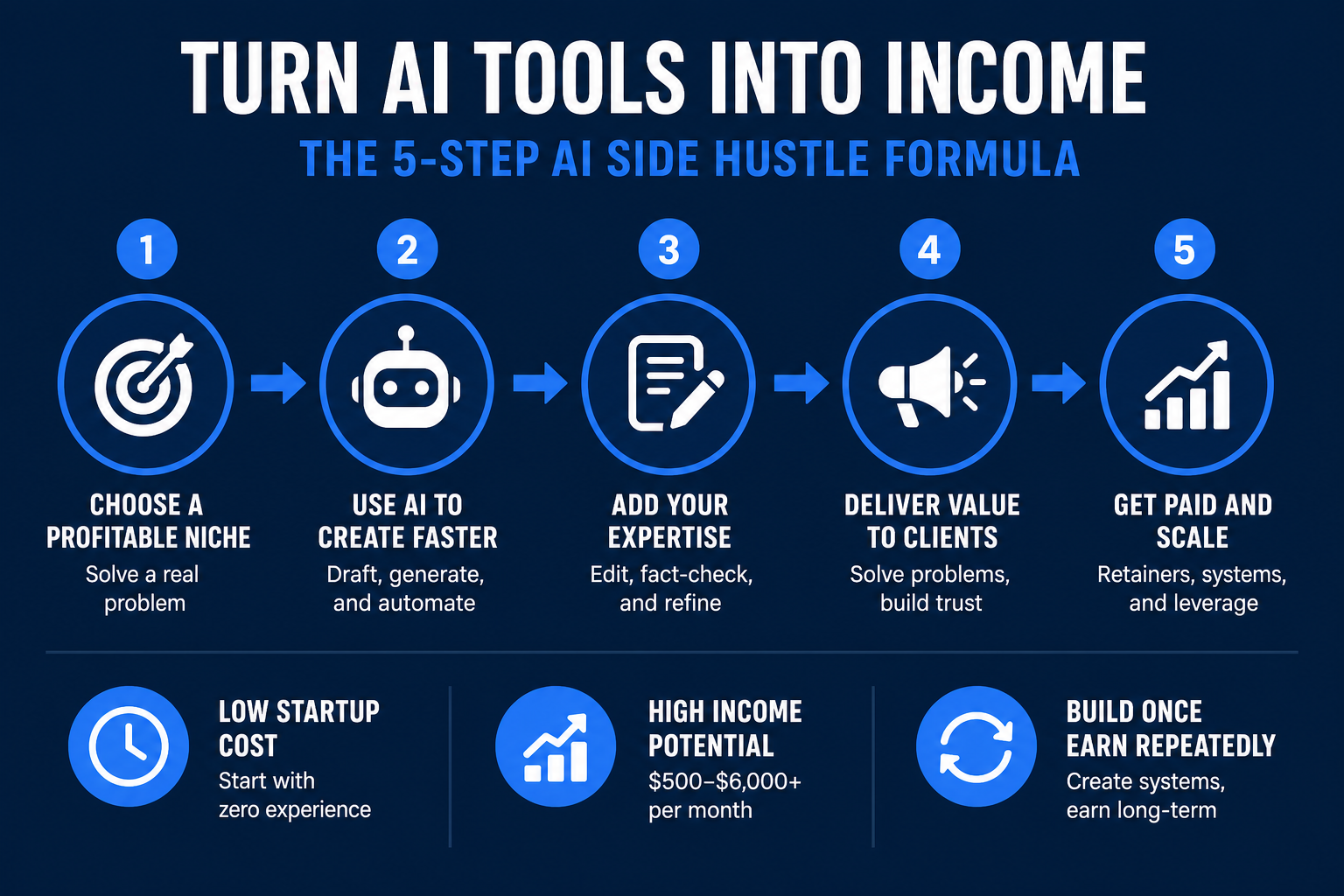
Every business has manual processes eating hours each week: moving data between tools, sending follow-up emails, generating weekly reports. AI automation tools (n8n, Zapier, Make) connect apps and add AI logic without coding.
High-value examples: Automated lead qualification and CRM entry, email triage and routing, weekly performance reports, social content scheduling, invoice processing.
How to start: Learn one tool deeply (n8n is the most powerful and free to self-host). Build a workflow template for a common business problem. Post it publicly as a lead magnet. Charge $500–$2,000 per custom workflow build plus $150–$400/month maintenance. For more on this model, see the AI automation agency guide.
Realistic income: $3,000–$10,000/month with 5–15 clients.
10. AI Affiliate Marketing
Promote AI tools through your content, email list, or social accounts and earn recurring commissions when people sign up. Most AI SaaS companies pay 20–30% recurring — meaning you earn every month a referred user stays subscribed.
Strong programs: CustomGPT.ai (20% recurring), Murf.ai (20% for 24 months), Jasper (30% recurring), Surfer SEO (25% recurring), ElevenLabs (22% recurring).
How to start: Build a niche blog or YouTube channel around AI tools. Write "best X for Y" comparison posts and tutorials targeting purchase-intent search queries. These convert significantly better than generic reviews. See the full AI affiliate programs guide.
Realistic income: $500–$5,000/month (scales with audience size; takes 3–12 months to build).
11. Canva Template and Digital Product Sales
Design templates — business card packs, pitch deck templates, social media kits, Notion dashboards — sell passively on Etsy, Creative Market, and Gumroad once created. Canva's AI features and Magic Design make producing professional template sets faster than ever.
What sells: PowerPoint/Canva presentation templates ($12–$40), social media kit bundles ($15–$50), resume templates ($8–$25), Notion workspace templates ($15–$45).
How to start: Research best-sellers in your chosen category on Etsy. Create 10–15 templates in a cohesive style. Write detailed listing titles and tags. Traffic comes from Etsy search and Pinterest.
Realistic income: $300–$2,500/month passive after building a catalog of 50+ products.
12. AI-Enhanced Podcast Production Services
Podcast hosts need consistent editing, transcription, show notes, and social clips — but most don't want to spend 3–4 hours per episode doing it. Descript (transcript-based editing), Otter.ai (transcription), and AI tools for show notes generation make it possible to handle this pipeline in 45–60 minutes per episode.
What the service includes: Audio cleanup, transcript, show notes (200–400 words), 2–3 social media clips, chapter markers. Deliver within 24–48 hours.
How to start: Pitch podcast hosts in communities (Podcast Movement, Facebook groups, Reddit's r/podcasting). Offer a free trial episode as proof of quality. Charge $100–$250/episode.
Realistic income: $2,000–$5,000/month with 5–8 regular podcast clients.
13. AI Video Production for Brands and Creators
Short-form video is the dominant content format. Brands need Reels, TikToks, and YouTube Shorts consistently — but video production takes time most teams don't have. Pictory converts blog posts and scripts into video cuts automatically; CapCut adds AI captions and B-roll.
Service offering: Monthly video packages — 8–12 short-form clips per month from a client's existing blog content or scripts. Priced at $500–$1,500/month depending on volume.
How to start: Build a sample reel from publicly available content. Pitch content-heavy brands (SaaS companies, coaches, consultants) who blog consistently but don't have video. LinkedIn outreach is the fastest channel.
Realistic income: $2,000–$6,000/month with 4–6 retainer clients.
14. Micro-SaaS Tools Built With AI
Solo founders are launching tools that solve one specific problem — an AI LinkedIn post generator, a niche email subject line tester, a domain name brainstormer. AI coding assistants (Claude, Cursor, GitHub Copilot) make it possible to build functional web tools with minimal programming experience.
Business model: Monthly subscriptions ($9–$29/month) or lifetime deals on AppSumo. Even 100 subscribers at $19/month is $1,900/month recurring revenue.
How to start: Identify a repetitive task in a niche you understand. Validate demand (Reddit, Indie Hackers) before building. Keep scope small — one problem, one solution. Host on Vercel (free for small traffic).
Realistic income: $500–$5,000/month (highly variable; depends on niche and execution).
15. Teaching AI Tools — Courses, YouTube, Newsletters
The fastest-growing audience online is people who want to learn how to use AI tools effectively. YouTube channels, email newsletters, and courses teaching practical AI workflows are all in high demand. You don't need to be a researcher — you need to be one step ahead of your audience and able to explain clearly.
Revenue models: YouTube ad revenue + affiliate links (high leverage, slow to build), paid newsletter on Beehiiv (immediate if you have an existing audience), course on Gumroad or Teachable ($47–$197).
How to start: Pick one specific tool (n8n, Midjourney, Claude, Canva AI) and one specific audience (small business owners, content creators, freelancers). Create 5–10 free tutorial posts or videos. Monetize once you have an engaged audience.
Realistic income: $1,000–$10,000/month depending on audience size and product mix.
How to Choose Your First Side Hustle
The fastest path to income is the option closest to what you already know:
| Background | Best starting point |
|---|---|
| Writing / editing | AI content writing (idea 1) |
| Tech / systems | Automation workflows (idea 9) |
| Video / audio | Voiceover or podcast production (ideas 4, 12) |
| Design | Templates + Etsy (ideas 5, 11) |
| Marketing / sales | SEO consulting or affiliate (ideas 8, 10) |
| Teaching / explaining | Course or YouTube (idea 15) |
Start with one. Build it to $1,000/month before adding a second income stream.
Frequently Asked Questions
Do I need experience to start any of these? No prior experience is required for most. The AI tools handle the technically difficult parts — writing, design, voiceover, editing. Your job is quality control and client communication.
Which has the fastest path to income? Client services (chatbots, content writing, voiceovers, video editing) can generate income within 2–4 weeks of active outreach. Passive models (Etsy, YouTube, affiliate) typically take 3–6 months to build meaningful volume.
How much do I need to invest upfront? Many tools have free tiers (ElevenLabs, Canva, n8n self-hosted, CustomGPT trial). A realistic starter stack costs $30–$80/month. Most services pay for themselves from the first client.
Can I run multiple side hustles at once? Yes — but stack them intentionally. A common combination: AI content writing (primary income) + Etsy digital products (passive) + one automation client. Don't add a second until the first generates at least $500/month consistently.
Is this competitive? Yes, but not as much as it looks. Most people try AI tools once and stop. Consistent execution over 90 days puts you ahead of 90% of people who started the same side hustle.

Alex the Engineer
•Founder & AI ArchitectSenior software engineer turned AI Agency owner. I build massive, scalable AI workflows and share the exact blueprints, financial models, and code I use to generate automated revenue in 2026.
Related Articles
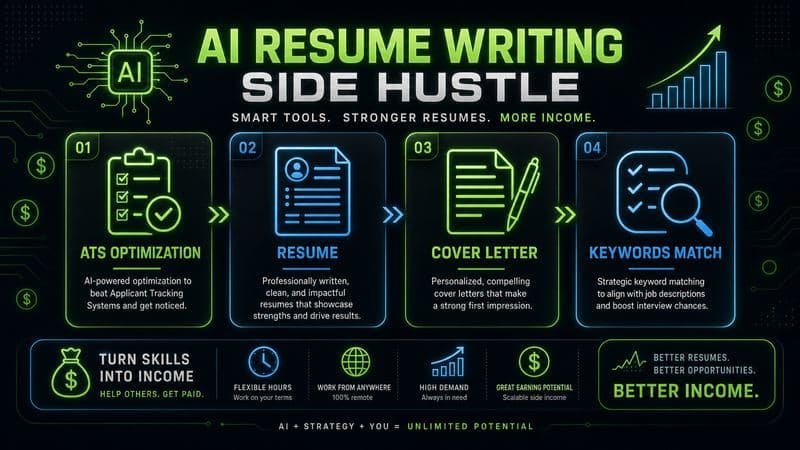
How to Start an AI-Assisted Resume Writing Side Hustle in 2026 (Beginner's Guide)
A step-by-step guide to using AI resume tools to offer a paid resume and cover letter writing service — what to charge, which tools to use, and how to find your first clients.
How to Build and Sell AI Voice Receptionists to Local Businesses in 2026
A beginner's guide to building AI voice agents that answer business phone calls — the tools to use, what to charge, and how to find your first client.
How to Make Money on Fiverr with AI Tools in 2026: 7 Gigs You Can Start This Week
Discover 7 real Fiverr gigs you can launch using free and low-cost AI tools in 2026 — no experience required. Real pricing data, step-by-step setup, and tools that actually work.