
MiniMax M3 Review: The AI That Beats GPT-5.5 at 5-10% of the Price (2026)
MiniMax M3 just launched with a 1 million token context window, frontier-level coding scores, and a price tag that's 90% cheaper than GPT-5.5. Here's what it means for regular users and developers.
A Chinese AI company nobody was talking about last year just dropped a model that outscores GPT-5.5 on coding benchmarks — and charges 5 to 10 percent of the price.
That is MiniMax M3, released on June 1, 2026. If you have been watching AI closely, this one is worth paying attention to. If you have not, here is the short version: a genuinely frontier-tier model just became available for $20 a month.
Let us look at exactly what it does, where it wins, where it does not, and whether it belongs in your toolkit.
What Is MiniMax M3?
MiniMax M3 is a large language model built by MiniMax, a Chinese AI startup. It was released on June 1, 2026 via the MiniMax API and the company's apps.
The headline features:
- 1 million token context window — that is roughly 700,000 words, enough to load several books
- Frontier-level coding and agent performance — scores above GPT-5.5 and Gemini 3.1 Pro on several key benchmarks
- Native multimodality — text, images, and visual data baked in from the ground up (not bolted on afterward)
- Open weights incoming — weights are scheduled for release on Hugging Face and GitHub within 10 days of launch
- $20/month subscription — or $0.30 per million input tokens at the API level (discounted launch price)
The comparison that is turning heads: GPT-5.5 costs $5 per million input tokens and $30 per million output tokens. MiniMax M3 at its discounted launch price is $0.30 input / $1.20 output — roughly 5 to 10 percent of the cost depending on which direction you look.
How Does MiniMax M3 Perform?
MiniMax published detailed benchmarks at launch, and VentureBeat independently reported on them. Here is what the verified numbers show.
Where MiniMax M3 Wins
SWE-Bench Pro (measures how well an AI can autonomously fix real software engineering issues): M3 scores 59.0%, beating both GPT-5.5 and Gemini 3.1 Pro. This is the benchmark that matters most for developers.
BrowseComp (autonomous web browsing and information retrieval): M3 scores 83.5%, slightly ahead of DeepSeek-V4 Pro Max (83.4%) and above Claude Opus 4.7 (79.3%).
MCP Atlas (tool use — how well the model uses external tools like calculators, APIs, and search): M3 scores 74.2%, edging DeepSeek-V4 Pro Max (73.6%).
OmniDocBench (multimodal document understanding): M3 scores above Gemini 3.1 Pro.
Where MiniMax M3 Falls Behind
Claude Opus 4.8 (released last week) holds meaningful leads on the hardest benchmarks:
- SWE-Bench Pro: Claude Opus 4.8 scores 69.2% vs M3's 59.0%
- Terminal Bench 2.1: Opus 4.8 at 74.6% vs M3 at 66.0%
- OSWorld-Verified (computer use): Opus 4.8 at 83.4% vs M3 at 70.0%
The honest take: if you need the absolute ceiling for complex coding agents or extended autonomous computer use, Claude Opus 4.8 is still ahead — and it should be, given that it costs 3 to 4 times more per token at full M3 pricing, and roughly 12 to 20 times more at M3's discounted launch price.
The Benchmark Picture in Plain English
M3 beats the previous generation of frontier models (GPT-5.5, Gemini 3.1 Pro) at a fraction of the cost. It does not beat the current best model from Anthropic on the hardest agentic tasks. But for most developers and most use cases — writing code, analyzing documents, building agents — it lands firmly in frontier territory at open-source pricing.
The Architecture Behind the Price Difference
The reason M3 can be priced this low while delivering these scores comes down to one engineering decision: MiniMax Sparse Attention (MSA).
Standard AI attention (how the model "pays attention" to different parts of its input) scales quadratically. Double the context length, and the compute cost does not double — it roughly quadruples. This is why long-context models are expensive to run.
MSA uses a block-filtering approach: instead of processing every token against every other token, it pre-identifies the relevant groups and skips the rest. The result:
- 4x faster than comparable open-source sparse attention implementations
- At 1 million token context: just 1/20th the compute of M3's previous generation
- 9x faster at the prefilling stage, 15x faster at decoding
This is not a tradeoff. MiniMax ran head-to-head comparisons with DeepSeek-V4 Pro Max, a model with 1.6 trillion total parameters, and M3 matched or beat it on most benchmarks despite running at lower computational cost. Efficiency at this scale is the story.
Pricing: What Does It Actually Cost?
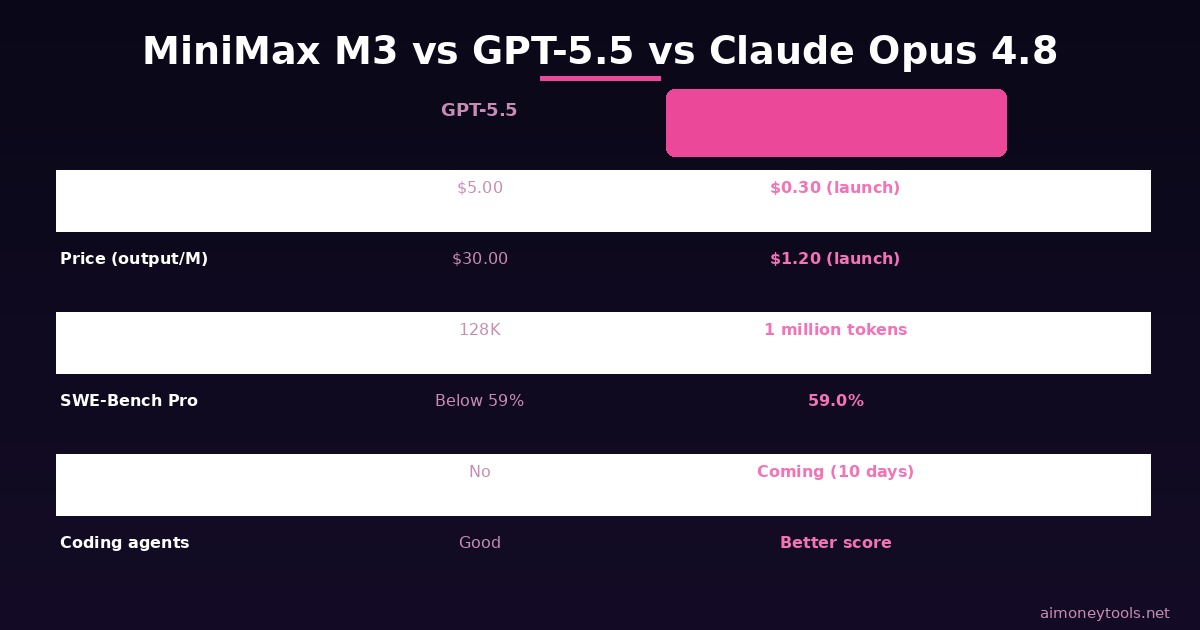
Here is the full cost picture, with verified API pricing from VentureBeat's snapshot at launch:
| Model | Input (per 1M tokens) | Output (per 1M tokens) |
|---|---|---|
| MiniMax M3 (launch price) | $0.30 | $1.20 |
| MiniMax M3 (full price) | $0.60 | $2.40 |
| DeepSeek-V4 Pro | $0.435 | $0.87 |
| Grok 4.3 (low context) | $1.25 | $2.50 |
| Kimi K2.6 | $0.95 | $4.00 |
| GPT-5.4 | $2.50 | $15.00 |
| Claude Opus 4.8 | $5.00 | $25.00 |
| GPT-5.5 | $5.00 | $30.00 |
Source: VentureBeat pricing snapshot, June 2026. Prices change — verify at minimax.io before billing.
For individual users, MiniMax also offers subscription plans:
- Plus ($20/month): ~1.7B tokens per month, up to 3–4 concurrent agents
- Max ($50/month): ~5.1B tokens per month, 4–5 agents, plus 3 AI video clips per day via Hailuo
- Ultra ($120/month): ~9.8B tokens per month, 6–7 agents, 5 video clips per day
For context: ChatGPT Plus is $20/month and gives you access to GPT-5.4. MiniMax Plus is the same price and gives you a model with competitive frontier-level coding scores. The value equation is hard to ignore.
Who Is MiniMax?
MiniMax is a Chinese AI startup founded in 2021. You may not have heard of them, but they have been building quietly:
- Talkie — their consumer AI companion app — has had tens of millions of users globally
- Hailuo AI — their video generation product — became one of the most-used AI video tools in 2025, including in North America
- They raised over $1 billion in funding and are valued at several billion dollars as of early 2026
M3 is not their first model. Previous MiniMax models have quietly powered large volumes of consumer AI products. M3 is their first model to compete directly at the frontier tier.
MiniMax Code: The AI Coding Agent
Alongside M3, MiniMax shipped MiniMax Code, an AI coding agent built on top of M3's capabilities. It is available as a web app and desktop app.
The standout feature is what MiniMax calls the Agent Team: a Producer and Verifier setup where one agent instance writes code while a second adversarially tests and reflects on the output. The system can run autonomously for extended periods without human oversight.
In a widely shared demonstration, M3 ran an autonomous verification task for nearly 12 hours, producing 18 code commits and 23 experimental figures, successfully reproducing a research paper that won an Outstanding Paper Award at ICLR 2025. The model completed the full experimental pipeline — matching predictions, validating statistical findings, implementing mitigation methods — without human intervention.
For developers, MiniMax Code supports API key configuration (sk-cp) compatible with Cursor, Cline, Roo Code, and Claude Code. If you are already using one of these tools, you can swap in M3 with a single API key change and a lower bill.
Open Weights: What This Means
Within 10 days of launch, MiniMax plans to publish M3's model weights on Hugging Face and GitHub. The exact license has not been confirmed yet (MIT, Apache 2.0, and the new OpenMDW license are the likely options), but if permissive, this opens up a critical capability:
Running M3 locally — no API costs, complete privacy, no rate limits.
Given that M3's MSA architecture is specifically designed to reduce per-token compute demands (1/20th of previous generation at 1M context), it may be more practical to run locally than it appears. Obviously, the full model will require serious hardware — but quantized versions (Q4/Q6 GGUF format) suitable for running in tools like LM Studio are almost certain to follow community publication.
If you are already set up for local AI (see our LM Studio beginner guide), M3's open weights release will be worth watching closely.
Should You Try MiniMax M3?
Yes, if:
- You are a developer looking to cut AI API costs without sacrificing too much capability
- You want to run coding agents without paying $30/million output tokens
- You want a 1 million token context window at an accessible price
- You are building with Cursor or Cline and want a cheaper, capable backend model
Wait and see, if:
- You need the absolute best performance on complex, long-horizon autonomous coding tasks (Claude Opus 4.8 still leads there)
- You want to run it locally — open weights are not out yet as of this writing
- You are in a regulated industry with data compliance requirements (verify MiniMax's data processing terms first)
Skip, if:
- You are a complete AI beginner and just want a simple chatbot — in that case, ChatGPT or Claude's web apps are easier to start with
- Your work requires the absolute cutting-edge model available (Opus 4.8 is still the performance leader)
Where to Access MiniMax M3
- Web app: chat.minimax.io (free tier available)
- API: platform.minimax.io — $0.30/$1.20 per million tokens at launch pricing
- MiniMax Code (agent): Available from the MiniMax platform
- Open weights: Coming within 10 days on Hugging Face and GitHub
For developers, the API is compatible with the OpenAI SDK — just swap the base URL and API key. No new libraries required.
What to Read Next
- LM Studio Beginner Guide — When M3's open weights drop, this is how you will run it locally for free
- Claude Opus 4.8 Review — The current performance leader, at a higher cost
- Kimi K2.6 Review — Another recent frontier open-weight model
- Best ChatGPT Alternatives 2026 — Full comparison of all major AI models
Frequently Asked Questions
What is MiniMax M3?
MiniMax M3 is a large language model released by Chinese AI startup MiniMax on June 1, 2026. It features a 1 million token context window, frontier-level coding scores, native multimodality, and pricing at 5 to 10 percent of comparable US frontier models like GPT-5.5.
How much does MiniMax M3 cost?
At its launch promotional price, M3 costs $0.30 per million input tokens and $1.20 per million output tokens via the API. Full price is $0.60/$2.40. Subscription plans start at $20/month (Plus), $50/month (Max), and $120/month (Ultra). For comparison, GPT-5.5 costs $5/$30 per million tokens.
Is MiniMax M3 better than GPT-5.5?
On certain coding benchmarks (SWE-Bench Pro), yes — M3 scores 59.0% versus GPT-5.5's lower score on the same test. On some other tasks, it is competitive. However, Claude Opus 4.8 outperforms both on the hardest autonomous agent benchmarks. MiniMax M3 is in the frontier tier, but not uniformly the best model on every task.
Is MiniMax M3 open source?
MiniMax has committed to releasing open weights within 10 days of launch. The exact license has not been confirmed yet. Once weights are available on Hugging Face, the model can potentially be run locally using tools like LM Studio.
What is the 1 million token context window useful for?
A 1 million token context window allows the model to read and reason over roughly 700,000 words in a single conversation. In practice, this means you can feed it an entire novel, a large codebase, years of email threads, or multiple lengthy documents at once, and it maintains full awareness of all of it throughout the conversation.
Does MiniMax M3 work with Cursor or Cline?
Yes. MiniMax Code uses an API key format (sk-cp) that is compatible with Cursor, Cline, Roo Code, and Claude Code. You can configure these tools to use MiniMax M3 as the backend model instead of the default (typically Claude or GPT).
Is MiniMax a trustworthy company?
MiniMax is a well-funded Chinese AI startup with products used by tens of millions of people globally (Talkie, Hailuo AI). Like all AI providers, you should review their data processing and privacy terms before using their API for sensitive work. For maximum privacy, wait for the open weights release and run locally.
How does MiniMax M3 compare to DeepSeek?
The two are very close. M3 edges out DeepSeek-V4 Pro Max on SWE-Bench Pro (59.0% vs 55.4%) and MCP Atlas (74.2% vs 73.6%). DeepSeek is slightly ahead on Terminal Bench (67.9% vs 66.0%). Both are open-weight models at competitive pricing. M3 has a larger native context window and natively multimodal architecture from training.

Alex the Engineer
•Founder & AI ArchitectSenior software engineer turned AI Agency owner. I build massive, scalable AI workflows and share the exact blueprints, financial models, and code I use to generate automated revenue in 2026.
Related Articles
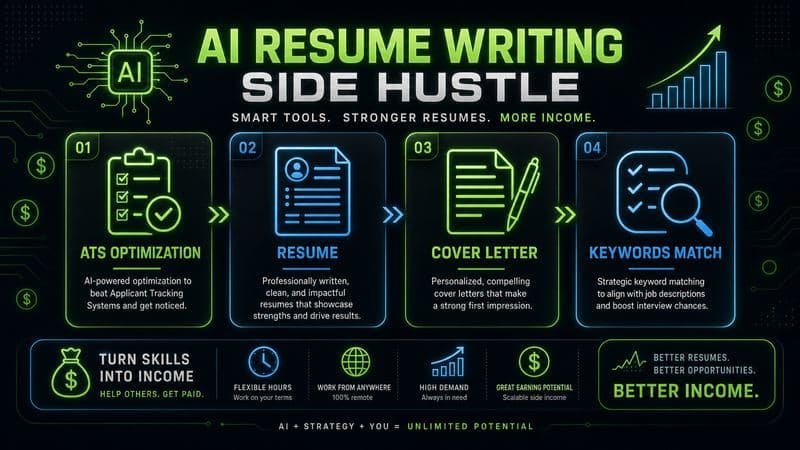
How to Start an AI-Assisted Resume Writing Side Hustle in 2026 (Beginner's Guide)
A step-by-step guide to using AI resume tools to offer a paid resume and cover letter writing service — what to charge, which tools to use, and how to find your first clients.
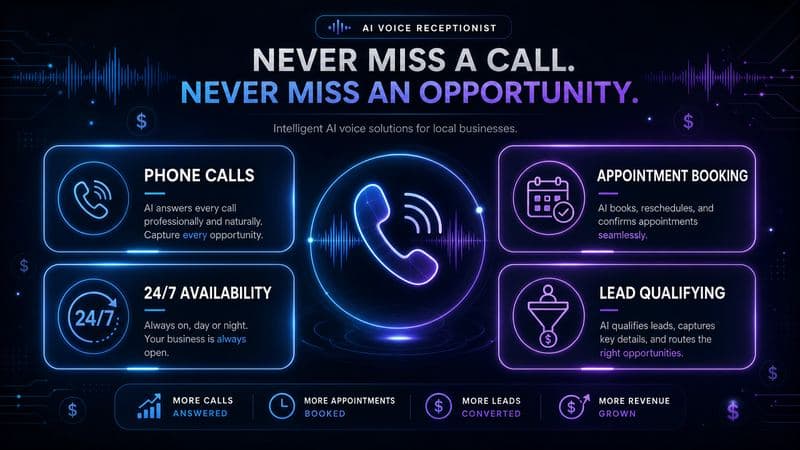
How to Build and Sell AI Voice Receptionists to Local Businesses in 2026
A beginner's guide to building AI voice agents that answer business phone calls — the tools to use, what to charge, and how to find your first client.
How to Make Money on Fiverr with AI Tools in 2026: 7 Gigs You Can Start This Week
Discover 7 real Fiverr gigs you can launch using free and low-cost AI tools in 2026 — no experience required. Real pricing data, step-by-step setup, and tools that actually work.