
Kimi K2.6 Review: Moonshot AI's Free Open-Source Model Is Beating GPT-5 at Coding
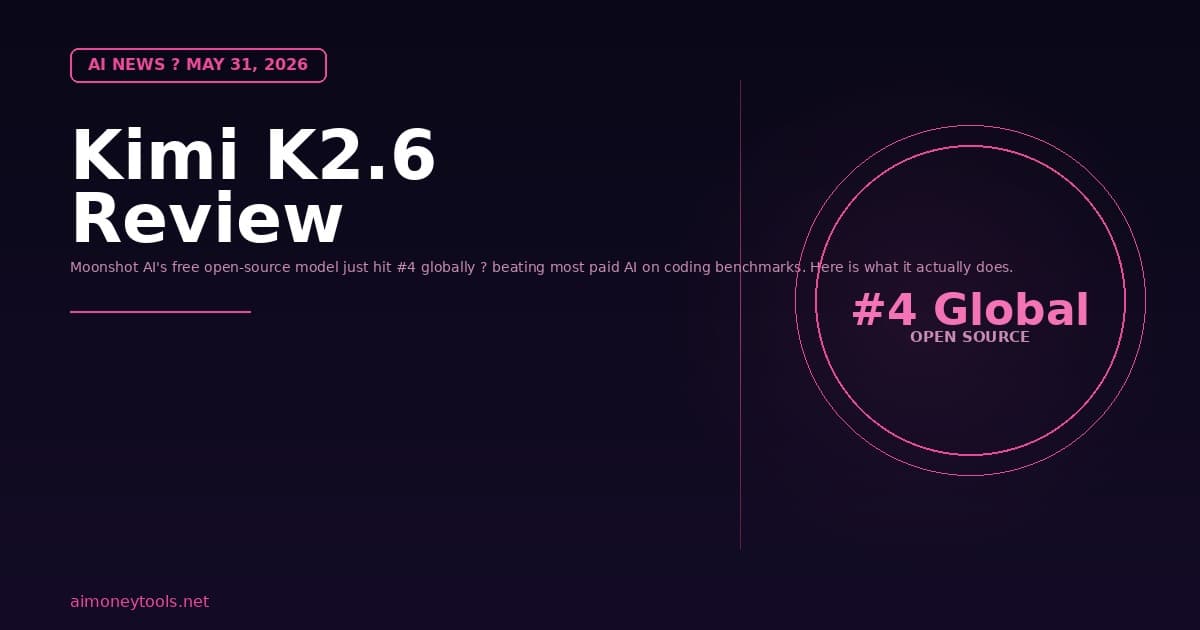
Moonshot AI just dropped Kimi K2.6, an open-source agentic model that ranks #4 globally and outperforms GPT-5 on coding benchmarks. Here is what it is, how it works, and how to use it — for free.
A free, open-source AI model that ranks ahead of most commercial offerings — and you can run it right now.
That is the short version of what Moonshot AI just released with Kimi K2.6. If you have been following the AI space, you know that open-source models have been closing the gap on GPT and Claude for months. Kimi K2.6 is the latest and arguably the most capable step in that direction — especially for coding and autonomous agent tasks.
Here is everything you need to know, explained for beginners.
What Is Kimi K2.6?
Kimi K2.6 is a large language model built by Moonshot AI, a Chinese AI lab that has been quietly building some of the most capable open-source models of 2026. "Kimi" is the name of their AI assistant (similar to how Anthropic has Claude, or OpenAI has ChatGPT). The "K2.6" designates the second generation of their flagship model, sixth iteration.
What makes it notable:
- It is open-source and free to download and run
- It is a native multimodal agentic model — meaning it can see images, write code, and execute multi-step autonomous tasks without hand-holding
- It is optimized for long-horizon coding — complex projects that require many sequential decisions, not just one-shot answers
- It supports agent swarm capabilities — multiple AI agents coordinating to solve a larger problem together
In plain English: this is an AI that can build things, not just answer questions about them.
How Does It Rank Against GPT-5 and Claude?
The independent benchmark site Artificial Analysis runs one of the most trusted AI evaluation indexes in the space. As of this release, Kimi K2.6 ranks #4 on the Artificial Analysis Intelligence Index with a score of 54.
To put that in context:
| Rank | Model | Type |
|---|---|---|
| 1 | GPT-5 (OpenAI) | Closed / paid |
| 2 | Claude Opus 4.8 (Anthropic) | Closed / paid |
| 3 | Gemini Ultra 3 (Google) | Closed / paid |
| 4 | Kimi K2.6 (Moonshot AI) | Open-source / free |
| 5+ | Other commercial models | Closed / paid |
The top three are all paid, closed models from the three major AI labs. Kimi K2.6 is the highest-ranked freely available model — and for coding tasks specifically, it matches or exceeds much of the commercial competition.
This matters because it means the gap between "what you pay for" and "what you can get for free" has effectively collapsed for software development and autonomous agent work.
What Is Kimi K2.6 Good At?
Based on benchmark results and early community testing, Kimi K2.6 excels in three areas:
1. Long-Horizon Coding
Most AI models are good at writing short, self-contained code snippets. Where they often fail is in larger tasks: building multi-file projects, debugging across a full codebase, or implementing a feature that requires understanding how ten different parts of a system interact.
Kimi K2.6 was specifically designed and trained for these scenarios. Community reports from r/LocalLLaMA describe it as handling multi-step coding projects with "surprising coherence" — following the thread of what is needed across many consecutive tasks.
2. Coding-Driven Design
This is a newer capability that blurs the line between generating code and generating interfaces. Kimi K2.6 can build functional UI components with design reasoning built in — not just outputting code but thinking about how the output should look and behave.
For beginners, this is relevant if you want to build tools or micro-apps without a design background. You can describe what you want, and the model produces something that is both functional and visually coherent.
3. Agent Swarm Orchestration
This is the most technically advanced feature. Kimi K2.6 supports running as part of a swarm — a group of AI agents that coordinate with each other to complete a larger task.
In practice: imagine assigning a project to five AI workers who each handle a different piece (research, writing, coding, testing, review) and then hand off between each other automatically. That is what agent swarm architecture enables, and Kimi K2.6 was built with this workflow as a first-class use case.
How to Use Kimi K2.6 for Free
There are three ways to access Kimi K2.6, depending on how technical you are comfortable being:
Option 1: Kimi.com (Easiest — No Setup)
Moonshot AI's own product at kimi.com offers access to their models directly in a chat interface. For basic use, you do not need to touch any code. It works similarly to ChatGPT: sign up, open the chat, start asking.
This is the right starting point if you want to explore what the model can do without any technical setup.
Option 2: API Access (For Builders)
Moonshot AI offers an API with a free tier. If you are building applications — automations, tools, bots — you can integrate Kimi K2.6 via their API in the same way you would use the Claude API or OpenAI's API.
The Moonshot API uses standard OpenAI-compatible formatting, which means any tutorial or script written for the OpenAI API will work with minor changes (swap the base URL and API key).
Option 3: Hugging Face (For Local Runners)
The full model weights are published at huggingface.co/moonshotai/Kimi-K2.6. If you have a machine with a capable GPU or want to run it in a hosted environment like RunPod or Vast.ai, you can download and run it entirely on your own infrastructure.
Before doing this, check our guide on how much VRAM you need for AI models — Kimi K2.6 is large and will need significant hardware to run locally at full capability.
Who Should Actually Use This?
Not every AI advancement is relevant to every reader. Here is an honest breakdown:
Use Kimi K2.6 if you:
- Are building software applications or automation scripts
- Want a free alternative to GPT-5 for coding tasks
- Are experimenting with AI agent workflows
- Need a model you can self-host (for privacy or cost reasons)
Stick with tools like ChatGPT, Claude, or CustomGPT if you:
- Are using AI for writing, customer service, or content tasks (not coding)
- Want a managed, no-setup experience with clean pricing
- Need extensive integrations and polished workflows out of the box
- Are not comfortable with API keys or command-line tools
The honest answer: Kimi K2.6 is a developer's tool. If you are not yet building with AI — just using it — the most capable free option is still Claude.ai for reasoning tasks or ChatGPT for everyday use.
If you are building, Kimi K2.6 is worth serious attention.
Why Open-Source AI Keeps Winning in 2026
This launch is part of a pattern that has been building since late 2024:
Llama 3 (Meta) proved that open-source could reach competitive quality. DeepSeek V4 proved it could match frontier models on reasoning at a fraction of the cost. Kimi K2.6 proves it can hold a top-5 global ranking on coding benchmarks.
Each of these releases shrank the practical advantage of paying for closed commercial models. The implication for anyone building AI-powered products or side hustles:
The input cost is now close to zero. The competitive edge is not which model you use — it is what you build with it, how well you understand your users, and how fast you ship.
This is why the 742-point HN discussion running this morning argues that domain expertise has become the real moat in AI. The models are free or cheap. The hard part is knowing what to build, for whom, and why it works.
Kimi K2.6 vs. Other Top Open Models
If you are deciding between free/open options for building, here is how the current field compares:
| Model | Best at | Access | Local? |
|---|---|---|---|
| Kimi K2.6 | Long-horizon coding, agents | API + HuggingFace | Yes (large) |
| DeepSeek V4-Pro | Reasoning, math | API + HuggingFace | Yes (large) |
| Llama 3.3 70B | General tasks, lightweight | HuggingFace | Yes (medium) |
| Gemma 4 (Google) | Efficient, fast | HuggingFace | Yes (small) |
| Mistral Medium 3 | Balanced, multilingual | API + HuggingFace | Yes (medium) |
For pure coding and agent tasks at the highest quality, Kimi K2.6 is the current leader in the open-source field.
Practical Next Steps
If you want to start using Kimi K2.6 today:
- Try it first at kimi.com — no setup, no API key, free tier available
- Read our Claude API tutorial for general patterns on how to work with AI APIs — the concepts transfer directly
- Check your VRAM with our VRAM guide before attempting to run it locally
- If you want to build a customer-facing AI tool (not just use one), CustomGPT gives you the simplest path to deploy an AI with your own knowledge base, without writing code
The open-source AI ecosystem is moving fast. Kimi K2.6 is worth bookmarking — it will be getting more attention as agent workflows become mainstream over the next six months.
Related Reading
- Claude Opus 4.8: The First Model to Pass Every Super-Agent Test
- Anthropic Is Now Worth More Than OpenAI
- How to Use the Claude API: A Beginner's Guide
- DeepSeek V4-Pro Price Cut: What It Means for AI in 2026
- How to Check Your VRAM for Running AI Locally
Frequently Asked Questions
What is Kimi K2.6?
Kimi K2.6 is an open-source AI model released by Moonshot AI in May 2026. It specializes in long-horizon coding, agentic task execution, and multi-agent coordination. It ranks #4 globally on the Artificial Analysis Intelligence Index — the highest-ranked freely available model in the world as of this writing.
Is Kimi K2.6 free?
Yes. The model weights are freely available on Hugging Face, and Moonshot AI offers API access with a free tier through kimi.com. You can use it at no cost via the web interface or integrate it into your own applications via the API.
How does Kimi K2.6 compare to GPT-5?
On the Artificial Analysis Intelligence Index, GPT-5 ranks #1 and Kimi K2.6 ranks #4. For general conversation and reasoning, GPT-5 maintains an edge. For coding-specific tasks and long-horizon agent work, the gap narrows significantly. The major practical difference is cost: GPT-5 is paid, Kimi K2.6 is free.
Can I run Kimi K2.6 on my own computer?
Yes, if you have a machine with sufficient GPU memory (VRAM). The model is large and running it locally requires significant hardware. Check our VRAM guide before attempting. For most beginners, using it via the API or kimi.com is a better starting point.
Who made Kimi K2.6?
Kimi K2.6 was made by Moonshot AI, a Chinese AI research company. Moonshot AI has been steadily releasing high-quality open-source models since 2024 and is widely respected in the open-source AI community.
What is "agentic AI" and why does it matter?
Agentic AI refers to models that can take sequences of actions autonomously — not just answering one question, but planning and executing a multi-step task. Kimi K2.6's agentic design means it can do things like "build this feature, test it, fix the bug, and document the result" without being told each individual step. This is increasingly important as AI shifts from a tool you ask questions to a tool that does work.
Is Kimi K2.6 better than Claude for coding?
For pure coding on benchmarks, Kimi K2.6 scores very close to Claude Opus 4.8. For overall reasoning, understanding, and safety, Claude remains a step ahead. The better comparison is: if you are building on a budget or want an open-source foundation, Kimi K2.6; if you want a managed, hosted solution with a polished API, Claude.
What is the Moonshot AI API?
Moonshot AI offers an API that lets developers integrate Kimi models into their own applications. It uses OpenAI-compatible formatting, which means developers familiar with the OpenAI API can switch with minimal changes. A free tier is available at kimi.com.

Alex the Engineer
•Founder & AI ArchitectSenior software engineer turned AI Agency owner. I build massive, scalable AI workflows and share the exact blueprints, financial models, and code I use to generate automated revenue in 2026.
Related Articles
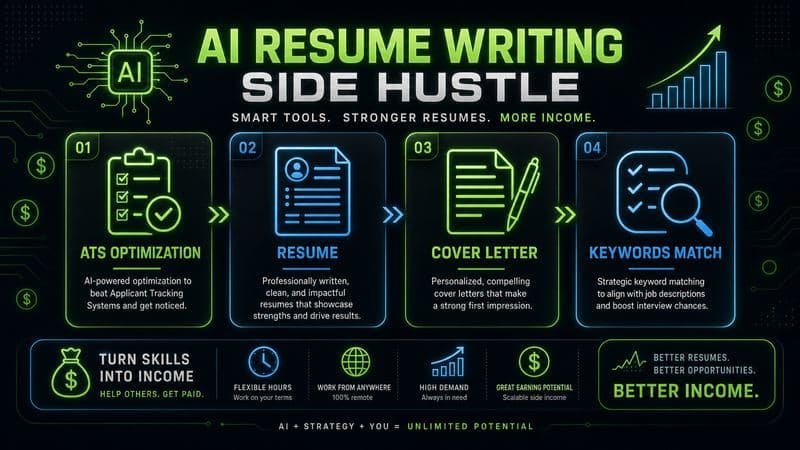
How to Start an AI-Assisted Resume Writing Side Hustle in 2026 (Beginner's Guide)
A step-by-step guide to using AI resume tools to offer a paid resume and cover letter writing service — what to charge, which tools to use, and how to find your first clients.
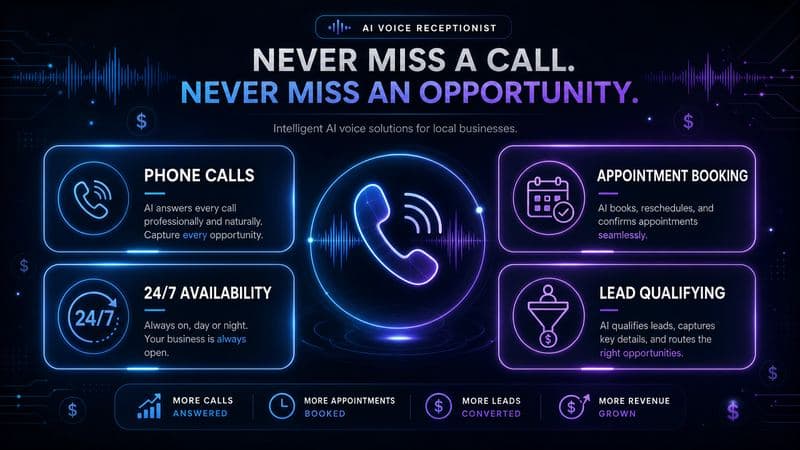
How to Build and Sell AI Voice Receptionists to Local Businesses in 2026
A beginner's guide to building AI voice agents that answer business phone calls — the tools to use, what to charge, and how to find your first client.

How to Make Money on Fiverr with AI Tools in 2026: 7 Gigs You Can Start This Week
Discover 7 real Fiverr gigs you can launch using free and low-cost AI tools in 2026 — no experience required. Real pricing data, step-by-step setup, and tools that actually work.