
AI Coding Tools Are Merging: What It Means for Beginners in 2026
OpenAI tried to buy Windsurf for $3 billion, Google hired its CEO instead, Cursor 3 just launched, and GitHub Copilot is injecting ads into code. Here's what the AI coding consolidation actually means for beginners.
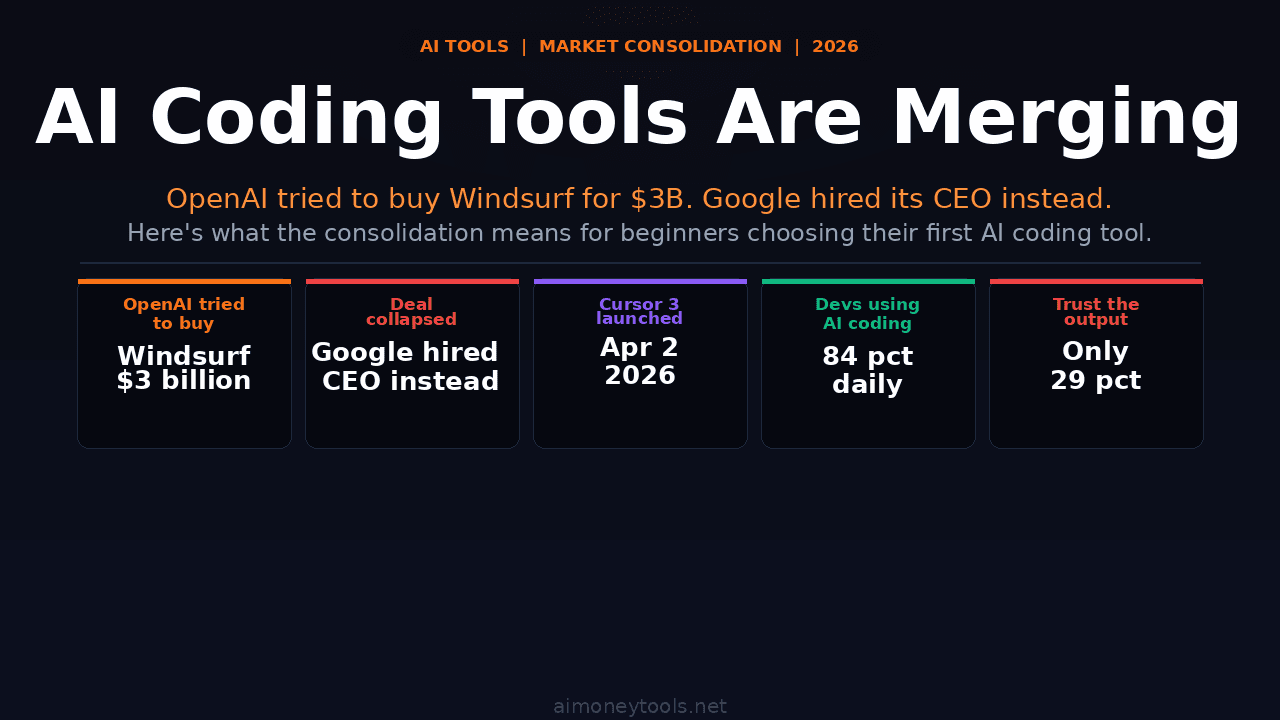
The landscape of AI development is shifting rapidly as major tech players fight for dominance. OpenAI recently attempted a $3 billion acquisition of Windsurf, only for Google to counter by hiring Windsurf's CEO and co-founder. Meanwhile, Cursor has remained independent, rejecting acquisition offers to launch its most significant update yet. Even GitHub Copilot is making waves, though not entirely for the right reasons, after injecting promotional content into 1.5 million developer pull requests.
This market consolidation is significant. The tools developers use to build software are being absorbed into the ecosystems of Google, Microsoft, OpenAI, and Anthropic. For beginners, these corporate movements dictate the pricing, privacy, and accessibility of the software you will use to learn.
What AI Coding Consolidation Actually Means
The current trend is driven by three major shifts in the industry as of April 2026.
First, these tools have evolved from simple autocomplete features into sophisticated agents. Cursor 3, which launched on April 2, 2026, introduced a multi-agent interface. This allows the software to spawn multiple AI workers that handle different segments of a codebase at the same time. This marks a massive leap in capability compared to the tools available just a year ago.
Second, big tech companies are aggressively acquiring the talent behind these innovations. After the OpenAI and Windsurf deal collapsed in mid-2025, Google DeepMind stepped in to hire Windsurf’s leadership in a deal valued at $2.4 billion.
Third, adoption has peaked while trust remains cautious. A 2026 Stack Overflow Developer Survey revealed that 84% of developers use AI coding tools daily, yet only 29% trust the output enough to deploy it without a manual review. This gap between usage and trust is the defining challenge for the current generation of tools.
The Power Map: Who Controls the Market
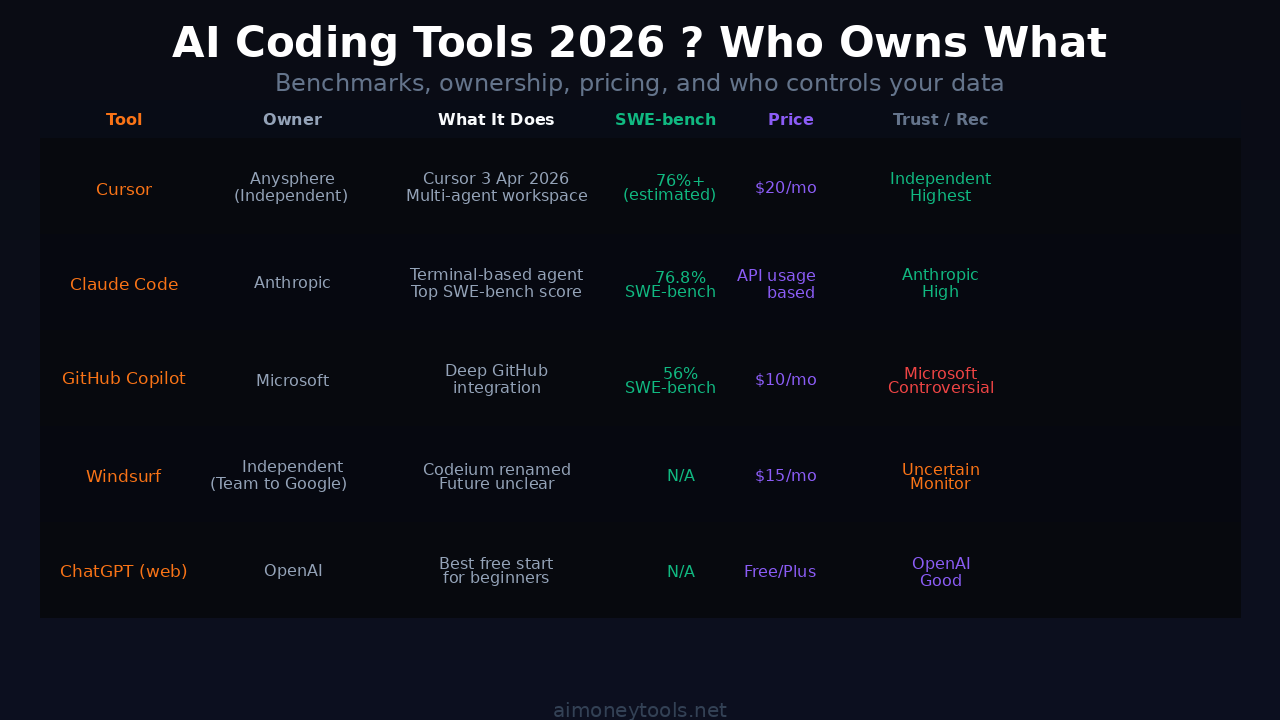
The following breakdown highlights the current leaders in the AI coding space:
Microsoft and GitHub As the owner of GitHub, Microsoft has a home-field advantage. GitHub Copilot is built directly into the workflow of millions. However, recent changes to data policies and the inclusion of promotional "tips" in pull requests have caused friction within the developer community.
OpenAI After missing out on the Windsurf acquisition, OpenAI has focused on its API-first strategy. By powering other tools through Codex and GPT-5.4, OpenAI remains the engine behind much of the industry, even without owning a dedicated code editor.
Google DeepMind By absorbing the Windsurf founding team, Google is positioning Gemini to be a central player in the coding agent space. While they have not yet launched a standalone "Windsurf-killer," the talent acquisition suggests a major product is on the horizon.
Anthropic Anthropic has prioritized model performance over platform expansion. Claude Code, their terminal-based agent, currently leads the industry benchmarks. Claude 4.5 Opus scores 76.8% on SWE-bench Verified, while their preview model, Claude Mythos, reaches an unprecedented 93.9% — verified by Anthropic's official system card.
Cursor (Anysphere) Valued at $9 billion, Cursor is the primary independent alternative. By refusing to sell to OpenAI, Cursor has maintained a specialized focus on user experience. Their multi-agent system in Cursor 3 is currently regarded as the gold standard for integrated AI development environments.
Strategic Advice for New Developers
The corporate shifts in the industry have practical consequences for anyone just beginning their coding journey.
Expect Tool Volatility The market is not yet stable. A tool that leads the pack today, like Windsurf in early 2025, can see its leadership team vanish in months. It is vital to focus on transferable skills—such as logic, prompt engineering, and code review—rather than becoming overly dependent on a single interface.
Prioritize Data Privacy The recent GitHub Copilot controversies highlight the risks of using tools owned by massive data-driven corporations. If you are developing proprietary software or working with sensitive client data, always audit the privacy settings and data retention policies of your chosen AI tool.
Verify Everything While benchmark scores are climbing, the "trust gap" remains. Even the most advanced models can produce logical errors that look correct but fail in production. Beginners should treat AI-generated code with the same skepticism as a random snippet found on an internet forum: read it, test it, and understand it before integration.
Which Tool Should You Choose?
Selection depends on your technical comfort level and specific project goals.
- For Peak Performance: Claude Code is the current benchmark leader. It is ideal for those comfortable with the command line.
- For Best User Experience: Cursor remains the most intuitive AI-first code editor. It is highly recommended for beginners who want a visual interface.
- For Integration: GitHub Copilot is the natural choice if your projects are already hosted on GitHub and you prefer a seamless workflow.
- For Privacy: Running local models via LM Studio ensures your code never leaves your machine. For those needing extra power without the hardware investment, Ampere provides scalable GPU access.

Key Takeaways
- The market is consolidating around Google, Microsoft, OpenAI, and Anthropic, with Cursor remaining a strong independent player.
- AI agents have moved beyond simple text completion to multi-file task management.
- Developer trust remains low at 29%, making manual code review a mandatory skill.
- Claude Code leads in technical benchmarks, while Cursor leads in user interface design.
- Beginners should stay flexible and avoid total lock-in to any single ecosystem.
FAQ
Are these tools merging or just consolidating?
Both. Large companies are acquiring the talent (merging), while the number of independent competitors is shrinking as users flock to the most powerful models (consolidating).
Is Windsurf still a viable option?
Windsurf is still active, but the departure of its founders to Google makes its long-term roadmap uncertain. It is functional for now but keep an eye on alternative tools.
Why did GitHub Copilot lose developer trust?
In March 2026, GitHub began injecting promotional content into pull requests and updated policies regarding training AI on user repositories, leading to concerns about privacy and professional workspace integrity.
Do I need a powerful computer to use these?
Most tools like Cursor and Claude Code run in the cloud. However, if you want to run models locally for privacy, you will need significant VRAM. Check out our VRAM guide for hardware requirements.
Can I use these tools if I am a total beginner?
Yes. ChatGPT and the Claude web interface are excellent for learning. As you progress, moving to Cursor or Claude Code will help you manage larger, more complex projects.

Alex the Engineer
•Founder & AI ArchitectSenior software engineer turned AI Agency owner. I build massive, scalable AI workflows and share the exact blueprints, financial models, and code I use to generate automated revenue in 2026.
Related Articles
How to Start an AI-Assisted Resume Writing Side Hustle in 2026 (Beginner's Guide)
A step-by-step guide to using AI resume tools to offer a paid resume and cover letter writing service — what to charge, which tools to use, and how to find your first clients.
How to Build and Sell AI Voice Receptionists to Local Businesses in 2026
A beginner's guide to building AI voice agents that answer business phone calls — the tools to use, what to charge, and how to find your first client.
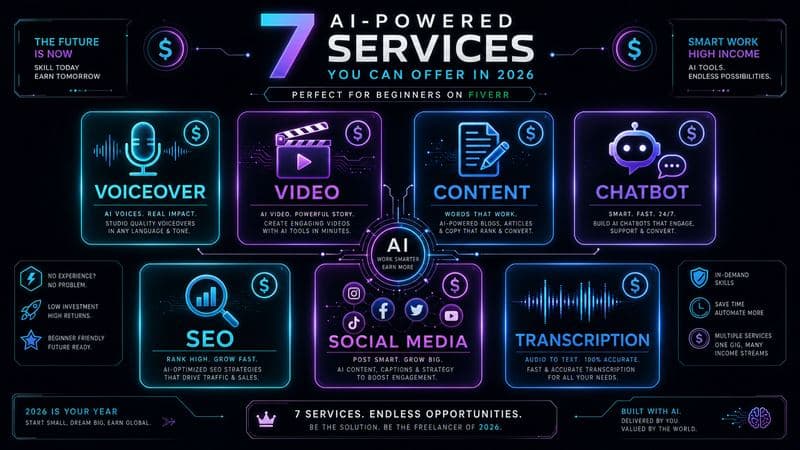
How to Make Money on Fiverr with AI Tools in 2026: 7 Gigs You Can Start This Week
Discover 7 real Fiverr gigs you can launch using free and low-cost AI tools in 2026 — no experience required. Real pricing data, step-by-step setup, and tools that actually work.