
AI Agency Pricing Guide: How to Price Automation Services
Master AI automation pricing for chatbots, workflows, and retainers. Learn how to calculate rates, structure packages, and scale your agency profitably.
Most entrepreneurs starting an AI automation agency (AAA) price themselves into a trap. They charge a flat $200 for a chatbot that took six hours to build, then wonder why they feel exhausted and broke after only three clients.
This guide outlines the exact pricing structures used by profitable AI agencies—from solo freelancers to $50k/month operations. No guesswork, just high-margin numbers.
The Core Problem: AI Work Is Priced Wrong
Traditional freelancers price by the hour. Agencies price by retainer. Most new AI agency owners do neither—they price based on what they think the client can afford, which is almost always too low.
The correct mental model: you are selling outcomes, not code. A custom AI chatbot that reduces a business owner's customer support load by 15 hours per week is worth $400–$600 per month to that business—not the $150 one-time fee you might see on discount freelance platforms.
Once you internalize that value, the tiers below become the standard.
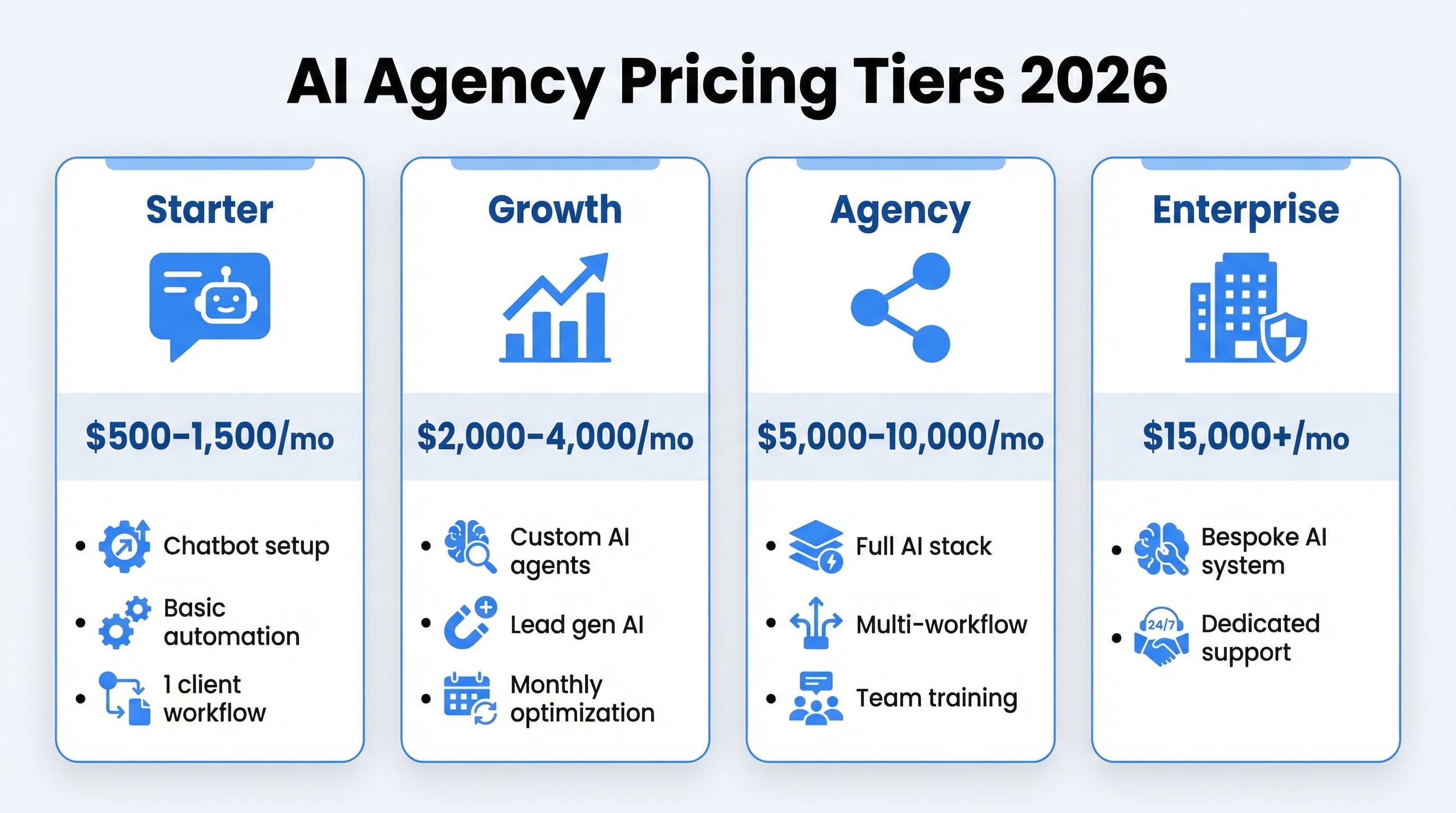
AI Agency Pricing Tiers
| Tier | Monthly Range | What's Included |
|---|---|---|
| Starter | $500–$1,500/mo | 1 workflow or chatbot, setup + basic support |
| Growth | $2,000–$4,000/mo | 2–3 workflows, lead gen AI, monthly optimization |
| Agency | $5,000–$10,000/mo | Full AI stack, multi-workflow, team training |
| Enterprise | $15,000+/mo | Bespoke AI systems, API integrations, dedicated support |
Key insight: Most new AI agencies should aim for the Growth tier immediately. Starter-tier clients are often price-sensitive, require high-touch support, and generate significant overhead. Growth-tier clients ($2k+/month) have already validated that AI tools work and are buying optimization and results, not basic education.
How to Calculate Your Rate
Pricing by "gut feel" is why agencies stall at low revenue. Use this formula to ensure every project is profitable:
Your Rate = (Base Time × Hourly Rate) + AI Tool Cost + 30% Margin
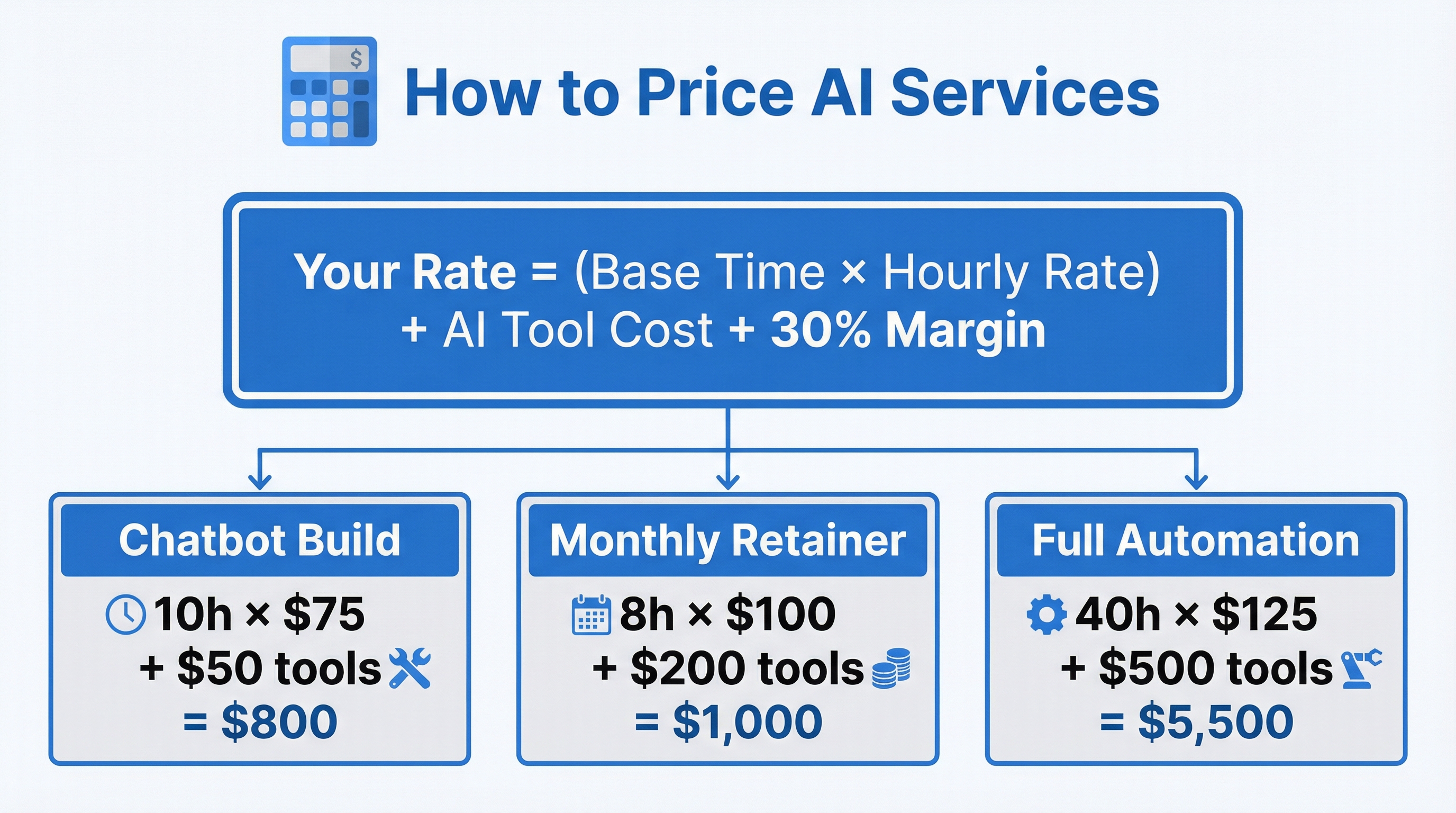
Example build calculations:
| Service | Calculation | Your Price |
|---|---|---|
| Simple chatbot | 10h × $75 + $50 tools | $800 one-time |
| Monthly retainer | 8h × $100 + $200 tools | $1,000/mo |
| Full automation stack | 40h × $125 + $500 tools | $5,500 build |
What hourly rate should you use? Set your internal rate based on your experience level:
- Beginner (< 3 months): $50–$75/hr internal
- Intermediate (3–12 months): $75–$125/hr internal
- Expert (1+ year, proven case studies): $125–$200/hr internal
Note: The "internal rate" is the figure you use to calculate your quote. Never quote the hours to the client; always quote the project or outcome price.
The "Value-First" Sales Process
To command premium rates, you must move from "order taker" to "strategic partner." Follow this 4-step framework during discovery calls to justify high-ticket pricing.
1. The Operational Audit
Before quoting, analyze the client's manual processes. Ask: "How many hours a week does your team spend on this task?" and "What is the hourly wage of the person doing it?" If a $40/hr employee spends 10 hours a week on manual data entry, that process costs the business $1,600 per month.
2. Identifying "Invisible" Costs
Automation does more than save time; it eliminates human error. Friction in lead follow-up can cause a 20% drop in closing rates. When pricing, include this "recovered revenue" in your pitch. If an AI system captures just two extra sales a month worth $1,000 each, your $2,000/mo retainer pays for itself instantly.
3. The Three-Option Quote
Never provide a single price. Offer choices to shift the conversation from "Yes/No" to "Which one?":
- The Pilot (Low): Solves the single biggest pain point.
- The Growth Engine (Recommended): Solves the main pain point plus two automated workflows.
- The Transformation (High): Full AI integration, team training, and weekly reporting.
4. Handling Price Objections
If a prospect balks at a $3,000 fee, pivot to the "Cost of Inaction." Remind them that every month they delay is another $1,600 lost to manual labor. The build fee is usually less than the cost of two months of inefficiency.
Standardizing Your Deliverables: The Service Catalog
To scale, you need a standardized "menu." This prevents "scope creep," where clients request extra features that erode your profit margins.
The Outreach & Lead Gen Stack ($2,500 Setup + $1,200/mo) The most common entry point for B2B clients.
- AI-driven prospecting bots (LinkedIn/Email).
- Automatic lead qualification via custom LLM prompts.
- CRM injection (HubSpot, Pipedrive, etc.).
- Performance reporting on automated meetings booked.
The Content Velocity System ($1,500 Setup + $900/mo) Ideal for marketing agencies and e-commerce brands.
- Workflows converting long-form video/articles into 10+ social snippets.
- AI-generated image assets for social platforms.
- Automated scheduling and approval queues.
The Knowledge Support Bot ($2,000 Setup + $500/mo) Best for SaaS or high-volume service providers.
- Chatbot trained on internal documentation and support tickets.
- Human hand-off logic for complex queries.
- Monthly fine-tuning based on user interaction data.
Practical Application: The "AI-Efficiency" Calculator
When you present your pricing, use a simple ROI calculator to visualize the value for the prospect. This removes the "expensive" label from your services and positions them as an investment.
Step 1: Calculate Total Manual Cost
- Hours spent per month on task: 20
- Average employee hourly rate: $50
- Monthly labor cost: $1,000
Step 2: Calculate Error and Opportunity Cost
- Leads lost due to slow response (est. value): $2,000
- Total "Cost of Old Way": $3,000/month
Step 3: Present the AI Solution
- Build Fee: $2,500 (One-time)
- Monthly Retainer: $1,000
- Year 1 Total Cost: $14,500
- Year 1 Savings: $36,000
- Net Profit for Client: $21,500
By walking a client through these numbers, a $1,000/month retainer no longer looks like a cost; it looks like a mechanism for generating $21,500 in found money. This is how high-end agencies close deals without lowering their rates.
Market Rates for Specific AI Services
These represent current 2026 market rates for active agencies:
One-time builds:
- Basic FAQ/Lead capture chatbot: $500–$1,500
- Custom GPT with proprietary knowledge base: $800–$2,500
- Automated AI email workflows: $1,200–$3,000
- Voice AI phone agents: $2,000–$5,000
- Full lead generation ecosystems: $3,000–$8,000
Monthly retainers:
- Chatbot optimization: $300–$800/mo
- AI content pipelines: $500–$1,500/mo
- Lead gen + CRM automation: $1,500–$3,500/mo
- AI sales funnel management: $2,000–$5,000/mo
Why Retainers Beat One-Time Builds
The fastest way to grow an AI agency is predictable monthly recurring revenue (MRR).
- Compounding ROI: Clients on retainers see better results through ongoing optimization.
- Predictable Income: Five $2k retainers equal a guaranteed $10k/month.
- Lower Churn: Once your AI systems become central to their operations, switching costs are high.
- Natural Upsells: Monthly check-ins naturally reveal new automation needs.
Pro Tip: Always anchor your project with a retainer option. Quote the build at $2,500, or offer a bundle: "$1,200 setup plus $800/month for ongoing management." Most clients choose the bundle.
For those running self-hosted models, infrastructure costs are a factor. Ampere cloud offers ARM-based GPU instances that are significantly more cost-effective than x86 alternatives when scaling for multiple clients.
Raising Your Rates Successfully
Follow these three rules to increase your margins without losing your client base:
- Time it with renewals: Notify clients 30 days before a contract renewal.
- Value-stack the increase: A 25% price hike is easier to digest if you add a "Monthly AI Performance Report."
- Grandfather legacy clients: Give your earliest supporters 6 months at their current rate while charging new clients the higher fee immediately.
If a client refuses a reasonable rate increase, it is a signal they don't value the output. This is your cue to replace them with a higher-quality lead.
Red Flags of Underpricing
- You are fully booked with 5+ clients but making less than $5k/month.
- Clients constantly "scope creep" with small, unpaid requests.
- You dread client calls because the effort outweighs the pay.
- You have a 100% close rate. (A healthy premium agency should close 40–60% of leads; if everyone says yes, you are too cheap.)
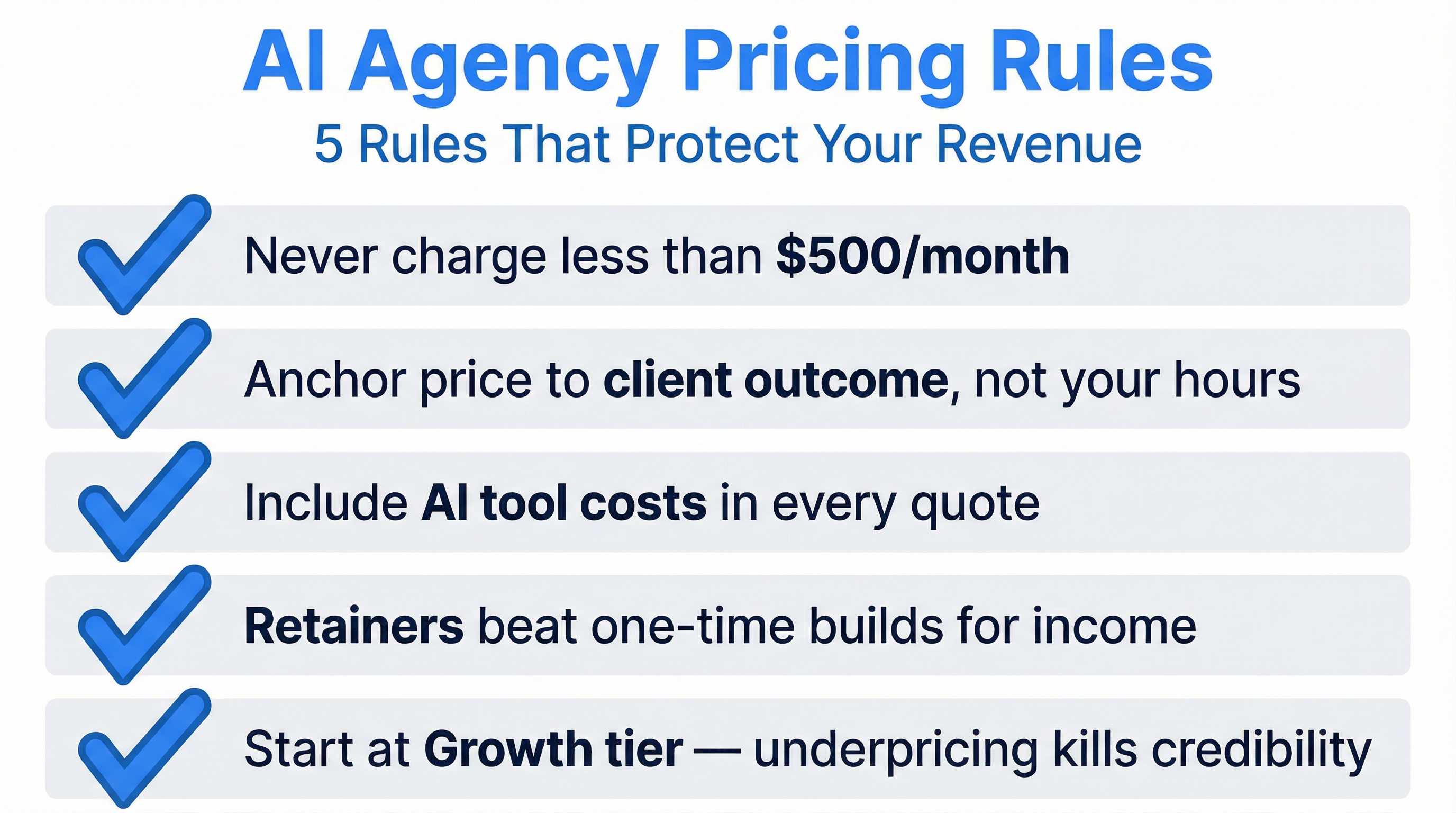
Key Takeaways
- Minimum Floor: Never charge less than $500/month for recurring services to ensure the economics work.
- Outcome Anchor: Price based on the value saved (e.g., $2k for a bot that saves 40 hours of labor).
- Pass Through Costs: Always account for AI API and tool costs in your quotes to protect your margins.
- Prioritize MRR: Aim for 5+ retainer clients before focusing on one-off project work.
- Target the Growth Tier: Avoid high-maintenance, low-budget clients by positioning your services for established businesses.
For more on building the technical side of your agency, read how to build an AI tool that makes money and our latest AI automation ideas breakdown.
FAQ
How do I find my first AI agency client? Start with your existing network. Offer a $500 "AI Audit & Roadmap." This is a low-risk way for them to test your expertise before you upsell them to a $2,000 implementation.
Should I charge more for custom code vs. no-code? The tool doesn't matter; the result does. A no-code Zapier workflow that saves $3,000/month is worth the same to a client as a custom Python script. Charge for the value created.
What is the best niche for an AAA in 2026? Local service businesses like law firms, real estate agencies, and dental offices are ideal. They have high margins and clear, repetitive tasks—like booking and follow-ups—that are easily automated.
When should I make my first hire? When you hit 80% capacity (roughly 32 billable hours/week). Your first hire should be a Project Manager or VA to handle operations, freeing you up to focus on sales.
Do I need a contract? Absolutely. Ensure your agreement covers the specific scope, payment terms (Net 7 is recommended), IP ownership, and a 30-day cancellation policy.

Alex the Engineer
•Founder & AI ArchitectSenior software engineer turned AI Agency owner. I build massive, scalable AI workflows and share the exact blueprints, financial models, and code I use to generate automated revenue in 2026.
Related Articles
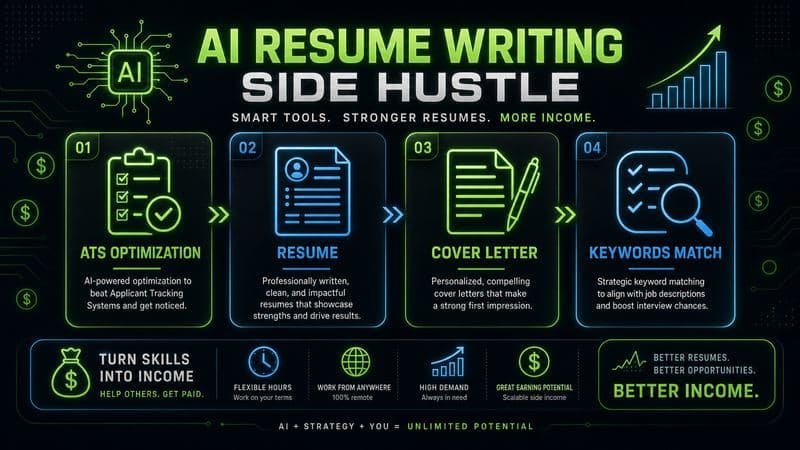
How to Start an AI-Assisted Resume Writing Side Hustle in 2026 (Beginner's Guide)
A step-by-step guide to using AI resume tools to offer a paid resume and cover letter writing service — what to charge, which tools to use, and how to find your first clients.
How to Build and Sell AI Voice Receptionists to Local Businesses in 2026
A beginner's guide to building AI voice agents that answer business phone calls — the tools to use, what to charge, and how to find your first client.
How to Make Money on Fiverr with AI Tools in 2026: 7 Gigs You Can Start This Week
Discover 7 real Fiverr gigs you can launch using free and low-cost AI tools in 2026 — no experience required. Real pricing data, step-by-step setup, and tools that actually work.