
SpaceX Buys Cursor AI for $60 Billion: What It Means for Developers
SpaceX has agreed to buy Anysphere — maker of AI coding tool Cursor — for $60 billion in stock. Here's what happened, why it matters, and what changes for the millions of developers using Cursor today.
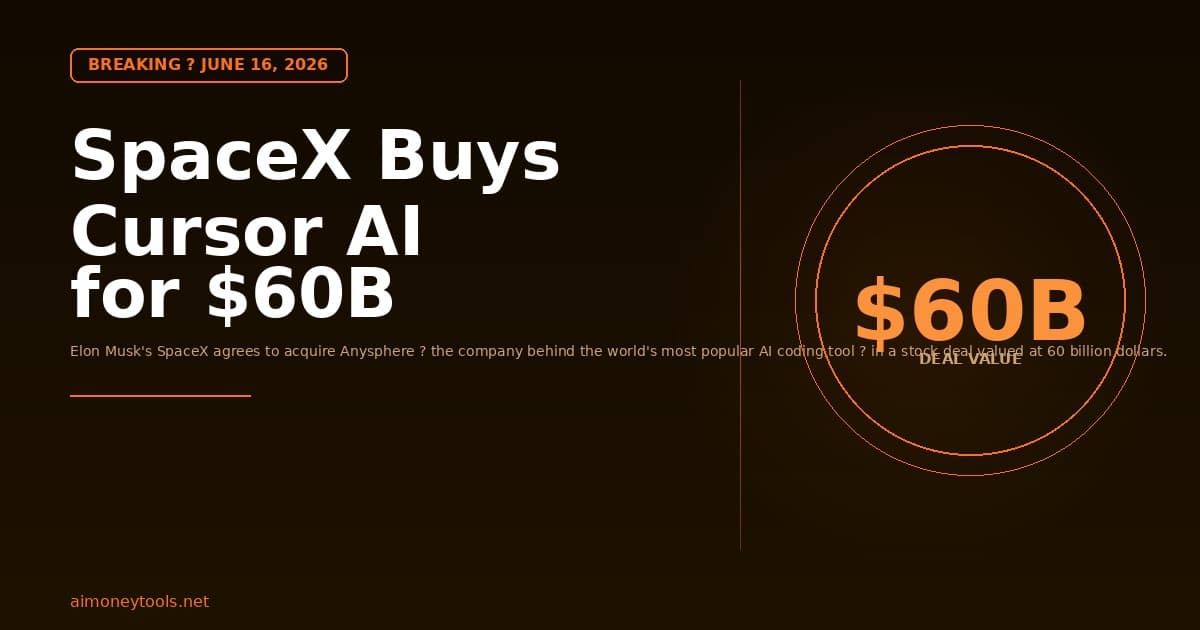
Elon Musk's SpaceX has officially agreed to acquire Anysphere — the company behind the AI coding tool Cursor — in a $60 billion stock deal. The announcement dropped on Tuesday, June 16, just days after SpaceX's blockbuster IPO, and it instantly became one of the largest AI acquisitions in history.
If you use Cursor to write code, this story directly affects you. Here is a clear breakdown of what happened, why SpaceX paid this much, and what it actually means for your coding workflow.
What Just Happened
SpaceX confirmed on June 16, 2026 that it has agreed to acquire Anysphere — the startup behind Cursor AI — in a stock-based deal valued at $60 billion. The acquisition is expected to close in the third quarter of 2026.
The deal structure is unusual: back in April 2026, SpaceX announced it would either buy Cursor for $60 billion in stock, or pay a $10 billion break-up fee if it chose not to follow through. SpaceX just exercised the buyout option.
The deal is being absorbed into SpaceX's AI division — which was rebuilt around Elon Musk's AI company xAI after the two merged earlier in 2026.
Who Is Anysphere and Why Is Cursor Such a Big Deal?
Cursor was founded in 2022 by four MIT students under the company name Anysphere. The core idea was simple but ambitious: instead of bolting AI autocomplete onto an existing editor, build an editor where AI understands your full codebase from day one.
The product took off fast:
- 2024: Cursor goes through OpenAI's startup accelerator. Word-of-mouth among developers explodes.
- June 2025: Anysphere raises a $900 million Series C. Cursor launches a $200/month Ultra plan for power users.
- Late 2025: Another $2.3 billion raised, pushing the valuation toward $29 billion.
- April 2026: Before a planned $2 billion round led by Andreessen Horowitz, Thrive, and Nvidia at a $50 billion valuation, SpaceX comes in with the $60 billion offer and preempts the fundraise entirely.
By early 2026, Cursor had roughly 10 million developers using it — from solo freelancers to enterprise engineering teams. It was arguably the most widely used AI coding tool in the world, beating out GitHub Copilot in developer satisfaction surveys.
Why Did SpaceX Pay $60 Billion for an AI Coding Tool?
This is the question everyone is asking. SpaceX builds rockets. What does it need with a code editor?
The answer is in the IPO filings. When SpaceX went public last week, it told investors it sees a $26 trillion total addressable market in AI — $22.7 trillion of that in enterprise applications. To justify that number, SpaceX needs actual AI products that people use and pay for.
The problem: SpaceX's internal AI division — built around xAI and the Grok chatbot — was in serious trouble. All 11 of xAI's original co-founders had left by March 2026. Musk publicly admitted that xAI "was not built right the first time around." Grok had faced controversies including generating harmful content, leading to legal challenges from California's attorney general.
Cursor is the clean acquisition that gives SpaceX AI credibility fast:
- 10 million users who are already paying
- Best-in-class product with real developer loyalty
- Revenue (Anysphere reportedly had over $2 billion in annual revenue run-rate)
- Talent — two of Cursor's senior engineering leads had already joined SpaceX's AI team
The $10 billion break-up fee built into the April agreement also signals how seriously SpaceX wanted this deal — that fee alone would have been the second-largest AI-focused acquisition of 2025.
And with SpaceX's stock rocketing from its $135 IPO price to over $200 per share in under a week, the company added roughly $1 trillion in market cap — about 16 Cursors' worth — making the $60 billion feel manageable in context.
What This Means for Cursor Users Right Now
The short answer: nothing changes today.
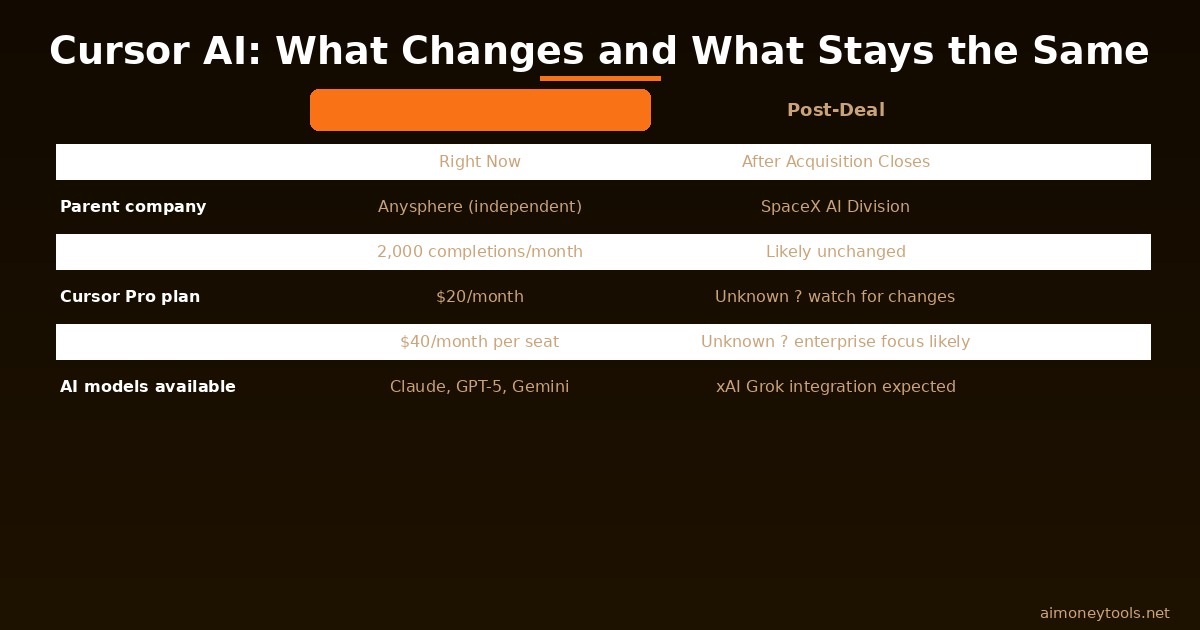
The deal is not closed yet. It is expected to finalize in Q3 2026. Until the acquisition is legally complete, Cursor operates as an independent company.
Here is what to watch for once the deal closes:
Pricing
Cursor's current plans:
- Free: 2,000 code completions per month
- Pro: $20/month — unlimited completions, fast AI models
- Business: $40/month per seat — team management features
- Ultra: $200/month — highest usage limits
SpaceX has not commented on pricing changes. The most likely scenario: the free and pro tiers stay stable to maintain market share, while SpaceX builds a new enterprise tier at the high end for companies buying into its broader AI platform.
AI Model Integration
Right now, Cursor lets you choose between Claude, GPT-5, and Gemini as its underlying models. Post-acquisition, SpaceX is likely to push Grok integration — xAI's rebuilt model — as a default or preferred option for SpaceX enterprise customers. Whether Claude and GPT-5 remain as options is unknown.
Data and Infrastructure
One clear change coming: Cursor's AI compute will move onto SpaceX's infrastructure. The xAI–Anysphere data center partnership was already in place before the acquisition. This could mean faster response times on SpaceX hardware, but it also means your code will run through SpaceX-owned servers.

What Are the Best Cursor Alternatives in 2026?
Acquisitions by large companies often worry developers who rely on the tool for daily work. Here are the strongest alternatives if you want to diversify or hedge:
Windsurf (Codeium)
The most direct Cursor competitor. Built by Codeium, which has stayed independent. Offers a similar AI-first editor experience with in-editor chat, codebase understanding, and autocomplete. Free tier available; Pro at $15/month.
GitHub Copilot
Backed by Microsoft and OpenAI. More conservative feature set than Cursor, but deeply integrated with GitHub. Best for teams already in the Microsoft ecosystem. $10/month for individuals.
Aider
Open-source, runs locally. You bring your own API key (works with Claude, GPT-5, Gemini, or local models). No subscription, no lock-in. Requires comfort with the terminal — see our terminal beginners guide to get set up.
Continue (VS Code extension)
Another open-source option. Works as a VS Code extension and supports local models via Ollama. Great if you want full control and privacy — no code sent to third-party servers.
If you want to run AI coding tools locally without any subscription fees, check our Ollama + Open WebUI setup guide for a practical walkthrough.
The Bigger Picture: What This Deal Signals
The SpaceX–Cursor deal is not just a product acquisition. It signals several things happening in AI right now:
1. AI coding tools are worth more than most companies thought. $60 billion for a code editor — even a very good one — would have seemed impossible two years ago. Developer tools are now a serious part of the AI market, not just a niche.
2. The AI arms race is pushing unusual buyers. SpaceX is not a software company. But Musk needs AI revenue to justify the $26 trillion market cap story he told IPO investors. Cursor was the fastest path to a credible AI product.
3. Developers should think about lock-in. Every major AI coding tool is now either owned by a large tech company (GitHub Copilot/Microsoft, Cursor/SpaceX) or backed by massive VC at valuations that require aggressive monetization. Open-source alternatives like Aider and Continue are increasingly worth keeping in your toolkit.
4. Smaller AI acquisitions will follow. A $60 billion deal sets a new benchmark for AI developer tool valuations. Expect other large companies to start circling Windsurf, Replit, and similar tools.
Frequently Asked Questions
Will Cursor's pricing go up after SpaceX takes over? Not immediately. The deal closes in Q3 2026, and no pricing changes have been announced. The most common pattern in tech acquisitions is a 6–12 month stability period before new pricing is introduced. Monitor the official Cursor blog for updates.
Is Cursor still safe to use for professional work? Yes, for now. Anysphere is still operating independently until the deal closes. The product, privacy policy, and data handling remain the same. If you have concerns about data sovereignty post-acquisition, Aider or Continue offer local-model alternatives.
Why would SpaceX want an AI coding tool? SpaceX's AI division (rebuilt from xAI) had serious internal problems. Cursor gave them a product with 10 million real users and over $2 billion in annual revenue — exactly what they needed to back up the $26 trillion AI market story told to IPO investors.
What is Anysphere? Anysphere is the company name behind Cursor AI. It was founded in 2022 by four MIT students. The Cursor product is the public-facing brand; Anysphere is the legal entity SpaceX is acquiring.
Could SpaceX force Cursor to use Grok instead of Claude? SpaceX has not said this. But it would be surprising if they did not at least add Grok as an option and promote it for enterprise customers. Whether Claude, GPT-5, and Gemini remain available is unknown — check for announcement in Q3 2026.
What happens to Cursor's free plan? No changes announced. SpaceX is unlikely to kill the free plan — it is how Cursor builds developer loyalty and feeds its paid tiers. Watch for usage limits to tighten before prices change outright.
What is the best Cursor alternative right now? Windsurf is the closest like-for-like replacement. For developers who want zero lock-in, Aider (open-source, bring your own API key) is the strongest option. GitHub Copilot is best for Microsoft/GitHub-heavy workflows.
Is this confirmed or just a rumor? Confirmed. Reuters, CNBC, TechCrunch, and WSJ have all independently reported the deal. SpaceX issued an official statement Tuesday morning. The SEC filing is also publicly available.
Could the deal fall through? The $10 billion break-up fee suggests SpaceX is committed. They would have to pay $10B just to walk away. Regulatory review is the main risk — a $60 billion acquisition of a widely-used software tool could attract antitrust attention.
Should developers start looking at alternatives now? It is reasonable to test at least one alternative. Not because Cursor is broken today, but because developer tools tied to large corporations have a history of price increases and feature changes post-acquisition (see: GitHub Copilot pricing increases, Figma/Adobe). Having a fallback you are comfortable with is good practice.

Alex the Engineer
•Founder & AI ArchitectSenior software engineer turned AI Agency owner. I build massive, scalable AI workflows and share the exact blueprints, financial models, and code I use to generate automated revenue in 2026.
Related Articles
How to Start an AI-Assisted Resume Writing Side Hustle in 2026 (Beginner's Guide)
A step-by-step guide to using AI resume tools to offer a paid resume and cover letter writing service — what to charge, which tools to use, and how to find your first clients.
How to Build and Sell AI Voice Receptionists to Local Businesses in 2026
A beginner's guide to building AI voice agents that answer business phone calls — the tools to use, what to charge, and how to find your first client.

How to Make Money on Fiverr with AI Tools in 2026: 7 Gigs You Can Start This Week
Discover 7 real Fiverr gigs you can launch using free and low-cost AI tools in 2026 — no experience required. Real pricing data, step-by-step setup, and tools that actually work.