
OpenAI GPT-5.5 and Codex Are Now on AWS: What This Means for You (2026)
OpenAI's most powerful models — GPT-5.5, GPT-5.4, and Codex — are now available on Amazon Bedrock. Here's what changed, who benefits, and how to get started.
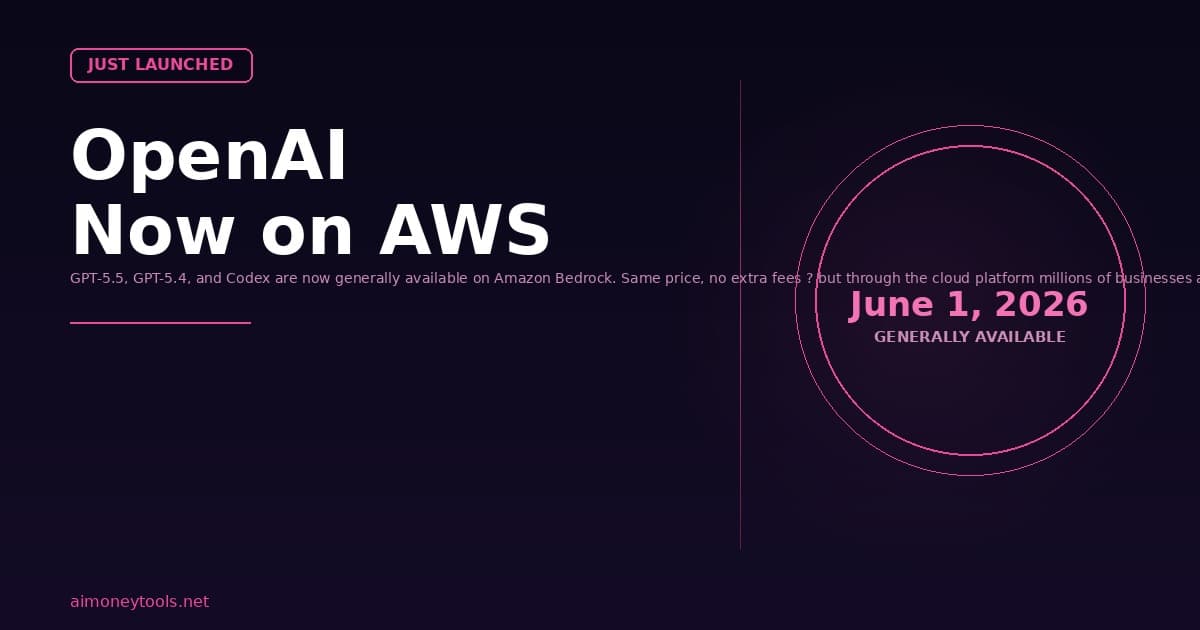
OpenAI's best models are now available on Amazon Web Services.
As of June 1, 2026, GPT-5.5, GPT-5.4, and Codex are generally available on Amazon Bedrock — meaning anyone with an AWS account can access OpenAI's frontier AI models without a separate OpenAI account, separate billing, or separate security setup.
If you have never heard of Amazon Bedrock, that is fine. This guide will explain what changed, why it matters, and whether this affects how you should be using AI tools.
What Is Amazon Bedrock?
Amazon Bedrock is AWS's managed AI service. Think of it as a "model marketplace" built into Amazon's cloud platform. Instead of signing up for separate AI services — one account for OpenAI, another for Anthropic Claude, another for Meta's Llama — enterprises can access multiple AI models through a single AWS interface.
Before this launch, Bedrock already offered models from Anthropic (Claude), Meta (Llama), Mistral, Cohere, Amazon (Titan and Nova), and others. OpenAI was the notable absence.
That absence is now over.
What Exactly Launched on June 1?
Three things became generally available on Amazon Bedrock on June 1, 2026:
1. GPT-5.5 and GPT-5.4 on Amazon Bedrock
OpenAI's two top general-purpose models are now accessible through the Bedrock Responses API. Both run on Bedrock's next-generation inference engine, which AWS built for performance, reliability, and security. Pricing matches OpenAI's first-party rates exactly — there are no extra fees for going through Bedrock.
2. Codex on Amazon Bedrock
Codex is OpenAI's AI coding agent, used by more than 5 million people weekly (according to OpenAI). It can write, debug, review, and modernize code. On Bedrock, Codex is available through the Codex CLI (command line), the Codex desktop app, and a VS Code extension. All inference runs through AWS infrastructure.
3. Amazon Bedrock Managed Agents, Powered by OpenAI
This is the most advanced option. It lets teams build full AI agent systems — multi-step, autonomous workflows — using OpenAI's frontier models on AWS infrastructure. The platform handles memory across sessions, permissions via IAM, and logging through AWS CloudTrail.
Why Does This Matter?
For individual users and freelancers, the direct impact is small. If you already have an OpenAI account and use ChatGPT or the API directly, nothing changes for you today.
Where this matters is for businesses and enterprises — and understanding why helps illustrate how the business world actually adopts AI.
The Real Problem This Solves
Most large companies cannot just "sign up for OpenAI" the same way you do personally. They have to go through:
- Procurement reviews — vendor approval processes that can take weeks or months
- Security audits — evaluating how the AI provider handles their data
- Compliance checks — especially in regulated industries like healthcare, finance, and government
- Budget approvals — consolidating software spend across departments
- Existing cloud commitments — many companies have spending commitments with AWS and want usage to count toward them
By putting GPT-5.5 and Codex inside Amazon Bedrock, OpenAI and AWS removed all of those barriers at once. A company that already uses AWS can now use GPT-5.5 without a new vendor, without new procurement, and without a new security review. It just goes on the AWS bill.
This is why 333 points on Hacker News lit up for this story. The business world knows what it means.
Who Benefits Most?

AWS-native teams and developers: If your company runs on AWS, you can now test and deploy GPT-5.5 without switching platforms. You authenticate with your existing AWS credentials. Your IAM roles and VPC security settings apply automatically.
Enterprises in regulated industries: GovCloud region support means US government agencies and heavily regulated sectors (healthcare, defense, finance) can use OpenAI models while staying inside the compliance boundaries AWS already provides.
Companies with large AWS spend commitments: Usage of OpenAI models on Bedrock counts toward existing AWS cloud commitments (known as Enterprise Discount Programs). If your company has a $10M annual AWS commitment, using GPT-5.5 through Bedrock helps fulfill that commitment.
Teams building AI agents: Bedrock Managed Agents (powered by OpenAI) gives developers a platform to build and deploy AI agents that run reliably at scale, with AWS handling the infrastructure, memory, and security pieces.
What Does It Cost?
Pricing for OpenAI models on Amazon Bedrock matches OpenAI's direct API pricing exactly, with no additional Bedrock fee on top:
- GPT-5.5: $5.00 per million input tokens, $30.00 per million output tokens
- GPT-5.4: $2.50 per million input tokens, $15.00 per million output tokens
- Codex: Billed separately through the Codex subscription (pricing via the Codex app)
There is no "Bedrock tax" — you pay the same price whether you access GPT-5.5 directly through OpenAI or through Bedrock. The benefit is operational convenience and AWS spend consolidation, not cost savings.
For context, if you are comparing this to MiniMax M3 (covered in our launch article this morning), you are looking at roughly 10 to 17 times more expensive per token for GPT-5.5 versus MiniMax M3's full price. The OpenAI/AWS path makes sense for companies that need the specific enterprise features, not for individuals trying to minimize API costs.
What About Data Privacy?
This is a common question and the answer is clear: OpenAI models on Bedrock run with the same AWS security controls as every other Bedrock model.
That includes:
- IAM-based access management: Only the roles you authorize can call the models
- AWS PrivateLink: Traffic between your application and the models does not travel over the public internet
- Encryption: Data encrypted at rest and in transit
- AWS CloudTrail logging: Every API call is logged for audit purposes
- VPC isolation: Models run inside your virtual private cloud
For businesses that have already approved AWS as a vendor, this means OpenAI models now inherit that approval. The data handling and security posture is AWS's, not OpenAI's standalone API terms.
How Is This Different From Using OpenAI Directly?
Here is the honest comparison:
| OpenAI API directly | OpenAI on AWS Bedrock | |
|---|---|---|
| Pricing | Standard OpenAI rates | Same OpenAI rates, no surcharge |
| Auth | OpenAI account | AWS credentials |
| Security model | OpenAI's security | AWS IAM, VPC, CloudTrail |
| Billing | OpenAI invoice | AWS invoice |
| AWS commitment spend | No | Yes |
| Available models | All OpenAI models | GPT-5.5, GPT-5.4, Codex (June 2026) |
| Setup for individuals | Very easy | Requires AWS account |
For individuals: OpenAI directly is simpler. For enterprises already on AWS: Bedrock is now the cleaner path.
What Is Coming Next?
OpenAI and AWS both hinted at expanding the partnership. Specifically:
- Daybreak: OpenAI's security-focused AI system (cyber defense, code security review, threat modeling) is coming to AWS in the future
- More models: OpenAI said they will continue adding capabilities to Bedrock as new models and features launch
- AgentCore integration: Bedrock AgentCore (AWS's open agent infrastructure) works alongside the Managed Agents powered by OpenAI, with more integration planned
For businesses evaluating AI infrastructure, this partnership signals that the lines between cloud provider and AI provider are blurring. AWS is no longer just the server — it is increasingly also the AI layer.
Frequently Asked Questions
Do I need an AWS account to use OpenAI on Bedrock?
Yes. To access OpenAI models through Amazon Bedrock, you need an AWS account and appropriate permissions. The models are not available through a separate consumer sign-up. If you are an individual and just want to use GPT-5.5, go directly to chat.openai.com or the OpenAI API.
Does using OpenAI on Bedrock cost more than using OpenAI directly?
No. Pricing matches OpenAI's first-party rates exactly with no additional Bedrock fee. You pay the same price, but the charges appear on your AWS invoice instead of a separate OpenAI bill.
Can I use Codex on AWS through VS Code?
Yes. Codex on Amazon Bedrock is available through the Codex CLI, the Codex desktop app, and a VS Code extension. All inference routes through Bedrock's infrastructure.
Is this available in government or regulated regions?
Yes. OpenAI models on Bedrock are available in both commercial and GovCloud regions, which matters for US government agencies and contractors.
What is the difference between GPT-5.5 and GPT-5.4?
GPT-5.5 is OpenAI's most advanced current model for complex reasoning, long-form generation, and hard coding tasks. GPT-5.4 is the previous version — still frontier-tier and faster, at a lower cost ($2.50/$15 vs $5/$30 per million tokens). For most tasks, GPT-5.4 delivers very strong results at a meaningful price difference.
Does this affect small businesses or freelancers?
Indirectly. If you sell AI services to enterprise clients on AWS, you now have an additional sales angle: your AI-powered services can run natively inside their existing AWS environment. That can shorten sales cycles with AWS-native prospects.
Should I switch from OpenAI's API to Bedrock?
Only if your business already runs on AWS and you want to consolidate billing or leverage AWS compliance controls. If you are a solo developer or small team using the OpenAI API directly, there is no compelling reason to switch.

Alex the Engineer
•Founder & AI ArchitectSenior software engineer turned AI Agency owner. I build massive, scalable AI workflows and share the exact blueprints, financial models, and code I use to generate automated revenue in 2026.
Related Articles
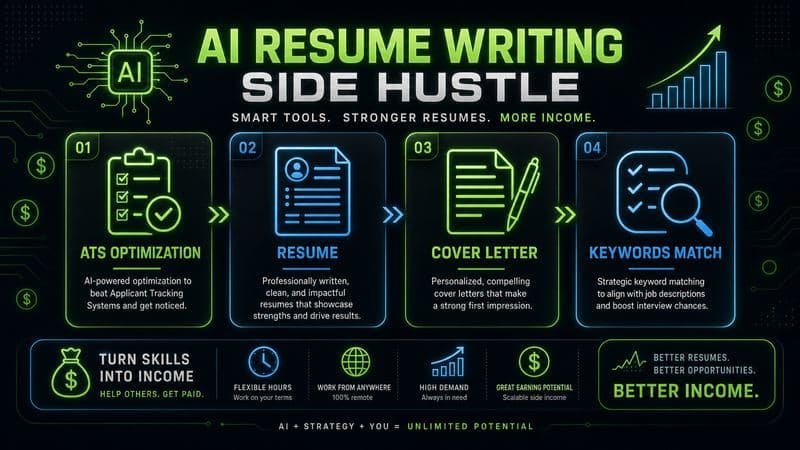
How to Start an AI-Assisted Resume Writing Side Hustle in 2026 (Beginner's Guide)
A step-by-step guide to using AI resume tools to offer a paid resume and cover letter writing service — what to charge, which tools to use, and how to find your first clients.
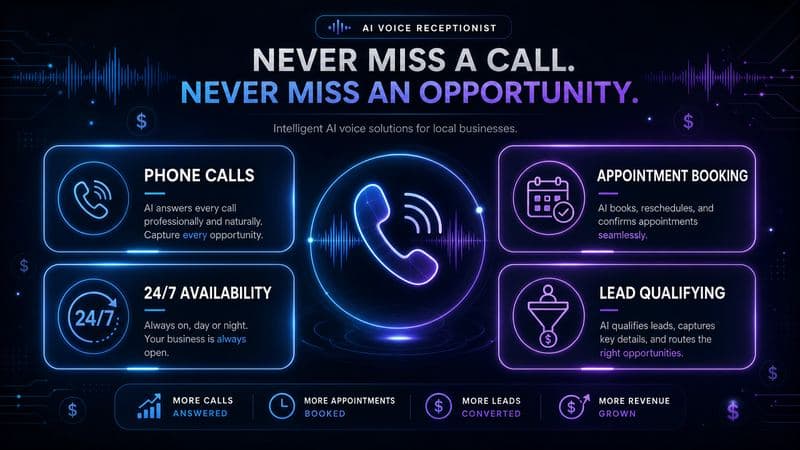
How to Build and Sell AI Voice Receptionists to Local Businesses in 2026
A beginner's guide to building AI voice agents that answer business phone calls — the tools to use, what to charge, and how to find your first client.
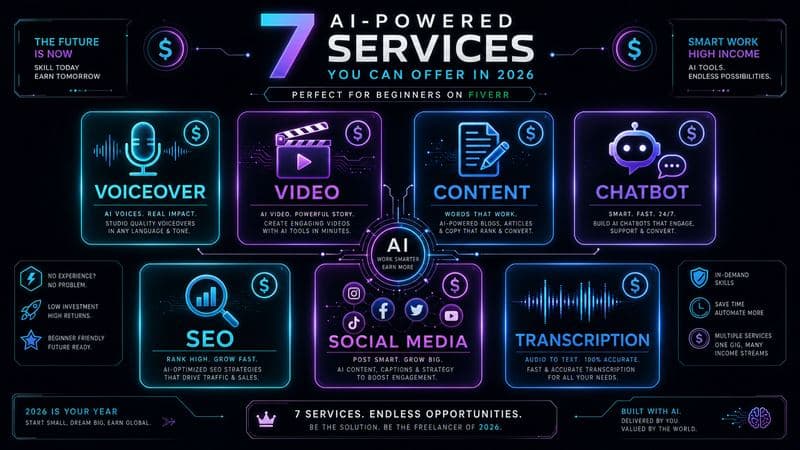
How to Make Money on Fiverr with AI Tools in 2026: 7 Gigs You Can Start This Week
Discover 7 real Fiverr gigs you can launch using free and low-cost AI tools in 2026 — no experience required. Real pricing data, step-by-step setup, and tools that actually work.