
Nvidia Launches Cosmos 3 and New AI Model Suite: What Beginners Need to Know
Nvidia just unveiled Cosmos 3, Nemotron 3, Isaac GR00T N1.7 and more. Here is a plain-English breakdown of what these models do, who they are for, and why it matters.
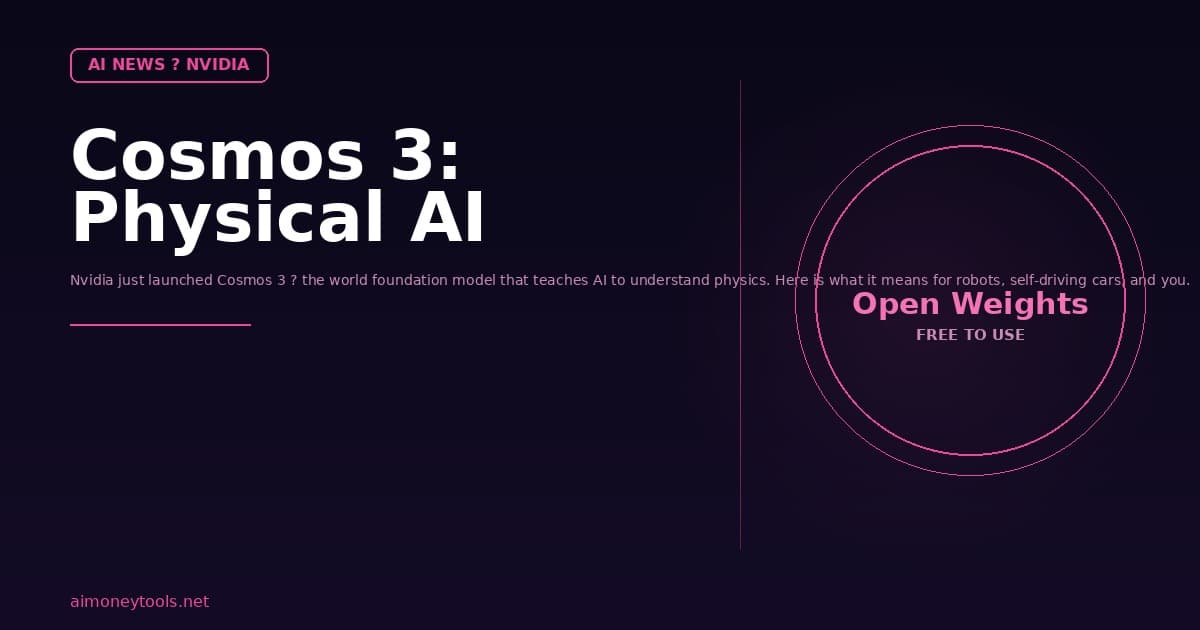
Nvidia just dropped a lot of AI at once.
On June 1, 2026, the company announced an expanded lineup of open AI models across robotics, autonomous vehicles, agentic AI, and even drug discovery. The headline model is Cosmos 3 — a so-called "world foundation model" that teaches AI to understand the physical world. But the full release is bigger than that.
If you follow AI news but words like "world foundation model" make your eyes glaze over, this is your plain-English breakdown.
What Nvidia Just Announced
The full release includes four model families, each targeting a different industry:
| Model | What it does |
|---|---|
| Cosmos 3 | Physical AI — teaches AI to simulate and understand the real world |
| Nemotron 3 | Agentic AI — multimodal models for chatbots, voice, vision, reasoning |
| Isaac GR00T N1.7 | Robotics — AI brain for physical robots |
| Alpamayo 1.5 | Autonomous vehicles — AI perception for self-driving |
All of these are open-weight models, which means developers can download and customize them for free.
It is a big move from Nvidia. The company is best known for the GPUs that power AI — but now they are building the AI itself.
Cosmos 3: The Headliner
What Is a World Foundation Model?
Most AI models today understand language (like ChatGPT) or images (like image generators). What they do not understand is physics — the way objects move, fall, collide, and interact in the real world.
Cosmos 3 is built to fix that.
A world foundation model learns from video data of the real world. It develops an internal model of how things work — not just what they look like, but what happens when you push a box off a table, how a robot arm should grip a fragile object, or how a car should predict the behavior of a pedestrian.
Think of it as the difference between a language model that knows the word "gravity" versus a model that actually understands what gravity does.
What Cosmos 3 Can Do
Nvidia describes Cosmos 3 as the first world foundation model to unify three capabilities in one:
1. Synthetic world generation It can create realistic simulated environments for AI training. Instead of needing thousands of hours of real-world footage, you can generate synthetic data that looks and behaves like the real world. This dramatically cuts the cost and time to train physical AI systems.
2. Physical AI reasoning It can analyze real scenes and reason about what is happening and what should happen next. This is what powers quality inspection systems, public safety cameras, and logistics AI — the ability to understand a real environment, not just describe it.
3. Policy model training It can be used to train the decision-making layer of physical AI systems — the part that decides what a robot should do next, or how a self-driving car should react.
Who Is Already Using It?
Nvidia announced that LG Electronics and Milestone Systems have already adopted Cosmos for physical AI use cases — industrial inspection, surveillance, and smart facility management.
Nemotron 3: The Agentic AI Model Family
While Cosmos 3 gets the headline, Nemotron 3 is arguably more relevant to the average person today.
Nemotron 3 is Nvidia's answer to the growing demand for multimodal AI agents — AI systems that can talk, see, listen, and reason simultaneously. The family includes three specialized versions:
Nemotron 3 Ultra
This is the heavy-lifter — a frontier-level model with 5x throughput efficiency using Nvidia's NVFP4 format on the Blackwell platform. It is designed for coding assistants, complex search systems, and workflow automation.
Companies like Cursor, Perplexity, CodeRabbit, Factory, and ServiceNow have already integrated it for agentic AI workflows.
Nemotron 3 Omni
This version combines audio, video, and language understanding in a single model. It can extract insights from videos and documents simultaneously — useful for business intelligence tools and AI-powered dashboards.
Nemotron 3 VoiceChat
This is the real-time voice model. It supports conversations where the AI listens and responds at the same time, combining speech recognition, language model processing, and text-to-speech into a single system.
If you have used a voice assistant that sounds natural in 2026, it is likely built on a model architecture similar to this.
Isaac GR00T N1.7 and Alpamayo 1.5
Isaac GR00T N1.7 (Robotics)
GR00T is Nvidia's robotics AI platform, and N1.7 is the latest iteration. It is the model that gives a physical robot the ability to learn new tasks, adapt to new environments, and generalize from training data to real-world situations.
In plain English: this is the "brain" that companies use when building robots that need to do more than follow pre-programmed instructions.
Alpamayo 1.5 (Autonomous Vehicles)
Alpamayo is Nvidia's model for self-driving and advanced driver assistance. Version 1.5 improves physical AI reasoning for vehicles — making better predictions about the behavior of other cars, pedestrians, and obstacles.
Why Open Weights Matter Here
The key thing all of these models share is that they are open-weight. This might sound like a technical detail, but it has real-world implications.
Closed models like GPT-5 or Claude 4 run on the company's servers. You access them through an API, you pay per use, and you cannot modify the underlying model.
Open-weight models can be downloaded and run locally. Developers can customize them, fine-tune them on their own data, and deploy them in environments where sending data to a third-party server is not an option — think hospitals, military systems, or manufacturing floors.
By releasing these as open models, Nvidia is betting on adoption at the infrastructure level. The more developers use Cosmos, Nemotron, and GR00T, the more they need Nvidia GPUs to run them.
What This Means for Everyday AI Users
If you are not a robotics engineer or a developer, you are probably wondering why any of this matters to you.
Here is the short version:
The AI products you will use in 3 to 5 years are being built on models like these right now.
Home robots that can fold laundry? Built on something like GR00T. Self-driving ride services that actually work? Built on Alpamayo. Voice assistants that feel like real conversations? Built on Nemotron VoiceChat architecture.
The current wave of AI (chatbots, image generators, coding assistants) is built on language models. The next wave is physical AI — and Cosmos 3 is one of the first foundation models designed for that future.
Comparison: Cosmos 3 vs Standard AI Models
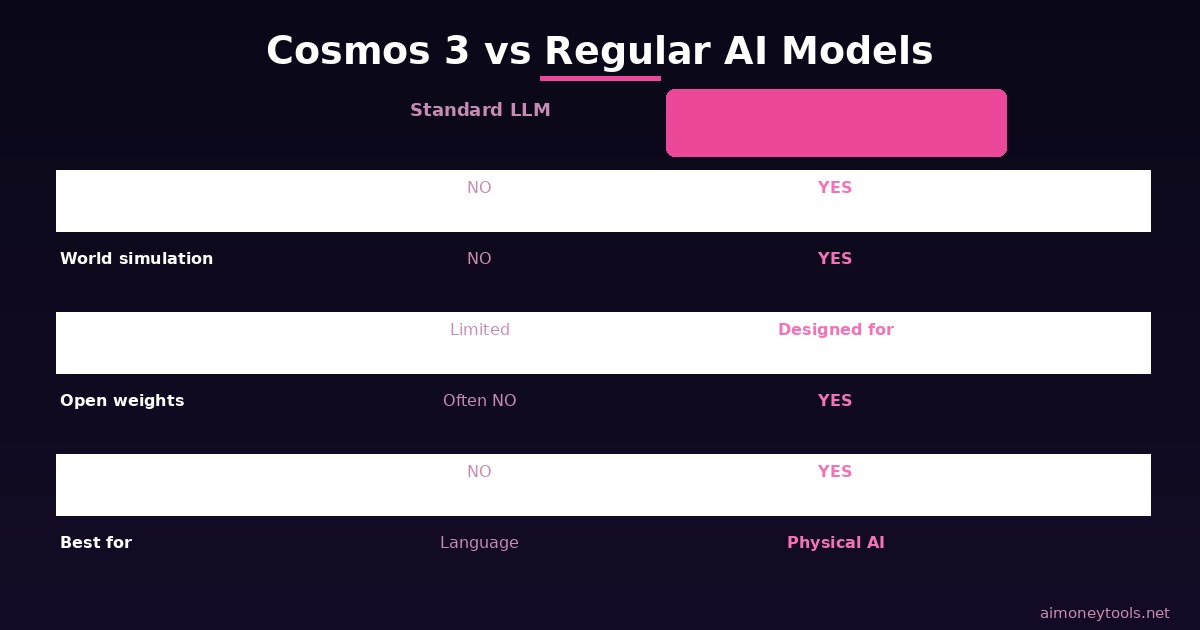
Standard language models like GPT-5 or Claude 4 are trained on text. They can discuss physics but they do not model it. Cosmos 3 is trained on video and sensor data from the real world, giving it a fundamentally different type of understanding.
This is not a comparison between better or worse — they are built for different purposes. ChatGPT is better at writing your emails. Cosmos 3 is better at teaching a robot not to knock things over.
How Cosmos 3 Works: 5 Things to Know

The five core concepts that help explain what makes Cosmos 3 different are covered in the image above. The short version: it is a world simulator, a physics reasoner, and a training platform for physical AI — all in one open-weight model.
The Bigger Picture: Nvidia's AI Strategy
Nvidia made its name selling the hardware that runs AI. CUDA, H100 GPUs, the Blackwell platform — these are the picks and shovels of the AI gold rush.
But the open model releases signal a shift. By building and open-sourcing Cosmos, Nemotron, GR00T, and Alpamayo, Nvidia is:
- Creating demand for its own hardware — the more developers adopt these open models, the more GPU time they need.
- Competing at the model layer — directly with Google, Meta, and Anthropic for developer mind share.
- Owning the physical AI stack — robots, vehicles, and industrial systems are a massive market that none of the language model labs have a strong position in.
This is Nvidia's long game. And for a company that is already the most valuable semiconductor company in history, a long game in physical AI is a credible threat to everyone in the space.
Related Reading
- Claude Opus 4.8 Release: What's New in Anthropic's Latest Model
- Best AI Tools for Content Creators in 2026
- What is an AI Automation Agency? How to Start One in 2026
- How to Make Money with AI in 2026
Frequently Asked Questions
What is Nvidia Cosmos 3?
Nvidia Cosmos 3 is a world foundation model — a type of AI trained to understand and simulate the physical world rather than just language or images. It is designed for robotics, autonomous vehicles, and industrial AI. It is open-weight, meaning developers can download and customize it for free.
What is a world foundation model?
A world foundation model is an AI system trained on real-world video and sensor data to understand how physical environments work — how objects move, interact, and behave over time. Unlike language models, which process text, world foundation models process spatial and temporal information to develop an internal model of physical reality.
Is Nvidia Cosmos 3 free to use?
Yes. Cosmos 3 is open-weight, which means the model weights are publicly available for developers to download and use. There may be commercial licensing terms for certain use cases — check the Nvidia developer portal for the latest license details.
What is the difference between Cosmos 3 and Nemotron 3?
Cosmos 3 is designed for physical AI — robots, vehicles, and real-world simulation. Nemotron 3 is designed for agentic AI — multimodal chatbots, voice assistants, and complex language + vision workflows. They serve different use cases and industries.
Which companies are using Nvidia's new AI models?
Nvidia announced adoption from CodeRabbit, CrowdStrike, Cursor, Factory, ServiceNow, and Perplexity (agentic AI via Nemotron 3), LG Electronics and Milestone Systems (physical AI via Cosmos 3), and Novo Nordisk, Viva Biotech, and Manifold Bio (healthcare AI via BioNeMo).
What is Isaac GR00T N1.7?
Isaac GR00T N1.7 is Nvidia's robotics foundation model. It is the AI component that enables physical robots to learn new tasks, adapt to new environments, and operate more autonomously. Version 1.7 builds on previous GR00T releases with improved reasoning and physical interaction capabilities.
How does this affect AI tools I use today?
Most AI tools you currently use — chatbots, image generators, writing assistants — are not directly affected by Cosmos 3 or GR00T. These models target physical AI applications. However, Nemotron 3 VoiceChat and Omni are relevant to consumer AI: expect more natural voice assistants and multimodal AI tools in 2026 and beyond to use Nemotron-style architectures.
What is Alpamayo 1.5?
Alpamayo 1.5 is Nvidia's physical AI model for autonomous vehicles. It handles perception and reasoning for self-driving systems — predicting the behavior of other vehicles, pedestrians, and road conditions in real time.

Alex the Engineer
•Founder & AI ArchitectSenior software engineer turned AI Agency owner. I build massive, scalable AI workflows and share the exact blueprints, financial models, and code I use to generate automated revenue in 2026.
Related Articles
How to Start an AI-Assisted Resume Writing Side Hustle in 2026 (Beginner's Guide)
A step-by-step guide to using AI resume tools to offer a paid resume and cover letter writing service — what to charge, which tools to use, and how to find your first clients.
How to Build and Sell AI Voice Receptionists to Local Businesses in 2026
A beginner's guide to building AI voice agents that answer business phone calls — the tools to use, what to charge, and how to find your first client.
How to Make Money on Fiverr with AI Tools in 2026: 7 Gigs You Can Start This Week
Discover 7 real Fiverr gigs you can launch using free and low-cost AI tools in 2026 — no experience required. Real pricing data, step-by-step setup, and tools that actually work.