
Google I/O 2026: Every AI Announcement to Expect (May 19 Preview)
Google I/O 2026 is May 19–20. Here's everything expected: Gemini upgrades, Android XR glasses, Aluminum OS, Veo 3, and the agentic AI shift — explained for regular people.
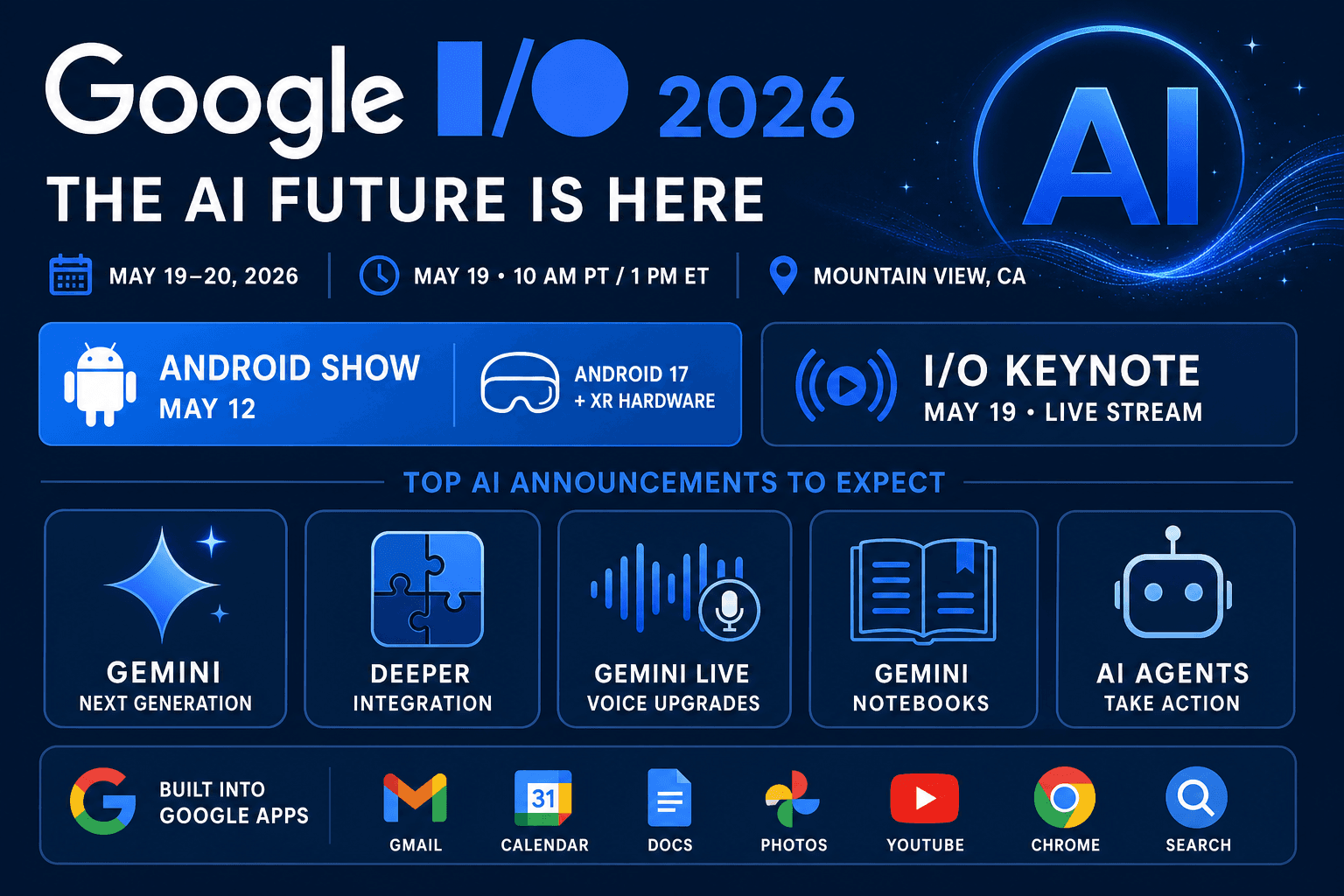
Google I/O is the biggest AI event of the year — and the 2026 edition is one week away.
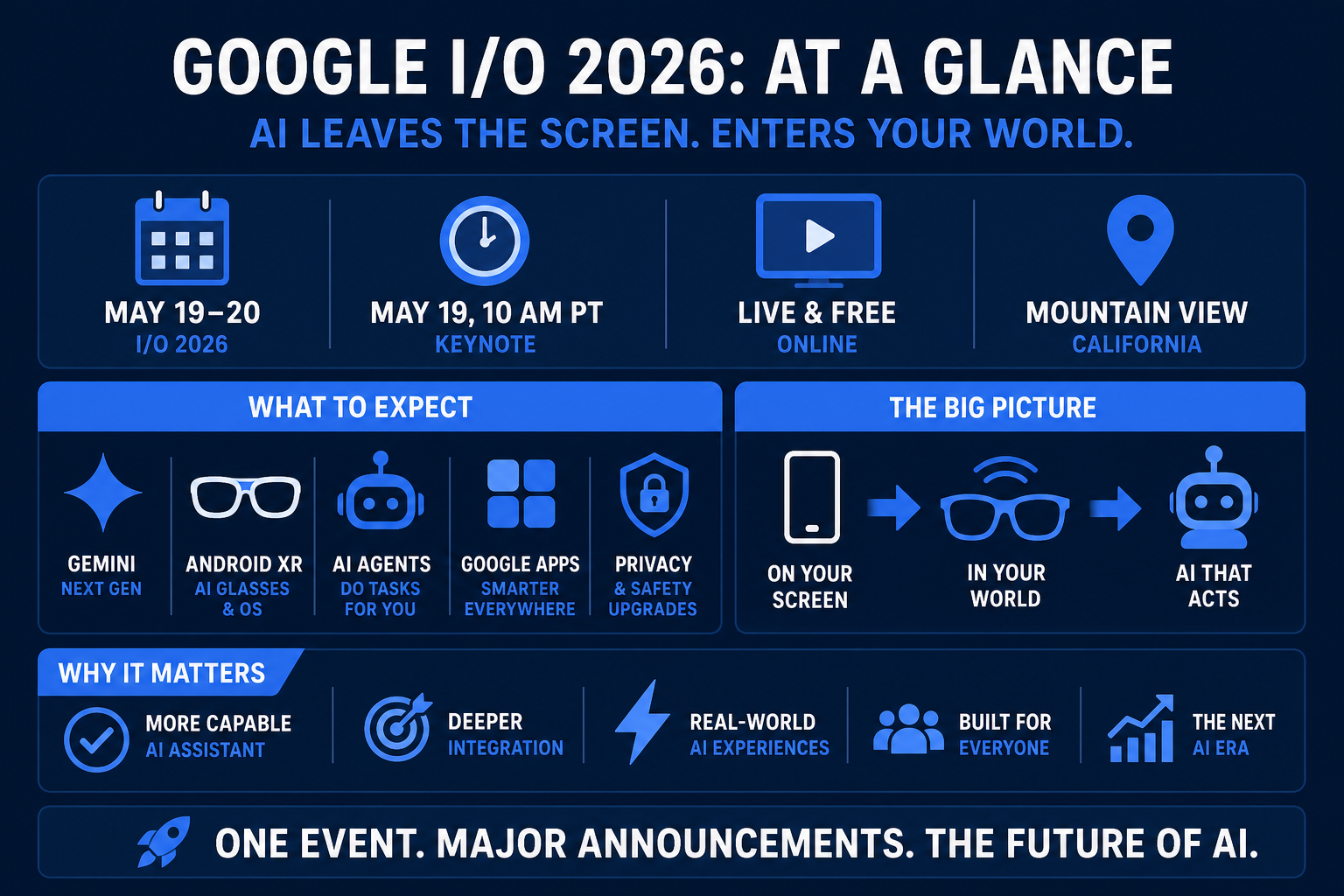
The keynote is scheduled for May 19, 2026, at 10 AM PT / 1 PM ET, live from Google's campus in Mountain View, California. The entire event runs May 19–20, with developer sessions, hands-on labs, and dozens of announcements streaming online for free.
But before the main show, there's a warm-up event: the Android Show streams tomorrow, May 12, focused entirely on Android announcements. If Google's past behavior is any guide, the really big AI news comes May 19 — but May 12 will surface Android 17 details and likely some Android XR hardware.
Here's everything expected, based on confirmed signals and verified reports from CNET, The Verge, and Android Authority.
What Is Google I/O?
Google I/O is Google's annual developer conference. Despite the word "developer" in the description, the announcements almost always impact everyday users — new features in Gmail, Google Search, Google Photos, Android, and whatever Google's biggest AI priority is that year.
Last year's I/O was dominated by Gemini. This year, the theme appears to be AI leaving your screen and entering your physical world — through smart glasses, a new OS, and AI agents that control your computer on your behalf.
If you use Google products (Android, Gmail, Google Docs, YouTube, Chrome), the announcements at I/O 2026 will directly affect the apps you use daily.
1. Gemini — The Next Generation
The centerpiece of every Google announcement since 2024 has been Gemini, Google's AI assistant. At I/O 2026, expect a major Gemini update — likely called either Gemini 4.0 or a 3.x update with a named tier (Ultra, Pro, Flash).
What's expected:
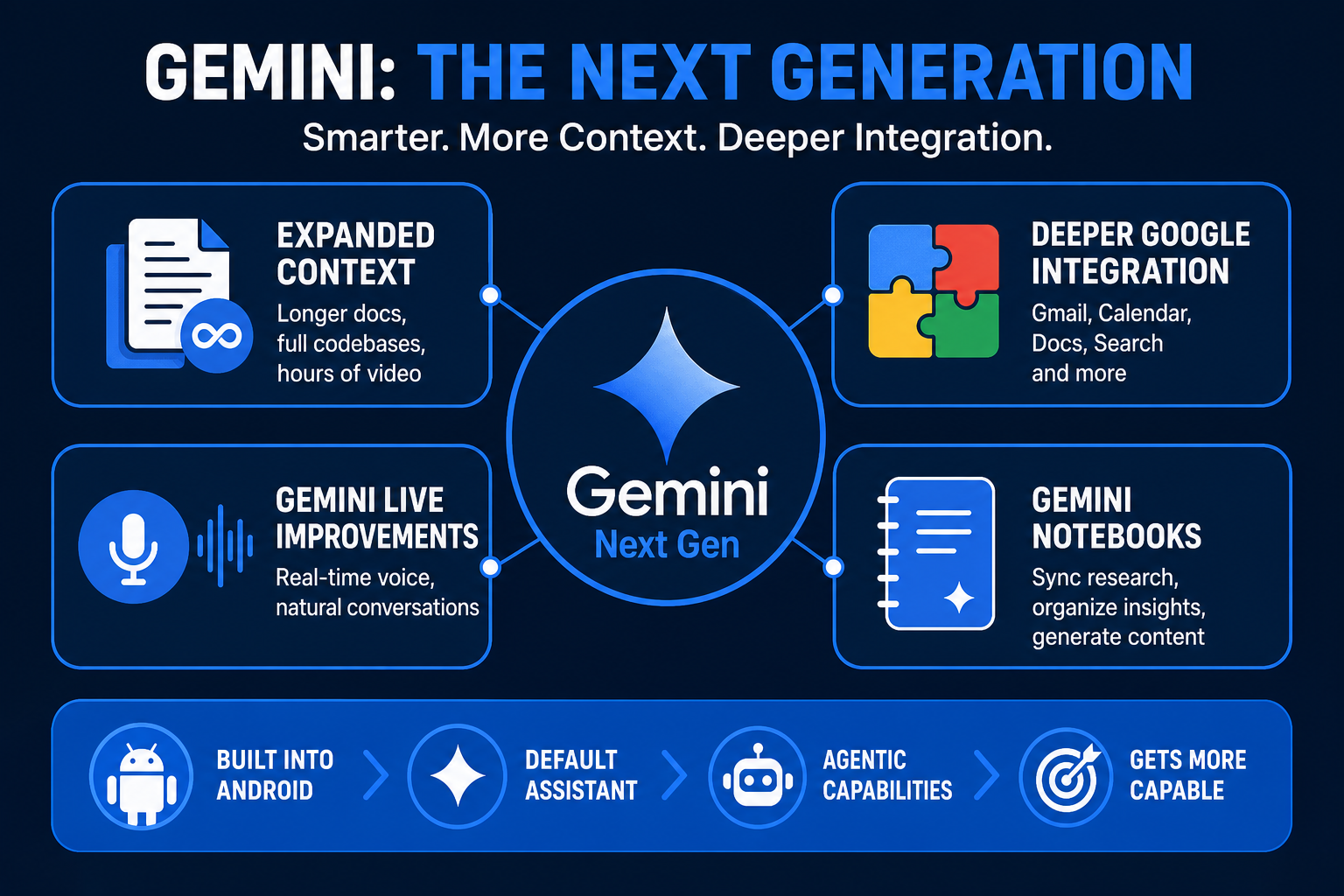
- Expanded context window — processing longer documents, full codebases, hours of video
- Deeper Google product integration — Gemini embedded more deeply into Gmail drafts, Calendar scheduling, Google Docs summarization, and Search
- Gemini Live improvements — the conversational, real-time voice mode that competes with ChatGPT's Advanced Voice
- Gemini Notebooks — a synced research management feature, expected to deepen the NotebookLM integration that already lets you turn any document into a podcast-style audio discussion
Gemini is already built into every Android phone shipped in 2025 and 2026 and is the default assistant replacing Google Assistant. The I/O update will likely make it significantly more capable at agentic tasks — meaning it won't just answer questions, it will do things for you.
2. Agentic AI — The Biggest Shift
The phrase you'll hear constantly at I/O 2026 is agentic AI.
An AI agent isn't a chatbot. It's an AI that can take sequences of actions: open a browser, search for information, fill out a form, schedule a meeting, order something, send a follow-up email — all without you clicking anything after giving the initial instruction.
Google's version is expected to show Gemini controlling your computer's interface directly, completing multi-step tasks that currently require you to switch between tabs, copy-paste between apps, and manually manage workflows.
This is the shift from "AI assistant you talk to" to "AI employee that works for you." For beginners, the practical impact will be felt most in:
- Google Search answering multi-step questions without requiring you to open separate sites
- Gmail drafting full email chains in response to received threads
- Google Calendar coordinating schedules across multiple people automatically
This feature has been in limited beta since early 2026 and Google I/O is where they're expected to announce the broader rollout.
3. Android XR Smart Glasses
Google Glass launched in 2013 and was pulled in 2015. After a decade-long gap, Google is back — and this time the glasses actually look like glasses.
Android XR is Google's platform for smart glasses and mixed reality headsets. Samsung already shipped the first device on Android XR (the Galaxy XR headset), but the consumer-facing smart glasses are expected to be the headline hardware announcement at I/O 2026.
What's confirmed or strongly expected:
- Multiple design partners: Warby Parker, Gentle Monster, and XREAL are reportedly building frames on the Android XR platform
- Gemini Live in your glasses — conversational AI you can speak to hands-free, with responses delivered through a small built-in speaker or bone conduction
- Live translation — real-time subtitles appearing in your field of view as someone speaks in another language
- Heads-up notifications — glanceable alerts without pulling out your phone
- Pricing and availability details for the first consumer wave
The comparison everyone is making is to Meta's Ray-Ban smart glasses — which have sold over 4 million units. Google's version adds Gemini's conversational AI on top of the hardware Meta already proved people will wear.
4. Android 17 — What's New
The dedicated Android Show (May 12, tomorrow) will cover most of the Android 17 news before the main keynote.
Android 17 is currently in Beta 4 and is expected to hit final release in June or July 2026. Key feature already confirmed:
- App Bubbles — float any app in a small resizable window that stays on top of whatever else you're doing. Works like Facebook Messenger's chat heads but for any app. Useful for quick Google Translate, calculator, note-taking, or AI chat access without leaving your current app.
Other expected Android 17 additions:
- Improved Gemini integration at the OS level (accessing any app, reading any screen)
- Privacy controls for AI features
- Better battery management for AI background tasks
- Satellite connectivity features for Android phones with compatible hardware
Google has described 2026 as "one of the biggest years for Android yet" — which is either genuine or their standard I/O hype. Based on the scope of Android XR, Aluminum OS, and AI agent features, the claim holds up more than usual.
5. Aluminum OS — Android and ChromeOS Merging
This is the sleeper announcement most people outside tech circles haven't heard about yet.
Aluminum OS is Google's new operating system that merges Android and ChromeOS into a single unified platform. The result: laptops that run the full Android app library alongside complete Chrome browsing — and phones that connect seamlessly to the same system.
What this means practically:
- Any Android app that runs on your phone could run on a Chromebook or future Google laptop
- No more separate ecosystems — Google apps, Android apps, and web apps in one environment
- Possible return of Google-branded Pixelbook laptops running Aluminum OS
The Pixelbook line was discontinued in 2022. If Google is reviving it as a unified Android/Chrome device, it would compete directly with Apple's MacBook (which runs both macOS apps and iPhone apps on M-series chips) and Microsoft's Copilot+ PCs.
6. Veo, Lyria, and Beam
Beyond the headline announcements, expect Google to update its AI creative tools:
Veo — Google's AI video generation model. Veo 2 already generates high-quality 60-second videos from text prompts, competing with OpenAI's Sora and Meta's Movie Gen. At I/O 2026, expect longer clips, better motion coherence, and integration into YouTube Studio for creators. Possible YouTube Shorts integration.
Lyria — Google's AI music generation model. Lyria creates full tracks from text descriptions ("upbeat acoustic guitar for a travel vlog"). Expect higher fidelity, new styles, and potential integration into YouTube's music tools.
Beam — A 3D video conferencing tool that renders meeting participants as lifelike 3D models on a screen in front of you. The effect is closer to holographic video calls than traditional flat grid views. Expect a consumer version announcement and possibly an integration with Google Meet.
What This Means for Beginners
If you've been casually following AI but don't have a developer background, here's the plain-English version of what I/O 2026 means for you:
Gemini will get smarter and more useful. If you already use it in Gmail or Google Search, expect noticeably better answers and the ability to hand off longer, more complex tasks.
AI will start doing things, not just answering questions. The agentic shift means Google's AI features will be able to take multi-step actions on your behalf — booking things, summarizing emails, filling forms — with your permission.
Android phones are getting smarter. AI features that were in limited beta throughout 2025 and early 2026 will become standard features in Android 17.
Smart glasses are coming back, and they might actually work. If the hardware partners and Gemini integration deliver what's been promised, AI glasses could be the first piece of new hardware most people seriously consider since AirPods.
Your laptop world is about to change — if Aluminum OS delivers on its promise, the line between phone and laptop blurs in a way it hasn't since the original iPad.
How to Watch Google I/O 2026
- Android Show: May 12, 2026 (streaming online — check android.com)
- I/O Keynote: May 19, 2026 at 10 AM PT / 1 PM ET — free livestream at io.google/2026
- Developer Sessions: May 19–20, fully online
- No in-person tickets required — everything is livestreamed and sessions are posted on YouTube after the event
For the best highlights without sitting through 2+ hours of keynote: check Google's summary page or our follow-up article on May 19 with everything actually announced, ranked by what matters most for regular users.
FAQ
Q: What is Google I/O?
A: Google's annual developer conference where they announce new products, AI features, and updates to Android, Google Search, and all Google apps. Free to watch online. Typically the biggest AI announcement event of Google's year.
Q: When is Google I/O 2026?
A: The keynote is May 19, 2026 at 10 AM PT. The full event runs May 19–20. A separate Android Show preview streams May 12.
Q: Will Gemini 4.0 be announced at Google I/O 2026?
A: Likely, though the exact naming isn't confirmed. Expect a major Gemini update — possibly Gemini 4, possibly a named tier upgrade (Ultra, Pro). Google has been releasing Gemini updates approximately every 6–9 months.
Q: What are Android XR smart glasses?
A: Smart glasses running Google's Android XR platform, with Gemini Live AI built in. They look like regular glasses (partnered with Warby Parker, Gentle Monster, XREAL) and can provide live translation, AI assistance, and notifications in your field of view.
Q: What is Aluminum OS?
A: Google's upcoming merger of Android and ChromeOS into one unified operating system. Lets Android apps run on laptops and creates a single ecosystem across phones, tablets, and computers — similar to how Apple's M-chip Macs run iPhone apps.
Q: Is Google I/O free to attend?
A: It's fully online and free to watch. In-person tickets exist but are not required. All sessions are livestreamed and posted on YouTube.
Q: How does this affect regular Google users (not developers)?
A: Directly. Android 17 rolls out to your phone. Gemini gets smarter in Gmail, Search, and Google Docs. Smart glasses and Aluminum OS may affect your hardware choices later this year. The agentic AI features will appear in everyday Google products throughout H2 2026.

Alex the Engineer
•Founder & AI ArchitectSenior software engineer turned AI Agency owner. I build massive, scalable AI workflows and share the exact blueprints, financial models, and code I use to generate automated revenue in 2026.
Related Articles
How to Start an AI-Assisted Resume Writing Side Hustle in 2026 (Beginner's Guide)
A step-by-step guide to using AI resume tools to offer a paid resume and cover letter writing service — what to charge, which tools to use, and how to find your first clients.
How to Build and Sell AI Voice Receptionists to Local Businesses in 2026
A beginner's guide to building AI voice agents that answer business phone calls — the tools to use, what to charge, and how to find your first client.
How to Make Money on Fiverr with AI Tools in 2026: 7 Gigs You Can Start This Week
Discover 7 real Fiverr gigs you can launch using free and low-cost AI tools in 2026 — no experience required. Real pricing data, step-by-step setup, and tools that actually work.