
GLM-5.2: The Free Open-Source AI Model That Just Beat GPT-5.5 on Coding
GLM-5.2 from Zhipu AI just topped the AI leaderboard with MIT-licensed open weights you can download and use for free. Here's what it can do, how it compares to GPT-5.5 and Claude, and how to start using it today.
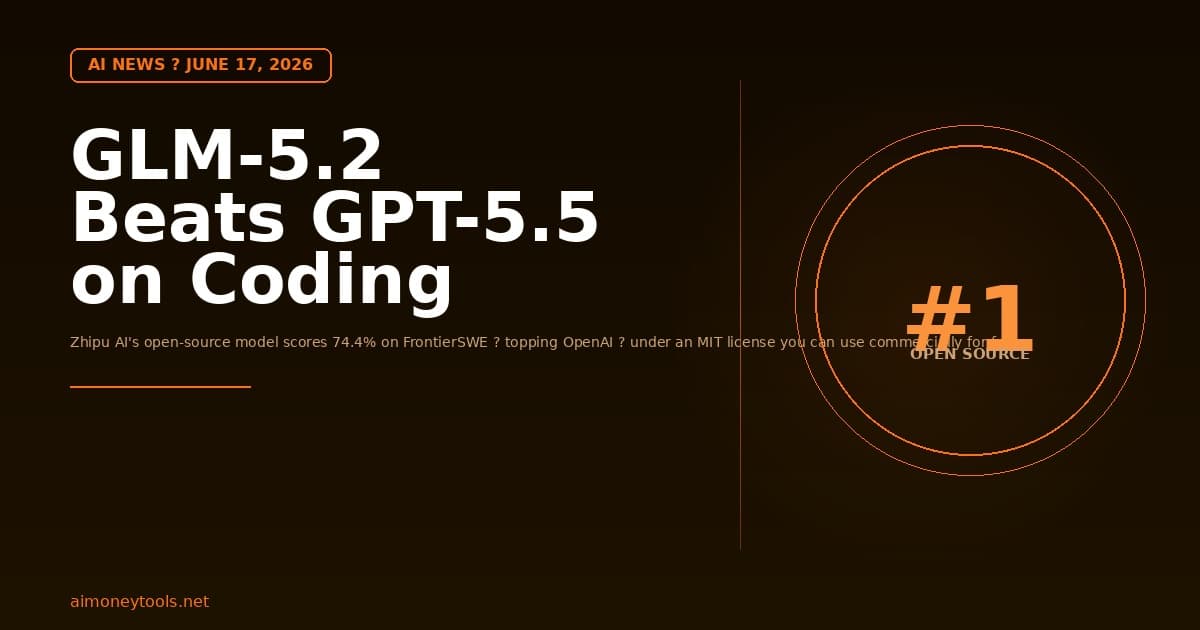
A new open-source AI model dropped this week and it immediately shot to the top of Hacker News. GLM-5.2 from Chinese lab Zhipu AI is now beating GPT-5.5 on the coding benchmark most developers actually care about — and you can download it for free under an MIT license that lets you use it commercially without paying anyone.
Here is what you need to know.
What Is GLM-5.2?
GLM-5.2 is a large language model (LLM) developed by Zhipu AI, a Beijing-based AI company spun out of Tsinghua University. The model was released June 13, 2026, with full open weights becoming available on HuggingFace and ModelScope — meaning anyone can download the actual trained model and run it themselves.
The "GLM" series has been quietly improving for years, but GLM-5.2 is the first version that stands up directly against the leading closed models from OpenAI and Anthropic. It is specifically designed for coding and what researchers call "long-horizon tasks" — meaning tasks that require many steps, a lot of context, and sustained reasoning, rather than quick single answers.
GLM-5.2 is licensed under the MIT License, which is the most permissive open-source license available. You can use it commercially, modify it, and build products on top of it — for free, with no restrictions based on where you live.
Why GLM-5.2 Is a Big Deal
It Edged Out GPT-5.5 on the Most Respected Coding Benchmark
FrontierSWE is the benchmark AI researchers currently consider the most realistic test of a model's ability to handle actual software engineering — not toy problems, but real bugs and codebases from GitHub repositories.
GLM-5.2 scored 74.4% on FrontierSWE. GPT-5.5 scored 72.6%. Claude Opus 4.8 still leads at roughly 75%, but GLM-5.2 is within 1% of the top.
This is the first time an open-source model has cracked the top 3 on this benchmark. Every other model above GLM-5.2 on FrontierSWE is closed-source and costs money to access.
On SWE-Bench Pro — a similar benchmark — GLM-5.2 scores 62.1%, up from GLM-5.1's 58.4%. On DeepSWE, it jumped from 18.0 to 46.2 — a 157% improvement over its predecessor.
These numbers matter if you use AI for coding. They mean GLM-5.2 can handle complex debugging, multi-file refactoring, and agentic tasks at a level that was exclusively available from paid services until now.
1 Million Token Context Window
The context window is how much text an AI can "read" in a single conversation before it starts forgetting earlier parts. GLM-5.2 supports a 1-million-token context window — approximately 750,000 words, or roughly 15 full-length novels in a single session.
For practical use, this means you can paste in an entire codebase, a full legal contract, or a year's worth of business documents and ask questions across the whole thing. GLM-5.1 topped out at 200K tokens; GLM-5.2 is 5x larger.
Two Thinking Modes
GLM-5.2 offers two reasoning effort levels:
- High — faster, good for most tasks
- Max — slower, deeper reasoning, recommended for complex multi-step coding tasks
This mirrors what OpenAI does with GPT-5.5's "extended thinking" mode, but it is available in a model you can run on your own hardware.
MIT License — No Regional Restrictions
Many open-source AI models come with strings attached. Meta's Llama models, for example, have commercial use limits above a certain number of users. Some Chinese AI models restrict distribution to certain countries.
GLM-5.2 uses a strict MIT license with "no regional limits or technical access restrictions" according to Zhipu AI's release. That means a freelancer in Toronto, a startup in Lagos, and a solo developer in Manila can all use it commercially without legal ambiguity.
GLM-5.2 vs GPT-5.5 vs Claude Opus 4.8
Here is how the models stack up on the benchmarks that matter for coding and long-horizon tasks:
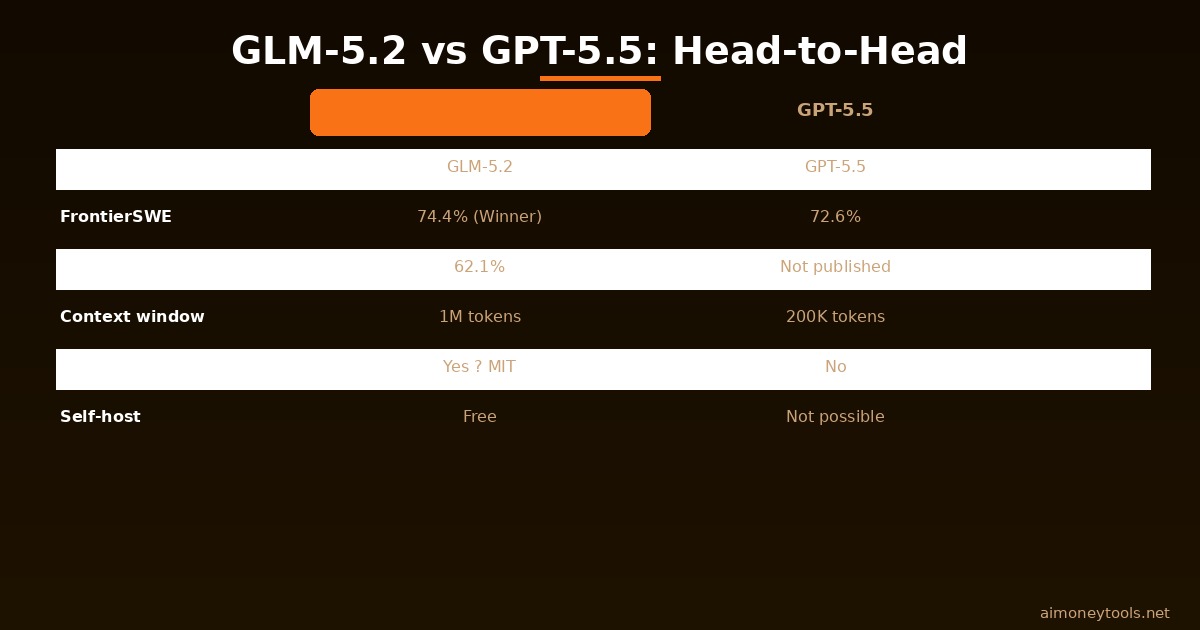
| Benchmark | GLM-5.2 | GPT-5.5 | Claude Opus 4.8 |
|---|---|---|---|
| FrontierSWE | 74.4% | 72.6% | ~75% |
| SWE-Bench Pro | 62.1% | — | — |
| Terminal-Bench 2.1 | 81.0 | — | 85.0 |
| DeepSWE | 46.2 | — | — |
| Context Window | 1M tokens | 200K | 200K |
| Open Source | Yes (MIT) | No | No |
| Cost | Free (self-hosted) | Pay-per-use | Pay-per-use |
| API access | Z.ai pricing | OpenAI pricing | Anthropic pricing |
The honest picture: Claude Opus 4.8 is still slightly better at coding. GPT-5.5 is still better at general tasks and reasoning. But GLM-5.2 is genuinely competitive — and it is the only model in this tier you can run locally for free.
How to Use GLM-5.2 — 3 Ways

Option 1: Z.ai API (Easiest for Beginners)
Zhipu AI offers GLM-5.2 through its API at z.ai. Pricing is the same as GLM-5.1, which was competitive with GPT-5.5 — typically cheaper per token than OpenAI.
How to get started:
- Go to z.ai and create an account
- Generate an API key in the dashboard
- Make API calls to
https://open.bigmodel.cn/api/paas/v4/chat/completions - Set the model name to
glm-5.2orglm-5.2[1m]for the 1M context version
The API is compatible with tools that support the OpenAI API format, including Cursor, Cline, and OpenCode. If you already use an AI coding assistant, you can often swap in GLM-5.2 by changing one line in the config.
Option 2: Run GLM-5.2 Locally
If you want to run GLM-5.2 on your own machine — completely free, no API costs — you can download the weights from HuggingFace and run them with one of the supported inference frameworks:
- vLLM (recommended for servers and high throughput)
- SGLang (best for agentic and multi-turn tasks)
- transformers (standard HuggingFace library — simplest to start)
Be aware: running a frontier-class model locally requires a serious GPU. The full GLM-5.2 weights require approximately 140GB of VRAM in full precision. You can run quantized versions (4-bit or 8-bit) with less — roughly 35–70GB — but you will see some performance reduction on the hardest tasks.
If you are curious about what GPU you actually need for local AI, our guide to checking your VRAM for AI covers what to look for.
Tools like LM Studio can load quantized versions of GLM-5.2 through a simple desktop interface if you do not want to work with the command line.
Option 3: Chat Interface at Z.ai
Z.ai has a web-based chat interface similar to Claude.ai or ChatGPT. You can try GLM-5.2 directly in the browser without setting up any API keys or downloading anything.
Go to z.ai, sign up, and select GLM-5.2 from the model dropdown. Free tier access is available. This is the fastest way to test what GLM-5.2 can do before committing to the API.
Who Should Switch to GLM-5.2?
You are a developer using Cursor or a similar AI coding tool and you pay per token. GLM-5.2's API pricing is competitive and its coding performance is near the top of the leaderboard. Worth testing as a drop-in replacement — especially for long context tasks where the 1M window helps.
You are building a product and OpenAI's terms or pricing are a concern. MIT license means you can embed GLM-5.2 in a product you sell without licensing restrictions. No revenue caps, no geographic restrictions.
You want to run AI locally without paying monthly fees. GLM-5.2 is the strongest open-source coding model available as of June 2026. If you have the GPU hardware, it is a clear upgrade from earlier open models.
You are a beginner just exploring AI. The Z.ai chat interface is a clean way to try a frontier-class model for free. The fact that it is open-source also means there is no vendor lock-in — the model exists independently of any company's pricing decisions.
You should probably stick with Claude or GPT-5.5 if: you need the absolute best performance on general reasoning tasks (not just coding), you rely on features like image generation, voice, or deep integration with other tools, or you need enterprise-grade support.
Context: Why This Launch Matters Beyond the Benchmarks
The timing of GLM-5.2's release is worth noting. It launched on June 13, 2026 — the same day the US government's export control order took Claude Fable 5 and Claude Mythos 5 offline globally.
Several AI researchers publicly pointed out the contrast: the most capable closed AI in the world was pulled from global access by government order, and within 24 hours an open-source alternative — that no government can pull from a centralized server — went to the top of the coding leaderboard.
This is the argument Zhipu AI has been making: open-source frontier AI is both possible and important. GLM-5.2's MIT license is an explicit statement that a top-tier AI model should be freely accessible regardless of geography or geopolitics.
Whether you find that argument compelling or not, the result is real: as of June 17, 2026, the most capable freely available AI model for coding tasks is GLM-5.2, and it can be downloaded and used today.
Frequently Asked Questions
What is GLM-5.2? GLM-5.2 is an open-source large language model from Zhipu AI (Z.ai), released in June 2026 under an MIT license. It is designed for coding and long-horizon tasks, with a 1-million-token context window and benchmark scores competitive with GPT-5.5.
Is GLM-5.2 free to use? The model weights are free to download and run on your own hardware under an MIT license with no commercial restrictions. Z.ai also offers paid API access with usage-based pricing, and a free-tier chat interface at z.ai.
How does GLM-5.2 compare to GPT-5.5? On FrontierSWE (coding benchmark), GLM-5.2 scored 74.4% vs GPT-5.5's 72.6%. For general reasoning and non-coding tasks, GPT-5.5 is still ahead. GLM-5.2 also offers a larger context window (1M tokens vs 200K for GPT-5.5) and can be run locally for free.
Can I use GLM-5.2 commercially? Yes. The MIT license allows commercial use without restrictions, revenue caps, or regional limits.
Where do I download GLM-5.2? The model weights are on HuggingFace and ModelScope, searchable as GLM-5.2 or under the Zhipu AI organization page.
Does GLM-5.2 work with Cursor? Yes. GLM-5.2's API is compatible with tools that support the OpenAI API format. You can configure Cursor or similar AI coding tools to use GLM-5.2 by pointing them to Z.ai's API endpoint.
What GPU do I need to run GLM-5.2 locally? The full model requires approximately 140GB of VRAM. Quantized versions (4-bit) run in roughly 35–40GB. Consumer GPUs like the RTX 4090 (24GB) can run small quantized versions; for the full model you need a server-grade setup. Check our VRAM guide for specifics on what hardware you need.
What is the GLM-5.2 context window?
1 million tokens, available through the glm-5.2[1m] model variant. This is approximately 5× larger than GLM-5.1 and larger than any closed model currently available from OpenAI or Anthropic.
How is GLM-5.2 different from DeepSeek? Both are Chinese open-source models with MIT-style licenses. DeepSeek R2 focuses on reasoning and mathematical tasks; GLM-5.2 focuses on long-horizon coding and agentic tasks. Both are worth benchmarking for your specific use case.
Is Zhipu AI a reliable company? Zhipu AI was founded in 2019, is backed by Alibaba and Tencent, and was spun out of Tsinghua University's Knowledge Engineering Group. The GLM series has been consistently improving for several years. The company is publicly listed on the Chinese A-share market.

Alex the Engineer
•Founder & AI ArchitectSenior software engineer turned AI Agency owner. I build massive, scalable AI workflows and share the exact blueprints, financial models, and code I use to generate automated revenue in 2026.
Related Articles
How to Start an AI-Assisted Resume Writing Side Hustle in 2026 (Beginner's Guide)
A step-by-step guide to using AI resume tools to offer a paid resume and cover letter writing service — what to charge, which tools to use, and how to find your first clients.
How to Build and Sell AI Voice Receptionists to Local Businesses in 2026
A beginner's guide to building AI voice agents that answer business phone calls — the tools to use, what to charge, and how to find your first client.
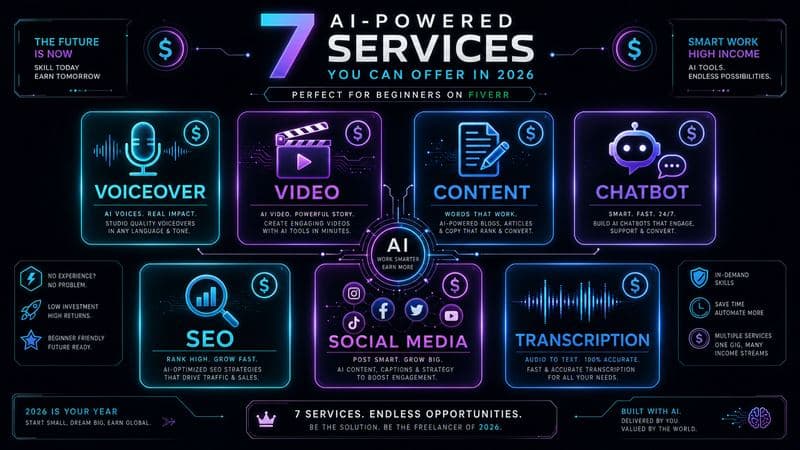
How to Make Money on Fiverr with AI Tools in 2026: 7 Gigs You Can Start This Week
Discover 7 real Fiverr gigs you can launch using free and low-cost AI tools in 2026 — no experience required. Real pricing data, step-by-step setup, and tools that actually work.