
9 Essential Blog Tools for Success in 2026
Master your workflow with 9 essential blog tools for 2026. Learn how to use AI, SEO, and automation to grow your traffic and income effectively.
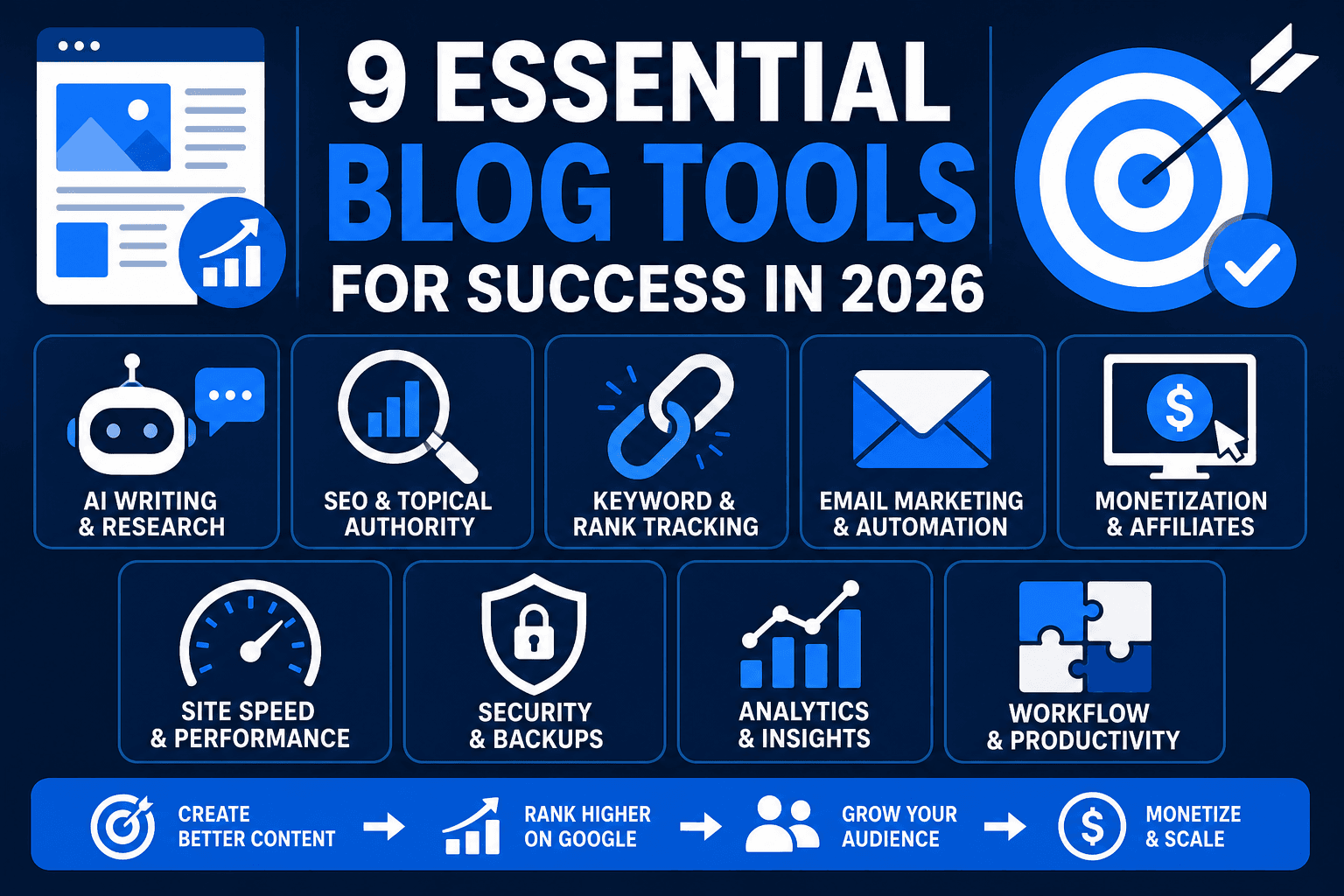
Running a profitable blog in 2026 requires more than good writing. The tools you use determine how much content you produce, how well it ranks, and how efficiently you convert readers into income. This guide covers nine categories of tools that working bloggers actually use — with specific recommendations in each area.
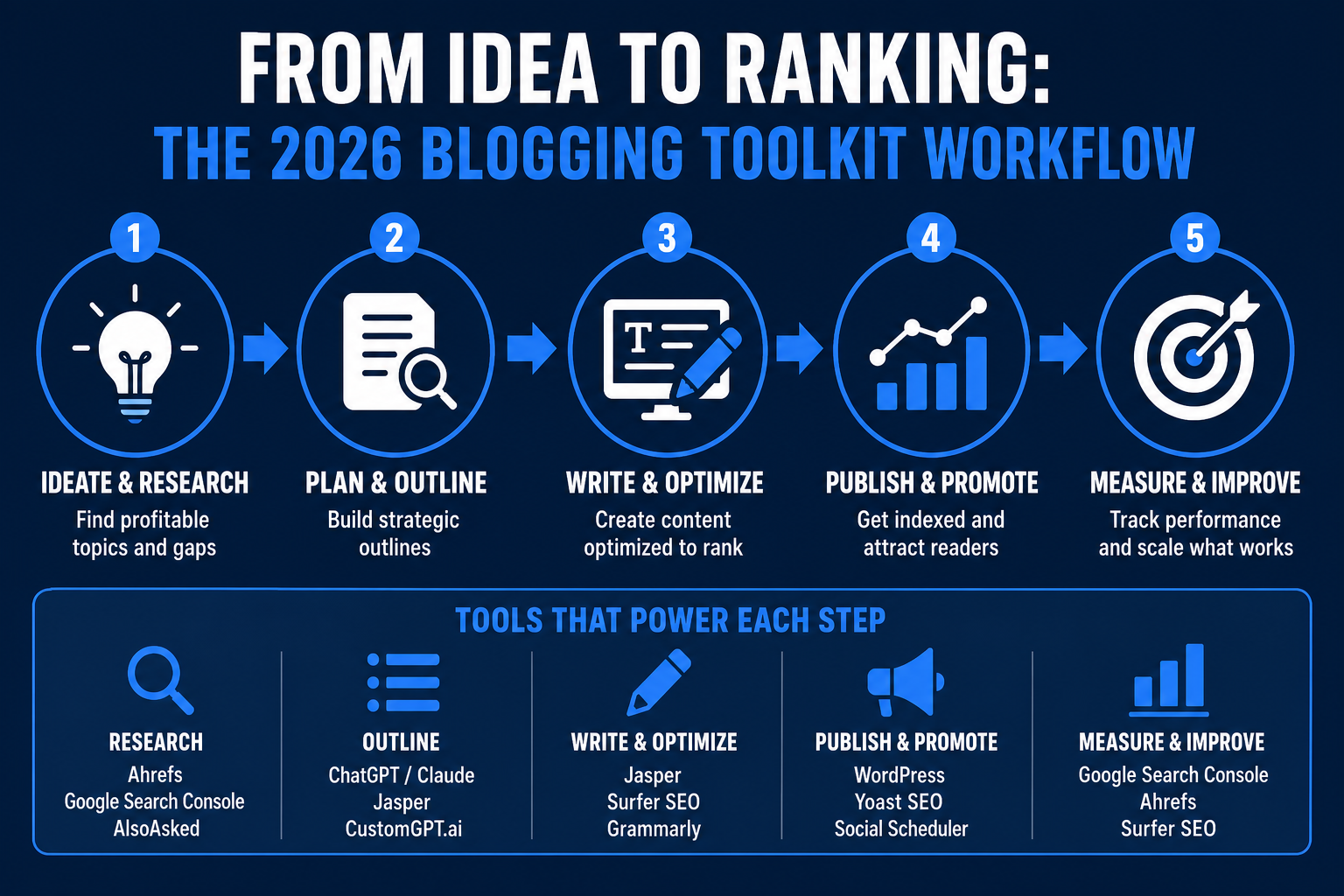
1. AI Writing and Research Assistants
AI writing tools have moved well past basic "generate a blog post" functionality. The useful version of these tools in 2026 is integrated research, brand voice training, and iterative editing — not single-click content generation.
Jasper offers brand voice training that analyzes your existing content and replicates your style in new drafts. The SEO mode integrates with Surfer to pull real-time keyword guidance into the editor. Best for blogs producing 10+ posts per month.
Claude and ChatGPT remain the strongest tools for research summarization, outline generation, and rewriting specific sections. The optimal workflow: use AI for first-draft structure and paragraph generation, then rewrite with your own voice and add original examples and data.
CustomGPT.ai adds a different angle — it builds an AI assistant trained on your own blog archive. This is useful for internal consistency (avoiding contradictions between old and new posts) and for answering reader questions automatically.
Practical tip: Never publish raw AI output. Use it for speed on structure and first drafts. Your voice, examples, and judgment are what Google's quality assessment systems reward.
2. SEO and Topical Authority Platforms
In 2026, ranking for competitive keywords requires topical authority — covering a subject cluster deeply rather than targeting isolated keywords. The tools that matter are the ones that help you identify cluster gaps.
Surfer SEO analyzes the top-ranking pages for any keyword and shows exactly what topics, entities, and word counts correlate with ranking. The Content Editor grades your post in real time as you write. Combining Surfer with AI writing tools creates a strong quality + depth pipeline.
Ahrefs remains the best tool for competitive analysis, backlink research, and identifying which keywords your site can realistically rank for given your current domain authority.
Google Search Console is free and essential. Check it weekly for your top queries, position changes, and which pages are "discovered but not indexed" — often a content quality signal worth acting on.
For generative search optimization (showing up in AI overviews and ChatGPT answers), see the GEO guide and AEO guide.
3. Workflow Automation and Scheduling
Manual task management kills productivity at scale. Every post requires the same set of sub-tasks: brief creation, image sourcing, formatting, internal linking, scheduling, and promotion. Automating the repeatable parts frees time for the work only you can do.
Notion works well as a content calendar that doubles as a project tracker. Set up a database with status fields (Idea → Briefed → Draft → Edited → Scheduled → Published) and use the board view to see your pipeline.
n8n handles automation between tools — automatically creating a Notion task when a keyword passes a GSC threshold, posting to social when an article goes live, or sending a Slack notification when a page drops in ranking. Self-hosted and free.
Buffer handles social distribution. Queue posts across platforms from one dashboard. The AI assistant feature suggests captions based on article summaries.
4. Email Newsletter and Audience Building
Organic search traffic is rented — algorithm updates can cut it overnight. An email list is yours. Every successful blogger treats email as infrastructure, not optional.
Beehiiv has emerged as the strongest platform for monetized newsletters in 2026. Built-in ad network, paid subscription management, referral program, and analytics all in one tool. Free up to 2,500 subscribers.
ConvertKit / Kit is still the standard for course creators and bloggers with complex automation sequences — welcome series, tag-based segmentation, and conditional email flows. Stronger automation than Beehiiv; weaker native monetization.
What to send: Don't just republish your posts. Add context, commentary, or a "what I didn't say in the article" section. Readers who open an email newsletter are 3–5x more engaged than social media followers — treat them accordingly.
5. Hosting and Site Performance
Core Web Vitals are a confirmed ranking factor. A slow site directly hurts your SEO and increases bounce rate before a reader even reads the first paragraph.
Vercel and Netlify are the fastest static site hosts available. For Next.js or static site generator blogs, both offer free tiers and edge CDN deployment that puts your content close to every reader globally.
WPX Hosting is the best managed WordPress host for Core Web Vitals performance — consistent sub-1s TTFB, included CDN, and fast support.
The minimum acceptable standard in 2026: Largest Contentful Paint under 2.5 seconds, Cumulative Layout Shift under 0.1, First Input Delay under 100ms. Check your scores at pagespeed.web.dev.
6. Visual Content and Design
Blog posts with custom visuals consistently outperform text-only posts in dwell time, social shares, and backlink acquisition. The tools to produce them efficiently:
Canva covers 95% of blogger design needs: featured images, infographics, social cards, and embedded diagrams. The AI Magic Design feature generates complete layout options from a text prompt. The brand kit keeps colors, fonts, and logos consistent across all content.
Midjourney produces photorealistic and stylized images from text prompts. Best for featured images with a distinctive aesthetic rather than screenshots or data visualizations.
Infographics specifically: A single well-designed infographic can generate passive backlinks for years if it visualizes data that no other resource covers. Build one for your highest-traffic article first.
7. Security, Privacy, and Technical Compliance
In 2026, GDPR and data privacy laws are enforced with real consequences in the US and EU. Bloggers collecting email addresses, running ads, or using analytics are collecting user data — and that requires correct disclosure and consent tools.
Termly generates legally compliant privacy policies, cookie consent banners, and terms of service pages. Free tier covers basic compliance for most blogs.
Cloudflare provides DDoS protection, SSL, and bot mitigation on the free plan. Essential if you're running any kind of monetized site — a brief outage during a traffic spike from a viral post can cost you readers and revenue.
Two-factor authentication on your hosting, CMS, and domain registrar accounts is non-negotiable. Blog account takeovers and content injection attacks are real threats.
8. Analytics and Revenue Tracking
You can't improve what you don't measure. The baseline analytics stack for a monetized blog:
Google Analytics 4 — traffic sources, session duration, conversion events, and audience demographics. The events model requires a bit of setup but gives you detailed behavior data across your whole site.
Google Search Console — organic search specifically. Tells you which queries are driving impressions vs. clicks, which pages have indexing issues, and where your click-through rate has room to improve.
MonsterInsights (for WordPress) bridges GA4 into a readable dashboard inside your WordPress admin — useful if GA4's native interface is too complex for regular use.
For affiliate revenue: most affiliate dashboards (ShareASale, CJ, individual programs) provide their own reporting. Build a simple monthly spreadsheet that tracks revenue by channel (AdSense, affiliate program A, affiliate program B, sponsorships) so you know which content type drives the most income.
9. Affiliate and Monetization Management
Monetization without tracking is guesswork. Two tools that make a real difference:
Pretty Links (WordPress) or a simple redirect folder on Vercel handles affiliate link management. Cloaking long affiliate URLs keeps content cleaner and makes it easy to swap out a dead affiliate link across hundreds of posts in one change.
Lasso is the strongest affiliate management plugin for WordPress in 2026 — automated product cards, broken link detection, and side-by-side comparison tables that convert at higher rates than plain text links. The ROI tracking feature shows which articles generate the most affiliate revenue.
For new bloggers, the affiliate programs with the best combination of conversion rate and commission:
- AI tool programs (CustomGPT, Jasper, Murf) — high ticket, SaaS recurring commissions
- Web hosting (WPX, Kinsta) — high one-time payouts ($100–$200 per referral)
- Course platforms (Teachable, Kajabi) — 30% recurring on referred sellers
Building the Stack Without Burning Your Budget
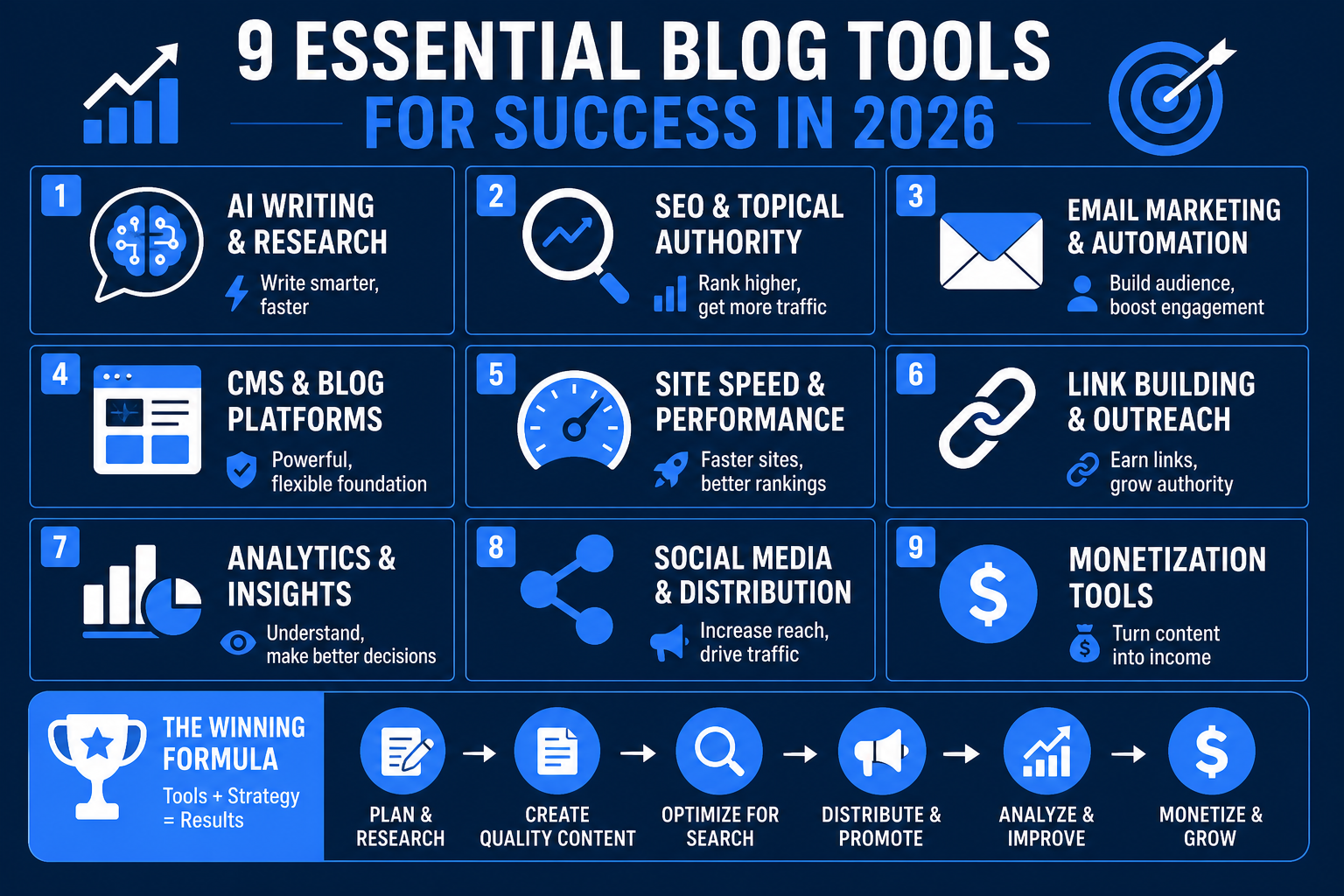
You don't need all nine categories on day one. A sensible build order:
Month 1: Google Search Console (free) + Canva free + Beehiiv free + Cloudflare free.
Month 2–3: Add SurferSEO or Ahrefs once you have enough content to analyze (minimum 20 posts). Add Jasper or Claude once you're producing more than one post per week.
Month 4+: Add Lasso once you have affiliate links generating enough traffic to track. Add n8n automation once your workflow is repeatable enough to automate.
The tools above pay for themselves when content output increases — don't spend money on SEO software before you have content to optimize.
Frequently Asked Questions
What is the single most important blog tool? Google Search Console. It's free, and it tells you exactly how Google sees your site — which pages are indexed, which queries are driving impressions, and where you have obvious opportunities to improve.
Do I need all these tools from the start? No. Start with the free tier of essential tools (GSC, Canva, Beehiiv, Cloudflare). Add paid tools once your content volume justifies the investment.
Is Wordpress still worth using in 2026? Yes for most bloggers — the plugin ecosystem is unmatched for monetization (Lasso, Pretty Links, affiliate management). Static site frameworks (Next.js, Astro) are faster and more flexible but require technical comfort. Choose based on your skills, not what's trendy.
How do AI writing tools affect Google rankings? Google's stated position is that well-written, helpful content ranks regardless of how it was produced. The issue is quality — thin, generic AI content doesn't rank. Edited, specific, experience-backed content does. The tool isn't the variable; the quality is.
What's the fastest way to monetize a new blog? Affiliate links from the first post, combined with email list building. Ad networks require traffic thresholds (Mediavine: 50,000 sessions/month). Affiliates pay from the first click if your content targets commercial-intent keywords.

Alex the Engineer
•Founder & AI ArchitectSenior software engineer turned AI Agency owner. I build massive, scalable AI workflows and share the exact blueprints, financial models, and code I use to generate automated revenue in 2026.
Related Articles

How to Start an AI-Assisted Resume Writing Side Hustle in 2026 (Beginner's Guide)
A step-by-step guide to using AI resume tools to offer a paid resume and cover letter writing service — what to charge, which tools to use, and how to find your first clients.

How to Build and Sell AI Voice Receptionists to Local Businesses in 2026
A beginner's guide to building AI voice agents that answer business phone calls — the tools to use, what to charge, and how to find your first client.
How to Make Money on Fiverr with AI Tools in 2026: 7 Gigs You Can Start This Week
Discover 7 real Fiverr gigs you can launch using free and low-cost AI tools in 2026 — no experience required. Real pricing data, step-by-step setup, and tools that actually work.