
Android Show I/O Edition 2026: Everything Google Is Announcing Today
Google's Android Show: I/O Edition streams today, May 12. Here's what to expect — Android 17 App Bubbles, Gemini updates, Aluminium OS debut, Android XR, and how to watch.
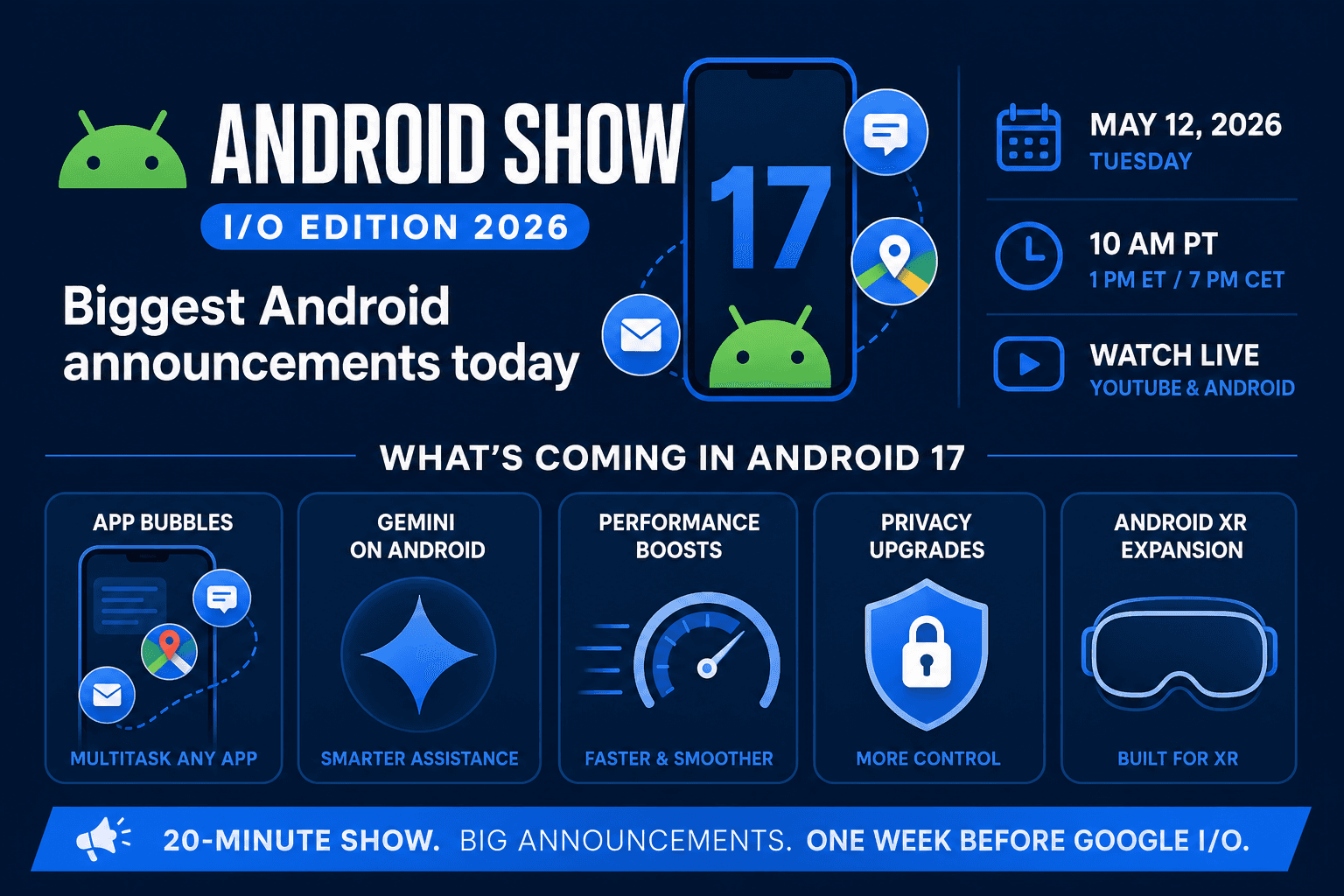
Google's big 2026 announcement season starts today — and it's not waiting until Google I/O.
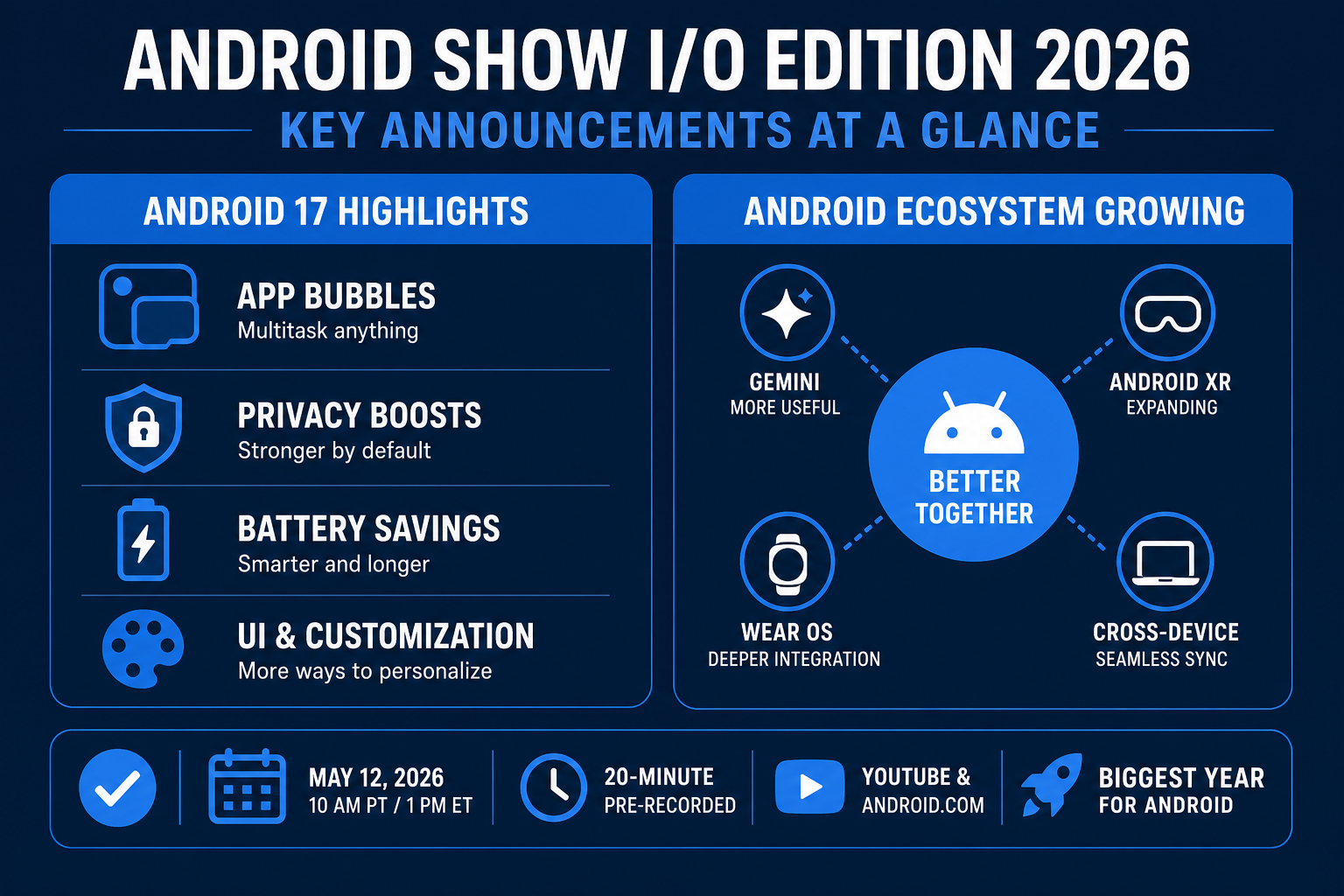
The Android Show: I/O Edition streams live today, May 12, 2026, at 10 AM PT / 1 PM ET (2 PM ET for the East Coast crowd). It's a 20-minute pre-recorded event Google holds every year the week before Google I/O to front-load its biggest Android announcements.
Last year's Android Show dropped Android 16 details, Gemini-on-Android features, and the first look at Android XR. This year, Google has already teased it as "one of the biggest years for Android yet" — and the signals back that up.
Here's everything expected today, based on developer previews, Android betas, and confirmed Google statements.
What Is the Android Show: I/O Edition?
The Android Show is a dedicated pre-I/O stream Google launched in 2024 to give Android its own announcement spotlight. Instead of cramming everything into the Google I/O keynote, Google uses this show to focus on Android OS, Gemini mobile features, and related hardware — then uses Google I/O (May 19 this year) for the broader developer platform and AI announcements.
Last year's show ran just over 20 minutes. This year's is expected to be similar in length but heavier on content. For more on what's coming at the full Google I/O event next week, see our Google I/O 2026 preview.
How to watch:
- YouTube: youtube.com/live/dXCCleAddEA
- Android website: android.com/new-features-on-android/io-2026
- Time: 10 AM PT / 1 PM ET / 7 PM CET — Tuesday, May 12, 2026
Android 17: What's Coming to Your Phone
Android 17 is the headliner. Google has been running developer betas since March, and several confirmed features have already surfaced.
App Bubbles
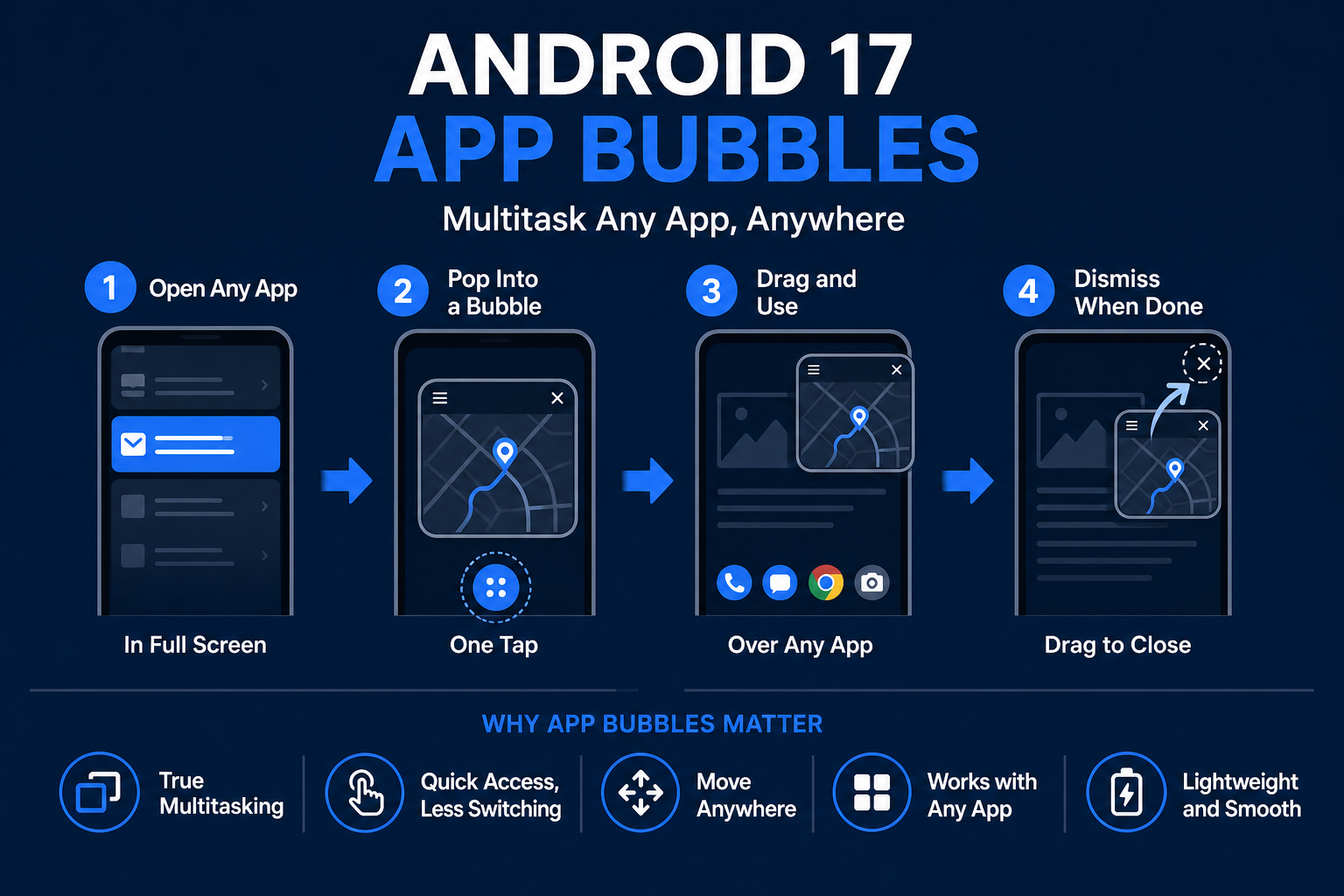
The biggest Android 17 feature getting early attention is App Bubbles — a new windowing system that lets you pop any app into a small, floating bubble you can drag around the screen while using something else.
Think of it like Picture-in-Picture for entire apps, not just video. You're reading an email and want to quickly check a map? Pull it up as a bubble overlaid on your current screen, interact with it, then dismiss it. It's closer to how PC multitasking works, brought to touch screens in a way that actually makes sense.
Bubbles appeared in Android 17 Beta 2 and are one of the most-discussed features in the Android developer community right now.
Privacy and Location Controls
Android 17 tightens location permissions in two ways:
-
One-time location sharing — apps can now request your location once, after which permission automatically expires. No more apps silently tracking you in the background after a single approval.
-
Non-system app indicator — a persistent indicator will show when any non-system app is actively accessing your location, similar to the camera/microphone indicators that appeared in Android 12.
Both features address complaints that Android's location controls have lagged behind iOS. This closes most of that gap.
Visual Design: Not Liquid Glass (But Something)
The 15-second teaser for the Android Show showed the Android mascot going from its usual solid green to a translucent, glassy look with color splashes — which immediately triggered speculation about Google copying iOS 26's Liquid Glass redesign.
Android ecosystem president Sameer Samat quickly responded: "Not happening."
But something visual is still coming. The teaser isn't accidental. Based on Gemini app screenshots already surfacing on iOS and Android, the most likely explanation is a Gemini app redesign rolling out broadly — a pill-shaped prompt interface, streamlined action buttons, and subtle gradient backgrounds. That aesthetic is what the teaser was previewing, not a full OS-level redesign.
Other Confirmed Android 17 Features
From developer preview builds that have been public since March:
- App label hiding on the home screen (cleaner aesthetic)
- Improved screen recording with more format and quality options
- Notification bundling improvements for high-volume apps
- Better battery optimization for background AI processes (Gemini integration)
Gemini on Android: What to Expect
Google has been pushing Gemini deeper into Android throughout 2026, and today's show will likely highlight where that stands heading into I/O.
The Gemini app redesign — already spotted rolling out on iOS and some Android builds — is the main visual story. The new interface replaces the older chat-bubble layout with a cleaner prompt box pinned to the bottom, with quick-access buttons for voice, camera, and files.
More interesting is the agentic Gemini functionality: the ability for Gemini to actually control and interact with other apps on your phone. Early demos have shown Gemini booking a restaurant (via Maps), composing a reply in Gmail based on context from Calendar, and summarizing a web page you're currently viewing — all without leaving whatever you were doing.
Whether that capability goes broadly live today or stays in limited testing through I/O is the main question.
A Gemini 4.0 announcement at the full I/O is also on the table, but that's a next-week story. Today is Android-layer Gemini features.
Aluminium OS: The First Official Look
Aluminium OS is Google's long-rumored project to merge Android and ChromeOS into a single PC operating system. It's been in internal development for at least two years — today may be the first official acknowledgment from Google that it exists.
What we expect from the reveal, if it happens:
- Aluminium OS combines Android's app ecosystem with ChromeOS's desktop window management
- Designed for laptops and desktops, not phones or tablets
- A possible successor to ChromeOS for Chromebook hardware
- Full launch unlikely until 2027–2028; any 2026 announcement would be a developer preview or limited beta
- There's early speculation about a new Pixelbook to accompany the OS reveal
Enterprise and education sectors — which currently use a lot of Chromebooks — are the initial targets. Consumer availability is a longer-horizon story.
Android XR: Smart Glasses Update
Android XR launched at last year's I/O with Samsung as the lead hardware partner. Today's show is expected to include updates on where that platform stands, specifically:
- Consumer release windows for Samsung's Galaxy XR headset and Galaxy Glasses
- Status updates on smart glasses partnerships with Warby Parker, Gentle Monster, and XREAL — all announced last year but without firm launch dates
- Android XR software features coming to devices in 2026
The XR story has moved slower than Google signaled at I/O 2025. Today's update will clarify whether that's still on track or being pushed further out.
Why This Matters for AI Tools
If you're here because you follow AI tools rather than Android specifically — here's the connection worth watching.
Gemini's agentic features on Android are effectively on-device AI agents. If Google rolls out broad availability today for Gemini controlling other apps, that's the same "AI agent on your phone" capability that people have been predicting for 2026. It means:
- AI that can act on your phone without you manually switching between apps
- Voice-triggered workflows that span Calendar + Gmail + Maps without a dedicated app
- The beginning of AI assistants that actually replace workflows instead of just answering questions
For beginners exploring what AI can do in 2026, the Gemini-on-Android updates are the most immediately accessible demonstration of where agentic AI is heading — on hardware you already own.
What's NOT at the Android Show
A few things people keep asking about that are Google I/O (May 19) territory, not today:
- Gemini 4.0 model release — next week
- Google Search AI overhaul — next week
- Google Workspace AI features — next week
- Pixel 9a launch — potentially I/O or shortly after
- Veo 3 / video generation updates — next week
Today is strictly Android + Gemini-on-Android. Keep expectations scoped to the 20-minute format.
FAQ
Q: What time does the Android Show 2026 stream?
A: Tuesday, May 12, 2026 at 10 AM PT / 1 PM ET / 7 PM CET. Stream live at youtube.com/live/dXCCleAddEA or android.com.
Q: Is the Android Show the same as Google I/O?
A: No. The Android Show is a separate 20-minute pre-event focused on Android OS and mobile Gemini features. Google I/O is the main developer conference, happening May 19, 2026, covering all Google platforms and AI.
Q: What phones will get Android 17?
A: Pixel phones will get it first (Pixel 6 and later expected). Samsung, OnePlus, and other Android OEMs typically follow 2–4 months later. Google will likely announce the exact rollout timeline today.
Q: Is Liquid Glass coming to Android?
A: No. Android ecosystem president Sameer Samat explicitly denied it. Android 17 has design tweaks, but not a full visual overhaul. The teaser appears to reference the Gemini app redesign, not the OS.
Q: What is Aluminium OS?
A: Google's project to merge Android and ChromeOS into a single PC operating system. It's designed for laptops and desktops. Today may be the first official announcement — but full availability is likely 2027 or later.
Q: When does Android 17 come out?
A: A broad stable release is expected in Q3 2026. The developer preview has been running since March 2026. Pixel phones will get it first.
Q: What is the Gemini app redesign?
A: A new interface rolling out across iOS and Android that replaces the older chat layout with a cleaner prompt bar pinned to the bottom of the screen, with quick buttons for voice, camera input, and file sharing. It also includes agentic controls for interacting with other apps.

Alex the Engineer
•Founder & AI ArchitectSenior software engineer turned AI Agency owner. I build massive, scalable AI workflows and share the exact blueprints, financial models, and code I use to generate automated revenue in 2026.
Related Articles
How to Start an AI-Assisted Resume Writing Side Hustle in 2026 (Beginner's Guide)
A step-by-step guide to using AI resume tools to offer a paid resume and cover letter writing service — what to charge, which tools to use, and how to find your first clients.
How to Build and Sell AI Voice Receptionists to Local Businesses in 2026
A beginner's guide to building AI voice agents that answer business phone calls — the tools to use, what to charge, and how to find your first client.
How to Make Money on Fiverr with AI Tools in 2026: 7 Gigs You Can Start This Week
Discover 7 real Fiverr gigs you can launch using free and low-cost AI tools in 2026 — no experience required. Real pricing data, step-by-step setup, and tools that actually work.