
Android Show 2026 Recap: Googlebook, Gemini Intelligence, Android 17 — Every Announcement
Complete recap of The Android Show: I/O Edition 2026. Google unveiled Googlebook laptops, Gemini Intelligence, Android 17 security upgrades, the biggest Android Auto update in 10 years, and more.
Google just wrapped its pre-I/O Android showcase, and it was far bigger than anyone expected.
The Android Show: I/O Edition 2026 dropped a brand-new laptop category, a new name for its most powerful AI features, the biggest Android Auto redesign in the platform's 10-year history, and a rebuilt iPhone-to-Android transfer that Google built with Apple. That's before getting into the 9 confirmed Android 17 features.
Here's every announcement from today's show, explained.
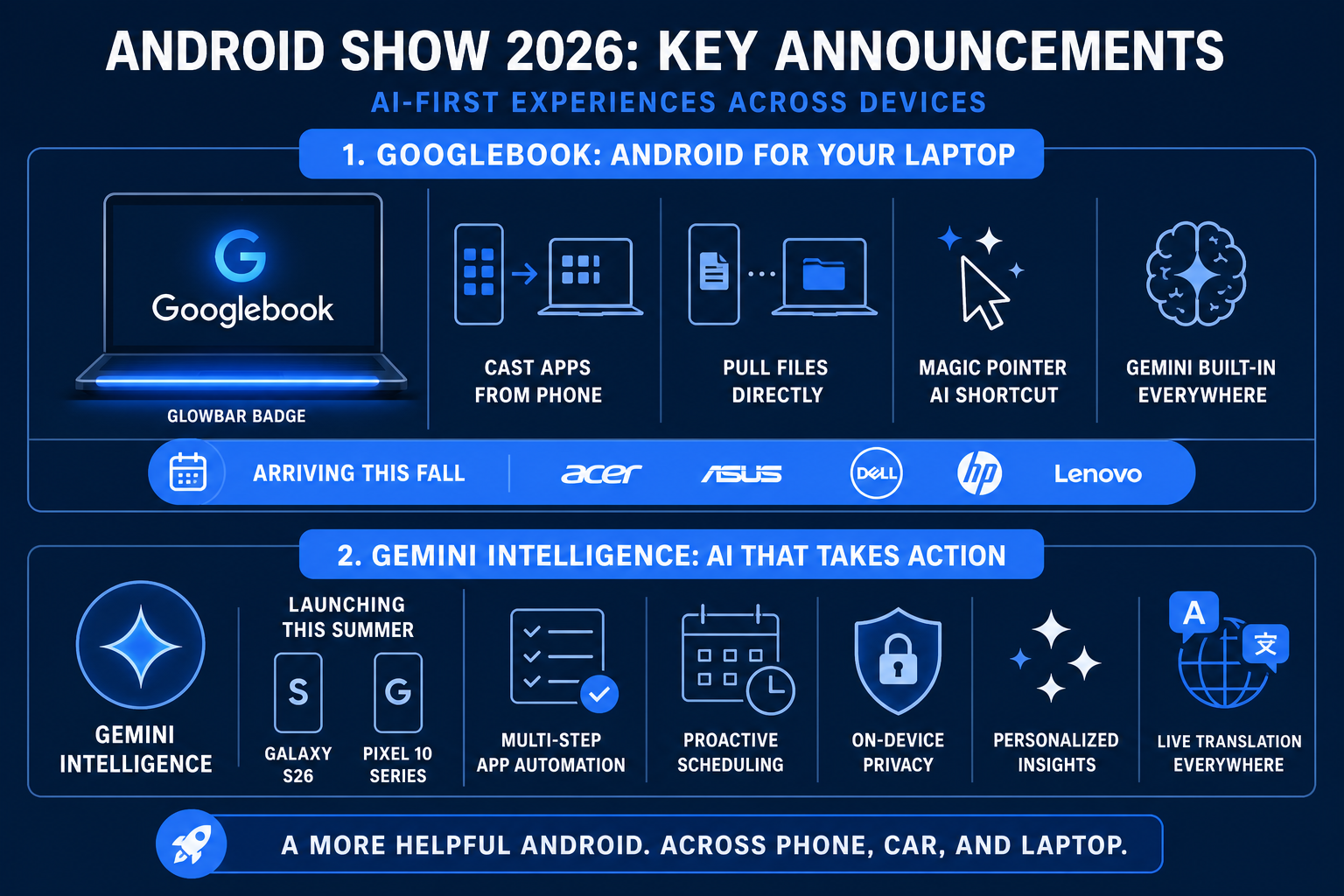
1. Googlebook: Google's Chromebook Successor Is Here
The headline announcement: Google has a new laptop category called Googlebook — and it's the platform that essentially replaces Chromebook.
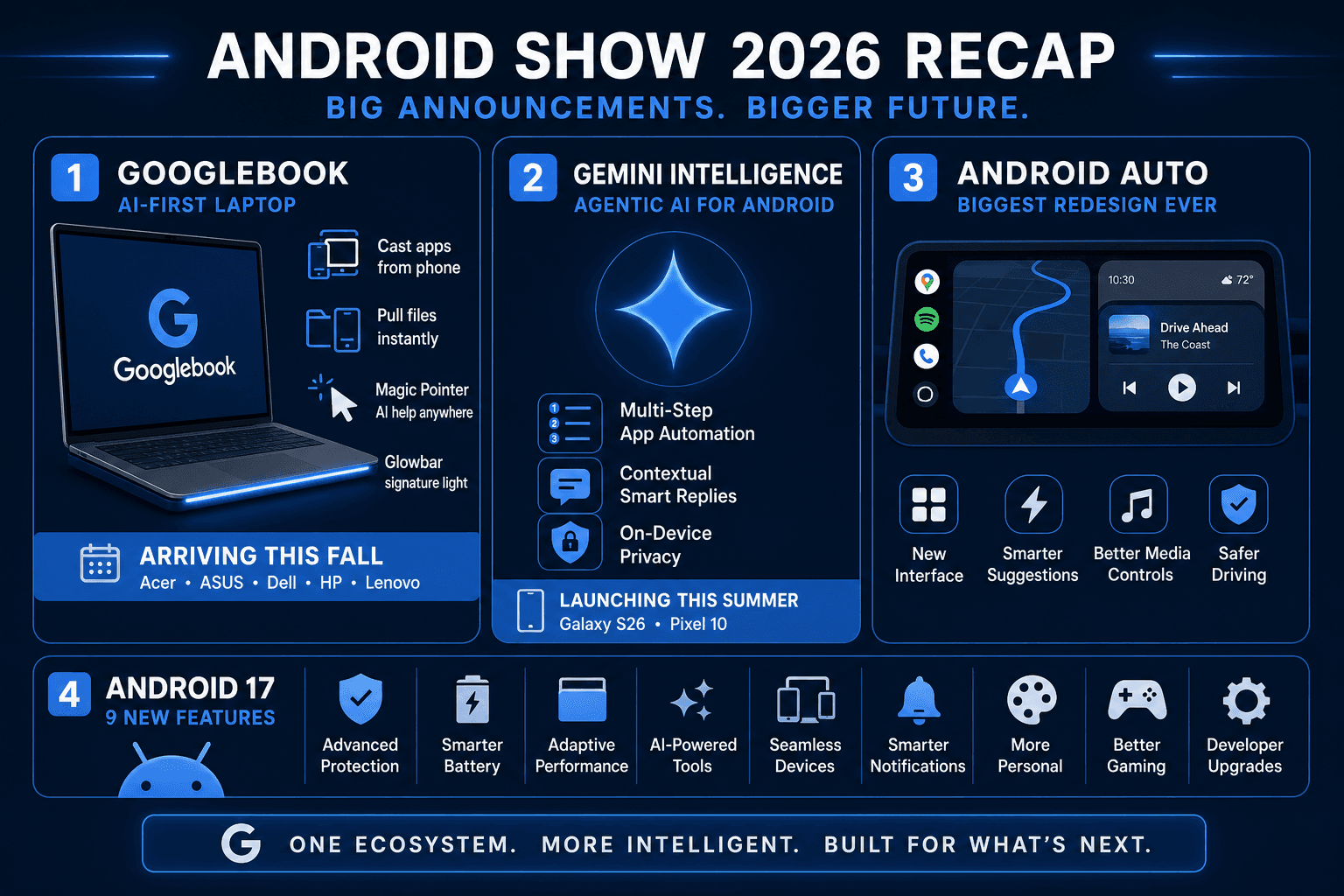
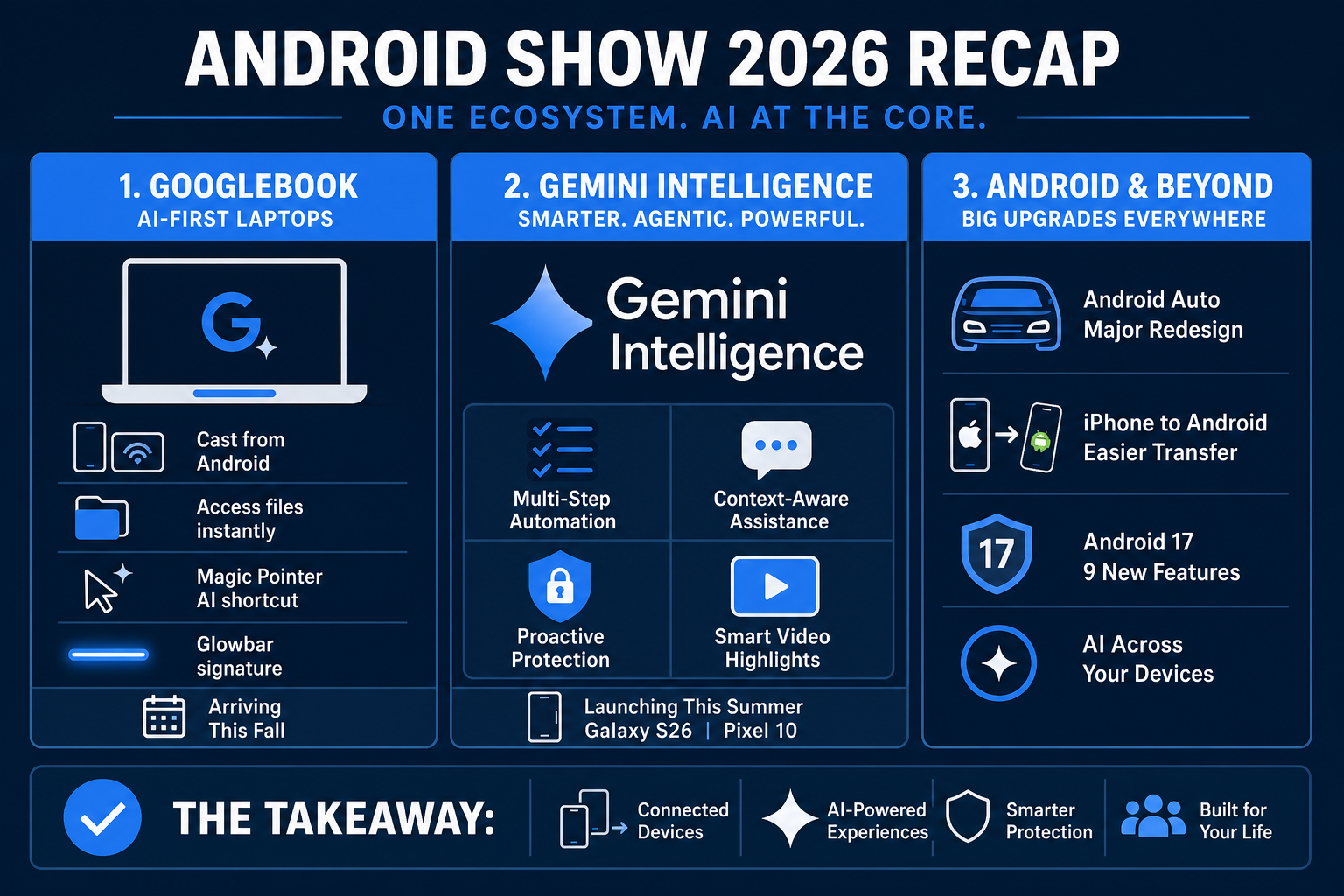
Googlebooks run Android with Gemini Intelligence baked in from the ground up. They're designed around the idea that your phone and laptop should work as one device. Key features:
- Cast apps from your Android phone directly to the Googlebook display
- Pull files directly from a connected Android device without cables or cloud sync
- Magic Pointer — your cursor becomes a contextual Gemini shortcut. Hover over anything on screen and Gemini can explain, edit, translate, or act on it
- Glowbar badge — a signature light strip that distinguishes Googlebooks from generic laptops
The first Googlebooks arrive this fall from Acer, ASUS, Dell, HP, and Lenovo. Pricing and exact specs haven't been confirmed yet — that's likely a Google I/O (May 19) story.
This is the announcement that analysts had been calling "Aluminium OS" for the past year. The actual product name is Googlebook, and it's positioned as an AI-first laptop for users who live in Google's ecosystem — not a developer-focused OS merger.
For beginners exploring what AI tools can do: Googlebook is Google's bet that your next laptop should have AI built into the mouse cursor. That's a meaningful shift from how most people use computers today.
2. Gemini Intelligence: What It Is and Which Phones Get It
Google introduced a new brand today: Gemini Intelligence. It's the umbrella name for Google's most advanced, agentic AI features — and it's reserved for premium Android hardware.
Gemini Intelligence launches this summer on the Galaxy S26 and Pixel 10 series. Here's what's included:
Multi-Step App Automation
Gemini can now navigate your apps for you. Tell it to "order my usual from the last restaurant I visited" and it opens the app, pulls your history, builds the cart, and checks out — without you touching it. It can also pull information from emails and calendar events to complete tasks across apps.
Create My Widget
Ask Gemini to build a home screen widget and it generates one on the spot — custom layout, live data, your preferences. No app store, no templates.
Rambler
Voice-to-text has always produced messy transcriptions full of "um," incomplete sentences, and filler words. Rambler cleans it up automatically, turning rambling voice recordings into coherent text. It works across messaging, notes, and email.
Magic Cue
A contextual suggestion layer that watches what you're doing and quietly surfaces relevant actions — without interrupting you. Think of it as a smarter version of Android's existing contextual shortcuts.
Smarter Autofill
Autofill now uses Gemini context across your apps, not just saved passwords. It can fill forms based on previous conversations, emails, and calendar data — not just stored credentials.
Gemini Intelligence expands to Wear OS watches, Android Auto, smart glasses, and Googlebooks later in 2026.
3. Gemini in Chrome for Android
Starting late June 2026, Gemini integrates directly into Chrome on Android. Requirements: Android 12 or higher, at least 4GB RAM.
What it does:
- Summarize any web page on demand
- Edit images on the fly using Nano Banana (Google's image editing model)
- Context-aware help that connects to your Google apps — if you're reading a recipe, it can add it to your shopping list; if you're on a booking page, it can check your calendar
Pro and Ultra subscribers also get auto-browse on mobile: Gemini can handle tasks in Chrome for you — parking reservations, food reorders, form fills — without you staying in the app. Same capability that's been available on desktop, now on phones.
4. Android Auto: Biggest Update in 10 Years
Google called today's Android Auto update "the biggest in its 10-year history." That's not hype — the changes are substantial:
- One screen size fits all: Android Auto now adapts properly to every car display, including irregular and non-rectangular screens. No more cut-off interfaces or awkward scaling
- Material 3 Expressive: Updated visual design language, widget support on the dashboard
- YouTube on your car screen: Stream YouTube to your car display when parked — or for passengers in cars with multi-zone displays
- Predictive lane-change suggestions: For select Google Built-in cars (not standard Android Auto), the car's front camera feeds into Gemini, which predicts optimal lane changes and nudges you
The update rolls out throughout 2026 as car manufacturers push Android Auto updates.
5. Quick Share + AirDrop Goes Cross-Brand
Quick Share's AirDrop interoperability — initially only on Pixel — is expanding massively:
- Samsung, OPPO, OnePlus, Vivo, Xiaomi, and Honor all confirmed for 2026
- Any Android device (even without a compatible phone) can now generate a QR code via Quick Share to send files to iOS through the cloud
- Quick Share is coming to WhatsApp — you'll be able to share files inside WhatsApp conversations using Quick Share's speed and cross-device awareness
This is the most practical announcement for everyday users who share files across iPhone and Android.
6. Google and Apple Rebuilt iPhone-to-Android Transfer Together
Google announced it worked directly with Apple to rebuild the iOS-to-Android switch process from scratch.
What moves in the new transfer:
- Passwords
- Photos
- Messages (iMessage history)
- Apps (with matched Play Store equivalents)
- Contacts
- Home screen layout
- eSIM transfer — no physical SIM card swap needed
It's wireless, and it launches first on Samsung Galaxy and Pixel devices later in 2026.
The fact that Apple collaborated on this is notable. It suggests both companies have some interest in reducing the friction of switching — though Apple's motivation is probably regulatory pressure more than enthusiasm.
7. Android 17: Security, Privacy, and the 9 Biggest New Features
Android 17 gets a confirmed feature list today. The security and privacy additions are the most significant:
Verified Financial Calls: Android 17 will automatically end calls from spoofed numbers impersonating your bank. It cross-references caller ID against a verified database. Revolut, Itaú, and Nubank are the launch partners, with more banks rolling in throughout 2026.
Live Threat Detection Upgrade: Dynamic signal monitoring that catches new threat patterns in real time — not just known malware signatures.
Other confirmed Android 17 features announced today:
- 3D emoji — animated, depth-enabled emoji across the system
- App Bubbles — confirmed (already in developer preview): floating windowed apps you can drag across the screen
- Pause Point — screen time management that surfaces a gentle reminder when you've been in an app longer than your set limit, without hard-locking you out
- One-time location sharing — confirmed shipping in Android 17
- Non-system app location indicator — persistent visual indicator when any third-party app is accessing your location
- App label hiding on home screen
- Improved screen recording with format and quality options
Android 17 stable release: expected Q3 2026, Pixel phones first.
8. Adobe Premiere Lands on Android
A smaller but creator-relevant announcement: Adobe's updated Premiere video editing app (which launched on iOS last September) is coming to Android. Full mobile timeline editing, not a stripped-down version. Timeline for Android availability: later in 2026.
What This Means for AI on Android
If you've been tracking where AI is actually showing up in tools people use every day, today's show is significant because:
-
AI is now in the mouse cursor (Googlebook's Magic Pointer). This is a new interaction paradigm — the cursor is no longer just a pointer, it's a prompt interface.
-
Gemini controls apps for you. The multi-step automation in Gemini Intelligence isn't a demo feature — it launches this summer on flagship phones. The era of AI assistants that actually do things rather than just answer questions has started on Android.
-
Security AI is built into the dialer. Verified financial calls uses AI to detect spoofing in real time. That's the first time AI-powered security has been built directly into the phone's default call behavior.
For a preview of what Google is saving for the full Google I/O keynote next week (May 19), see our Google I/O 2026 Preview.
FAQ
Q: What is a Googlebook?
A: Googlebook is Google's new laptop category, announced today as the successor to Chromebook. It runs Android with Gemini Intelligence built in. The first models come from Acer, ASUS, Dell, HP, and Lenovo this fall.
Q: What is Gemini Intelligence?
A: Google's new branding for its most advanced agentic AI features on Android. It includes multi-step app automation, Create My Widget, Rambler, Magic Cue, and smarter Autofill. Launching summer 2026 on Galaxy S26 and Pixel 10.
Q: Which phones get Gemini Intelligence?
A: At launch: Galaxy S26 series and Pixel 10 series. Google says it expands to more devices later in 2026.
Q: What is Rambler?
A: A new Android 17 / Gemini Intelligence feature that automatically cleans up messy voice-to-text. It removes filler words, incomplete sentences, and stammers to produce clean, readable text.
Q: When does Android 17 come out?
A: Stable release expected Q3 2026. Developer preview has been running since March. Pixel phones get it first, followed by Samsung and other manufacturers.
Q: What is Googlebook vs Chromebook?
A: Googlebook replaces Chromebook as Google's laptop platform. Instead of ChromeOS, Googlebooks run Android with Gemini Intelligence. They're designed to work seamlessly with Android phones — casting apps, pulling files, sharing context.
Q: Does the new iPhone-to-Android switch tool require anything from Apple?
A: Google built it in collaboration with Apple. It works wirelessly and moves passwords, photos, messages, apps, contacts, home screen layout, and even your eSIM. It launches first on Samsung Galaxy and Pixel devices.
Q: What's left for Google I/O on May 19?
A: Gemini 4.0, Google Search AI updates, Workspace AI features, Veo 3 / video generation updates, and broader developer platform announcements. The Android Show handled Android OS and mobile Gemini — I/O is for the AI platform layer.

Alex the Engineer
•Founder & AI ArchitectSenior software engineer turned AI Agency owner. I build massive, scalable AI workflows and share the exact blueprints, financial models, and code I use to generate automated revenue in 2026.
Related Articles
How to Start an AI-Assisted Resume Writing Side Hustle in 2026 (Beginner's Guide)
A step-by-step guide to using AI resume tools to offer a paid resume and cover letter writing service — what to charge, which tools to use, and how to find your first clients.
How to Build and Sell AI Voice Receptionists to Local Businesses in 2026
A beginner's guide to building AI voice agents that answer business phone calls — the tools to use, what to charge, and how to find your first client.
How to Make Money on Fiverr with AI Tools in 2026: 7 Gigs You Can Start This Week
Discover 7 real Fiverr gigs you can launch using free and low-cost AI tools in 2026 — no experience required. Real pricing data, step-by-step setup, and tools that actually work.