
Paperclip: Run a Zero-Human Company With AI Agents
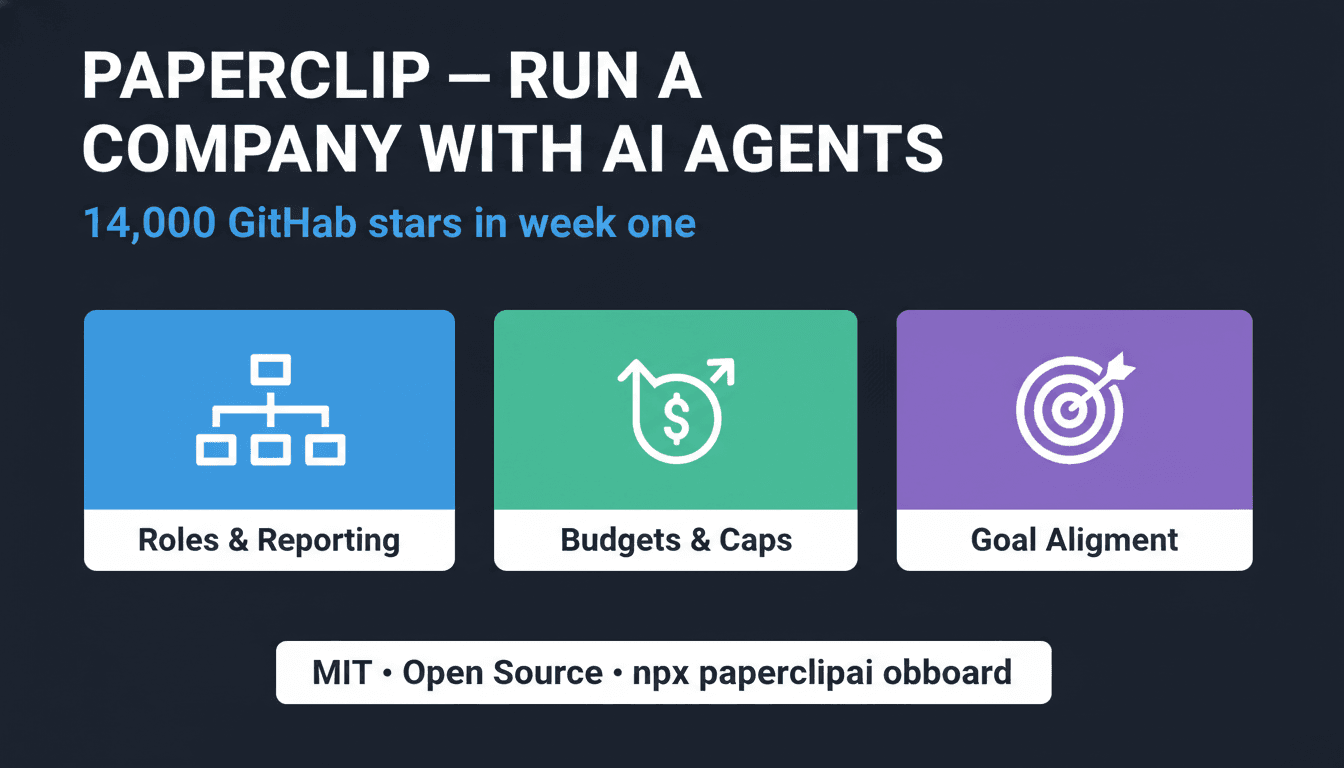
Paperclip is an open-source platform for orchestrating AI agent teams like a real company — with org charts, budgets, governance, and goal alignment. 14k GitHub stars in its first week.
Most people running multiple AI agents end up with the same mess: 20 Claude Code tabs open, no idea who's doing what, sessions that die on reboot, and runaway token spend you don't notice until the bill arrives.
Paperclip is built to fix that. It's an open-source Node.js server + React UI that treats AI agents like company employees — with org charts, budgets, goal alignment, governance, and a ticket system. You define the mission, hire agents, set budgets, and the company runs.
Released under MIT license, it hit 14,000 GitHub stars in its first week. Here's what it actually does and how to get started.
The Core Idea
Paperclip's tagline: "If OpenClaw is an employee, Paperclip is the company."
That's not just a metaphor. Paperclip models a real organizational structure:
- Goals flow from the company mission down to every task — agents always know why they're doing something, not just what
- Org charts define roles, reporting lines, and delegation — a CEO agent supervises engineering agents, who can delegate to sub-agents
- Budgets cap monthly spend per agent — when they hit the limit, they stop. No runaway loops
- Heartbeats trigger agents on a schedule — recurring jobs (support, social, reports) happen automatically
- Tickets track every task, conversation, and decision — with full tool-call tracing and an immutable audit log
- Governance lets you (the human board) approve hires, override strategy, or pause any agent at any time
It's not a workflow builder or a chatbot. It's company infrastructure for agent teams.
Who It's For
Paperclip is explicit about this: if you have one agent, you probably don't need it. If you have twenty — you definitely do.
You're the right fit if:
- You coordinate multiple agents (OpenClaw, Claude Code, Cursor, Codex) toward shared goals and lose track of what's happening
- You run recurring automated jobs and manually kick them off
- You want persistent agent sessions that survive reboots
- You want to audit costs and enforce budgets on AI work
- You're building autonomous systems and want governance without babysitting
Quickstart
Requirements: Node.js 20+, pnpm 9.15+
The fastest path:
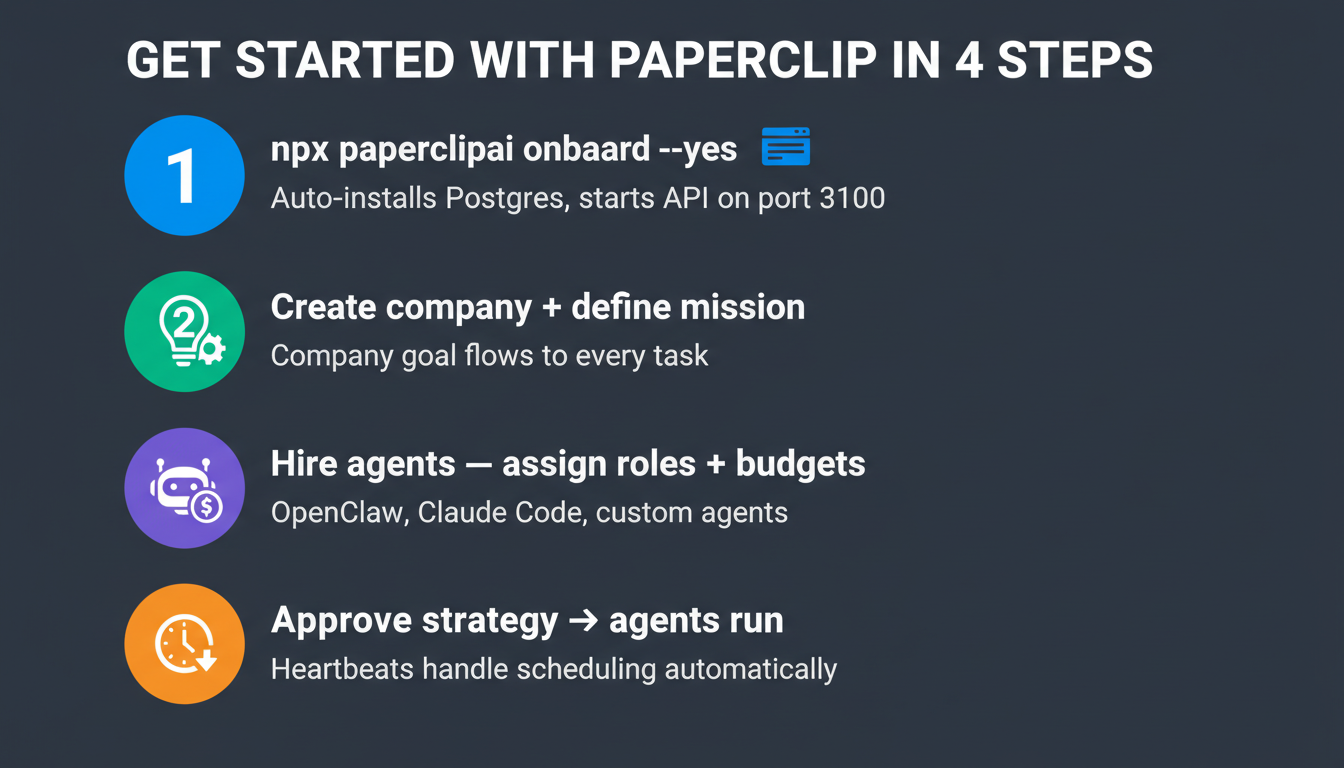
npx paperclipai onboard --yes
This scaffolds the config, starts the API server at http://localhost:3100, and creates an embedded PostgreSQL database automatically — no separate database setup required.
Or manually:
git clone https://github.com/paperclipai/paperclip.git
cd paperclip
pnpm install
pnpm dev
The React dashboard opens at http://localhost:3100. From there, create your first company, define the mission, and start adding agents.
Core Features Explained
Bring Your Own Agent
Paperclip doesn't ship agents. It orchestrates them. Any agent that can receive a heartbeat ping — OpenClaw, Claude Code, Cursor, a custom script — can be "hired" and added to the org chart. You configure their prompt, model, runtime, and budget. Paperclip handles the rest.
Heartbeats
Agents don't run continuously by default. They wake on a schedule (heartbeat), check for assigned work, complete it, and report back. This prevents runaway loops and makes costs predictable. You set the heartbeat interval per agent.
Goal Alignment
Every task carries its full goal ancestry — the agent knows the task's parent project, the project's company goal, and the company's mission. This eliminates context drift where agents optimize for a local task at the expense of the actual objective.
Cost Control
Monthly token budgets per agent. When an agent hits its limit, it stops and notifies management. No surprise bills. Budget enforcement is atomic — checked at task checkout to prevent double-spend.
Multi-Company Support
One Paperclip deployment can run multiple companies with complete data isolation. If you're running several autonomous businesses or projects, a single instance manages all of them from one dashboard.
Mobile-Ready
The React dashboard works on mobile browsers. Monitor agent activity, approve tasks, and check costs from your phone without needing a desktop.
What Problems It Actually Solves
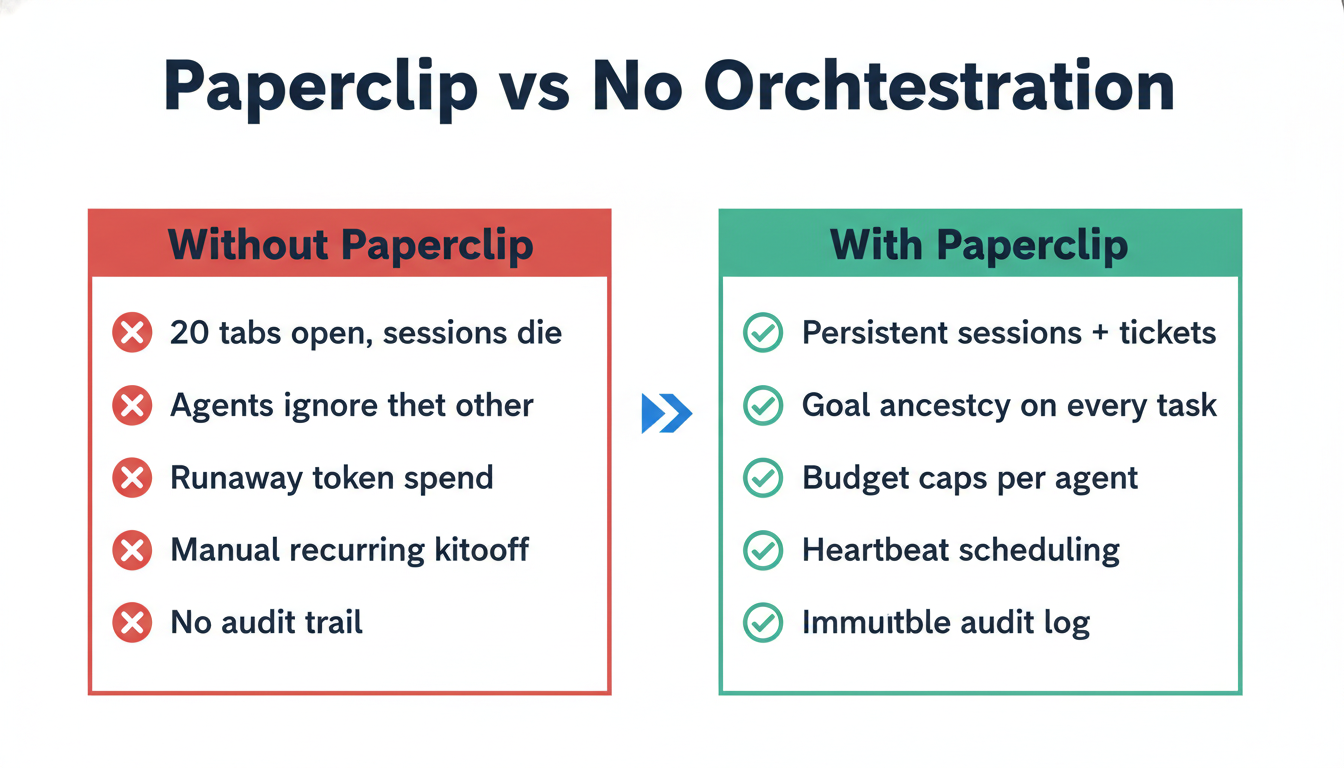
| Without Paperclip | With Paperclip |
|---|---|
| 20 Claude tabs open, sessions die on reboot | Persistent sessions, ticket-based task tracking |
| Manually gather context to brief each agent | Context flows from task → project → company goal automatically |
| Runaway loops burn hundreds of dollars unnoticed | Monthly budgets per agent, atomic enforcement |
| Recurring jobs require manual kickoff | Heartbeats handle scheduling — agents work without prompting |
| No audit trail of what agents decided | Full tool-call tracing, immutable audit log |
Deploying Beyond Local
For solo operators: the FAQ recommends using Tailscale to access Paperclip remotely without exposing it to the internet. This is the cheapest setup — your existing machine runs the server, Tailscale lets you reach the dashboard from anywhere.
For production: Paperclip supports any Postgres instance and standard Node.js deployment. Vercel, Railway, Fly.io, or a VPS all work. The embedded Postgres is fine for local dev; point it at a managed database for production use.
For the GPU compute side — if your agents are doing AI inference or you want them to run models locally — Ampere.sh is worth looking at for affordable ARM-based GPU instances. Significantly cheaper than AWS for AI inference workloads.
What's on the Roadmap
Already shipped:
- Plugin system, OpenClaw agent employees, org import/export (
companies.sh), Skills Manager, Scheduled Routines, Better Budgeting
Coming soon:
- CEO Chat (natural language control from within the dashboard)
- Artifacts & Deployments
- MAXIMIZER MODE (details not disclosed yet, but it's on the list)
- Multiple Human Users
- Cloud/Sandbox agents (Cursor, e2b)
- Desktop App
The roadmap is moving fast — this project is a week old and already shipping production features.
Key Takeaways
- Install:
npx paperclipai onboard --yes— embedded Postgres, no setup required - What it is: Company infrastructure for AI agent teams — org charts, budgets, governance, tickets
- What it's not: A chatbot, workflow builder, or single-agent tool
- Best for: Anyone running 5+ agents with overlapping goals and no structure
- Cost control: Monthly budget caps per agent, atomic enforcement — runaway loops can't happen
- License: MIT — open-source, self-hosted, free
- GitHub: paperclipai/paperclip — 14k stars in week one

Alex the Engineer
•Founder & AI ArchitectSenior software engineer turned AI Agency owner. I build massive, scalable AI workflows and share the exact blueprints, financial models, and code I use to generate automated revenue in 2026.
Related Articles
How to Start an AI-Assisted Resume Writing Side Hustle in 2026 (Beginner's Guide)
A step-by-step guide to using AI resume tools to offer a paid resume and cover letter writing service — what to charge, which tools to use, and how to find your first clients.
How to Build and Sell AI Voice Receptionists to Local Businesses in 2026
A beginner's guide to building AI voice agents that answer business phone calls — the tools to use, what to charge, and how to find your first client.
How to Make Money on Fiverr with AI Tools in 2026: 7 Gigs You Can Start This Week
Discover 7 real Fiverr gigs you can launch using free and low-cost AI tools in 2026 — no experience required. Real pricing data, step-by-step setup, and tools that actually work.