
OpenAI Daybreak Explained: What Is GPT-5.5-Cyber and How Does It Work? (2026)
OpenAI just launched Daybreak, a new AI cybersecurity platform powered by GPT-5.5 and Codex Security. Here is what it is, how it works, and what it means for everyday users.
OpenAI just launched something that has nothing to do with chatbots, image generation, or writing essays.
On June 23, 2026, the company released Daybreak — a dedicated AI platform for cybersecurity defense, built around GPT-5.5 and a new tool called Codex Security. It also quietly dropped GPT-5.5-Cyber, a specialized version of its most powerful model, available in limited preview to verified security researchers and critical infrastructure defenders.
If you have been following AI news, you have probably seen the headline — 173 points on Hacker News and climbing. But what does this actually mean? Is this for you? Can you use it? And what is the difference between GPT-5.5 and GPT-5.5-Cyber?
Let us break it down.
What Is OpenAI Daybreak?
Daybreak is OpenAI's answer to the growing problem of AI being used by attackers to find and exploit software vulnerabilities at machine speed.
The name is a nod to the concept of "getting ahead of the threat before it strikes." OpenAI's framing is that the bottleneck in cybersecurity is no longer finding vulnerabilities — it is fixing them. Attackers can now use AI to scan for weaknesses in code at scale. Defenders need equivalent capability just to keep up.
Daybreak is a platform designed to close that gap. It brings together four components:
- Codex Security: An agentic security tool that scans codebases, builds a threat model, identifies attack paths, validates vulnerabilities in isolated environments, and proposes patches for human review.
- GPT-5.5 with Trusted Access for Cyber (TAC): The version of GPT-5.5 most security professionals will use — standard GPT-5.5, but with reduced refusals for legitimate defensive workflows like penetration testing, vulnerability triage, and malware analysis.
- GPT-5.5-Cyber: A specialized model in limited preview for verified defenders working on critical infrastructure. More permissive than standard TAC for dual-use workflows.
- Daybreak Cyber Partner Program: A network of security vendors — including Cloudflare, Cisco, SentinelOne, Snyk, Intel, and Semgrep — integrating GPT-5.5 into their products and workflows.
The overall loop: find the vulnerability, validate it, generate a patch, verify the fix works, disclose responsibly. Daybreak is built to make every step of that loop faster.
What Is Codex Security?
Codex Security is probably the most immediately useful part of Daybreak for developers and security researchers.
It is an agentic tool that plugs directly into Codex (OpenAI's code-focused environment) via a plugin. You point it at a codebase and it does the following automatically:
- Builds a codebase-specific threat model based on what the code actually does
- Explores realistic attack paths an adversary might take
- Validates findings in isolated sandbox environments (not on live systems)
- Proposes patches with reasoning about why they fix the vulnerability
- Generates documentation for responsible disclosure
OpenAI is also offering Codex for Open Source: selected maintainers of critical open-source projects can apply for free access to Codex Security alongside Codex and API credits. The goal is to reduce the review burden on open-source maintainers who are often one person maintaining software that runs inside millions of systems.
To try it, you can use the Codex Security plugin (available in Codex interfaces like the app or CLI) for code-level security scanning. Broader access for teams is available through OpenAI's enterprise cyber sales team.
What Is GPT-5.5-Cyber?
Here is the part where it gets more nuanced.
GPT-5.5-Cyber is not a smarter or more capable model than GPT-5.5. OpenAI is clear about this: the initial preview is not intended to significantly increase raw cyber capability. Instead, it is trained to be more permissive on security-related tasks.
Think of it this way:
Standard GPT-5.5 is cautious. Ask it to write a proof-of-concept exploit for a published CVE, and it will often refuse or heavily hedge. That is the right behavior for a general-purpose AI that anyone can access.
GPT-5.5 with Trusted Access for Cyber (TAC) is designed for verified defenders. When you have been vetted through OpenAI's identity verification process, you get reduced refusals for authorized security workflows: creating exploit PoCs for vulnerability validation, analyzing malware, reverse engineering binaries, red teaming within approved scope.
GPT-5.5-Cyber goes a step further. It is for verified security professionals at organizations defending critical infrastructure — government agencies, major cloud providers, critical infrastructure operators. It allows more specialized dual-use workflows where even TAC might trigger refusals, such as fully agentic red team operations on authorized targets.
The access tiers in plain language:
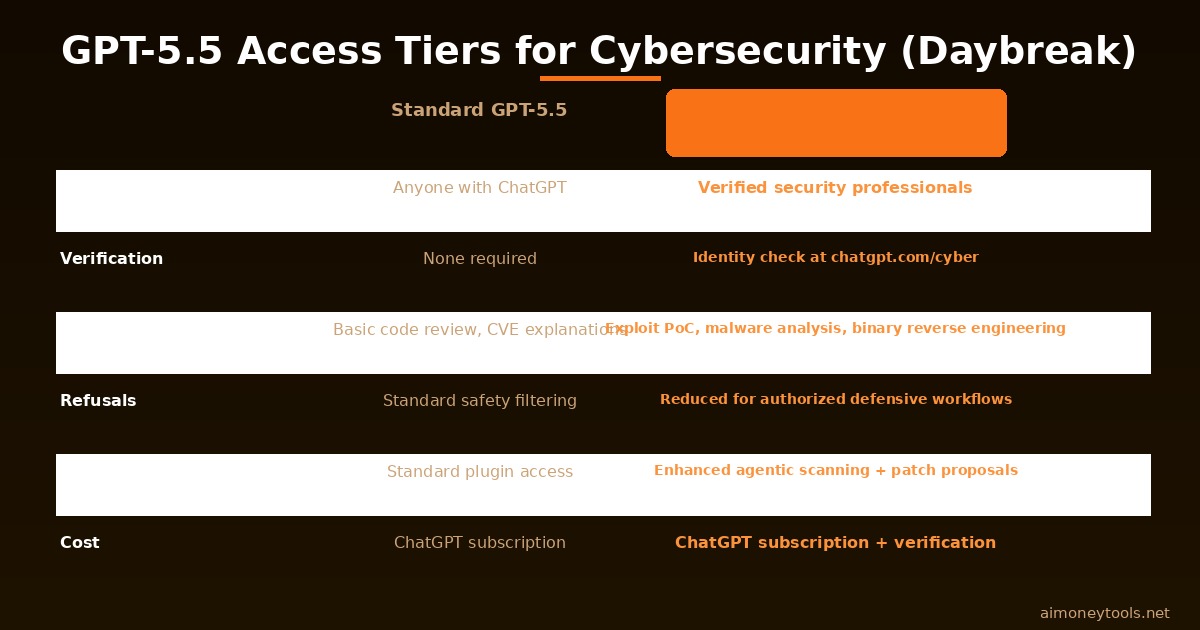
| Level | Who It Is For | What You Can Do |
|---|---|---|
| Standard GPT-5.5 | Everyone | General security questions, secure code review basics |
| GPT-5.5 with TAC | Verified defenders (individual verification) | Vulnerability triage, malware analysis, patch validation, exploit PoC in authorized environments |
| GPT-5.5-Cyber | Critical infrastructure organizations (enterprise verification) | Advanced authorized red teaming, more permissive exploit analysis |
To get Trusted Access for Cyber as an individual, go to chatgpt.com/cyber and verify your identity. Enterprises apply through their OpenAI account representative.

Daybreak vs. Anthropic Glasswing
Daybreak is OpenAI's direct answer to Anthropic Project Glasswing — the Anthropic initiative that uses Claude Opus/Mythos for similar defensive cybersecurity workflows.
The situation is interesting: Anthropic's most capable cyber model, Claude Mythos 5, was suspended by the US government in June 2026 amid an investigation into its use in a state-sponsored cyber incident. Glasswing is still operating with Claude Opus 4.8, but at reduced capability while Mythos is offline.
OpenAI launched Daybreak into that window. Whether that timing was intentional or opportunistic is unclear, but the effect is that Daybreak is currently the most capable commercially available AI cybersecurity platform.
Both companies are framing their work as "democratizing defense," but the architectures are slightly different:
- Anthropic's Glasswing emphasizes Claude's reasoning and constitutional AI safety for autonomous workflows
- OpenAI's Daybreak emphasizes the "full remediation loop" — from finding a bug to shipping the fix — with Codex Security as the execution layer
What Does This Mean for Beginners and Non-Security People?
If you are not a security researcher, Daybreak is not something you will directly use. GPT-5.5-Cyber requires enterprise verification, and even the standard TAC tier is designed for working security professionals.
But here is why it matters for anyone who uses the internet:
1. Software you use daily will be patched faster. Every company that uses Codex Security can now scan their codebase, find vulnerabilities, and generate patches significantly faster than before. The bottleneck shifts from "can we find the bug" to "can we ship the fix" — and Daybreak helps with both.
2. Open-source software is getting extra protection. The Codex for Open Source program specifically targets critical open-source projects — the libraries that underpin much of the internet's infrastructure. A small group of volunteer maintainers keeping a cryptography library or a logging framework is now getting access to AI-assisted security scanning for free.
3. AI-powered attacks now have AI-powered defenses. This is the real stakes: AI can write malware, generate phishing, and scan for vulnerabilities at machine speed. Daybreak is explicitly designed to make sure defenders can move at the same speed as attackers.
4. GPT-5.5 already helps everyday users with security. Even without TAC, the regular version of GPT-5.5 is significantly better at security-related tasks than previous models. Asking GPT-5.5 to review your code for security issues, explain a suspicious email, or understand a privacy policy is now meaningfully more useful than a year ago.
How to Get Started
For individuals curious about AI-assisted security:
- You can already ask ChatGPT (GPT-5.5) to review code for basic security issues, explain CVEs, or analyze suspicious content — no special access needed.
- For verified defenders: go to chatgpt.com/cyber to apply for Trusted Access for Cyber.
For developers and small teams:
- The Codex Security plugin is available in Codex interfaces. You can scan individual branches or codebases for free in the standard preview tier.
- Open-source maintainers can apply for Codex for Open Source at openai.com/form/codex-for-oss.
For enterprises:
- Contact OpenAI through your account representative for GPT-5.5-Cyber preview access and enterprise TAC enrollment.
- Partners include Cloudflare, Cisco, SentinelOne, Snyk, Intel, and Semgrep. If you already use any of these tools, AI-powered security capabilities may already be rolling out in your existing workflows.
The Bigger Picture
What OpenAI is doing with Daybreak is not just building a security product. It is building infrastructure for a world where AI agents are running continuously inside every organization's codebase, looking for problems and proposing fixes — autonomously, at scale, 24 hours a day.
That future is closer than most people realize. The models are ready. The question now is governance: who can use these capabilities, under what conditions, with what oversight, and with what accountability when something goes wrong.
OpenAI's answer — Trusted Access, identity verification, scope controls, human-in-the-loop review — is one model. Whether it is the right model will depend on how well those controls hold as the technology becomes more capable.
For now: software you use will be more secure. Defenders have better tools. And the AI arms race in cybersecurity just got a lot more interesting.
Frequently Asked Questions
What is OpenAI Daybreak? Daybreak is OpenAI's cybersecurity defense platform, launched June 23, 2026. It combines GPT-5.5, Codex Security (an agentic vulnerability scanner and patcher), and the Trusted Access for Cyber framework to help security teams find, validate, and fix vulnerabilities faster.
What is GPT-5.5-Cyber? GPT-5.5-Cyber is a specialized version of GPT-5.5 with reduced refusals for advanced security workflows. It is available in limited preview to verified organizations defending critical infrastructure. It is not more capable than GPT-5.5 in terms of raw intelligence — it is more permissive for authorized dual-use security tasks.
Can I use Daybreak for free? The Codex Security plugin is available for individual use through Codex interfaces. Open-source maintainers can apply for free access via the Codex for Open Source program. Full enterprise access requires contacting OpenAI's sales team.
What is Trusted Access for Cyber (TAC)? TAC is OpenAI's identity verification system for security professionals. Verified defenders get access to GPT-5.5 with reduced refusals for legitimate defensive workflows. Individual verification is done at chatgpt.com/cyber. Enterprise verification is done through OpenAI account representatives.
Is this the same as what Anthropic is doing with Glasswing? They are solving the same problem but with different architectures. Anthropic's Project Glasswing uses Claude for agentic cybersecurity workflows, with a focus on constitutional AI safety. OpenAI's Daybreak uses GPT-5.5 + Codex Security for the full vulnerability remediation loop. Both are actively competing in the enterprise cybersecurity AI space in 2026.
How is this relevant to me if I am not in cybersecurity? Daybreak affects the security of software everyone uses. Companies that adopt Codex Security will patch vulnerabilities faster, open-source projects will get free security scanning, and GPT-5.5 is already better at everyday security tasks (reviewing code, explaining suspicious emails, analyzing privacy policies) without needing any special access.

Alex the Engineer
•Founder & AI ArchitectSenior software engineer turned AI Agency owner. I build massive, scalable AI workflows and share the exact blueprints, financial models, and code I use to generate automated revenue in 2026.
Related Articles
How to Start an AI-Assisted Resume Writing Side Hustle in 2026 (Beginner's Guide)
A step-by-step guide to using AI resume tools to offer a paid resume and cover letter writing service — what to charge, which tools to use, and how to find your first clients.
How to Build and Sell AI Voice Receptionists to Local Businesses in 2026
A beginner's guide to building AI voice agents that answer business phone calls — the tools to use, what to charge, and how to find your first client.
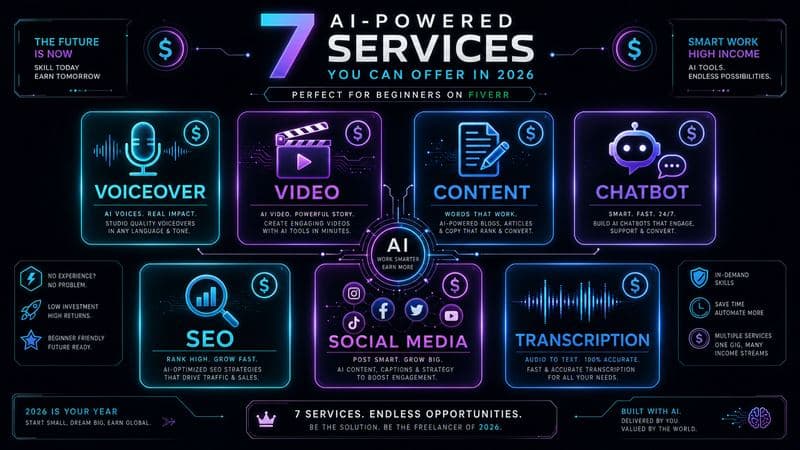
How to Make Money on Fiverr with AI Tools in 2026: 7 Gigs You Can Start This Week
Discover 7 real Fiverr gigs you can launch using free and low-cost AI tools in 2026 — no experience required. Real pricing data, step-by-step setup, and tools that actually work.