
Midjourney Medical: The AI Company Is Now Building a 60-Second Full-Body Scanner
Midjourney — the AI image generation company — has announced Midjourney Medical, a full-body Ultrasonic CT scanner that produces MRI-quality results in 60 seconds with no radiation and no magnets. Here is what it is, how it works, and when you can actually use it.

Midjourney is best known for generating AI images. So it was a genuine surprise when the company — a 60-person lab founded by David Holz — announced this week that it is building a medical division, a hardware scanner, and a chain of health spas.
Midjourney Medical is now a real product. And it might be one of the more ambitious health technology announcements since the original iPhone changed how we think about personal computers.
Here is what it is, how the scanner works, and when you can actually get a scan.
What Is Midjourney Medical?
Midjourney Medical is a new division of Midjourney focused on a technology the company calls Ultrasonic CT — a new form of whole-body imaging that uses sound waves and water instead of radiation or magnetic fields.
The pitch is simple: a 60-second full-body scan that produces image quality comparable to an MRI machine, available at a spa-like facility you can visit casually, the same way you would go to a gym.
The comparison to their AI image work is not accidental. Midjourney built its reputation on making complex image generation accessible and visually impressive. The same principles — accessibility, quality, and a consumer-first experience — appear to be driving Midjourney Medical.
How the Scanner Works

The core hardware is called The Midjourney Scanner. It is an ultrasound-based ring device that works like this:
You enter a shallow pool of water and stand on an elevator-like platform. The platform slowly descends at about 5 centimeters per second while you pass through a sensor ring. The scan takes approximately 60 seconds start to finish.
The sensor ring contains 500,000 tiny transducers — each about the size of a grain of sand. These transducers work like dolphin echolocation: they emit ultrasonic waves from every angle simultaneously and capture the returning signals to build a 3D model of your body.
The result is a detailed 3D body composition map with resolution down to a fraction of a millimeter — comparable to what an MRI machine produces, but completed in roughly 1% of the time it takes a standard MRI scan.
What makes it different from existing scanners:
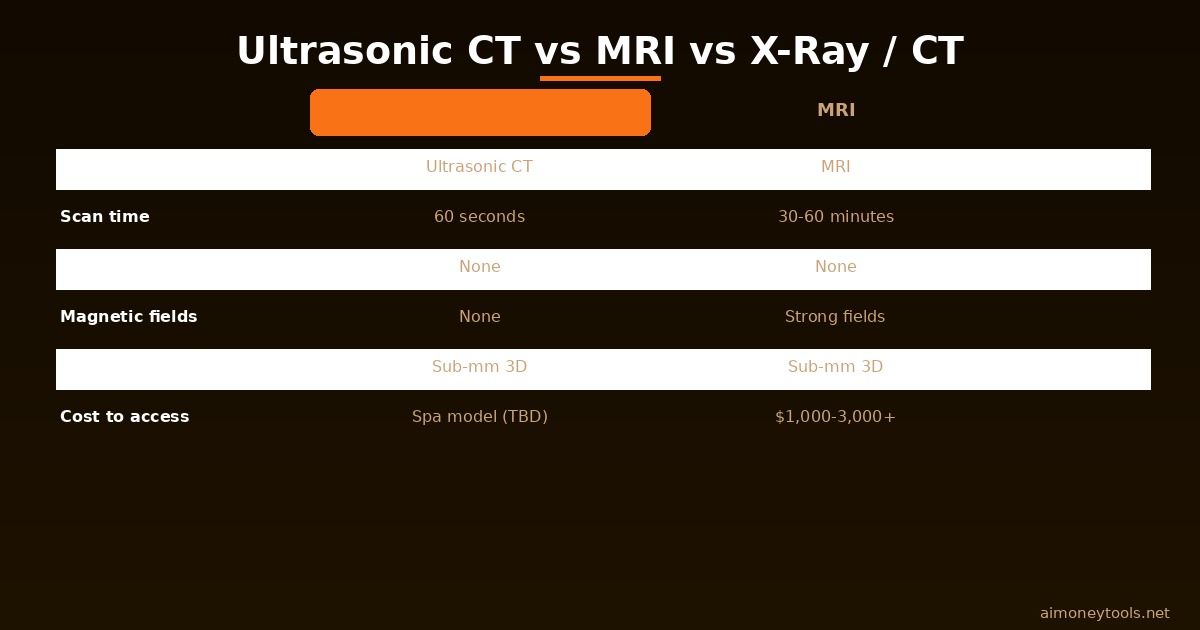
The three main medical imaging technologies in widespread use today each have significant drawbacks. X-rays and CT scans use ionizing radiation, which accumulates over repeated use. MRI machines avoid radiation but require large, powerful magnetic fields — making them expensive, slow (30–60 minutes per scan), and physically imposing. Traditional ultrasound is safe but produces low-resolution 2D images that require specialist interpretation.
Midjourney's Ultrasonic CT avoids all three of these trade-offs. No radiation. No magnets. Sound waves and water — and a 60-second scan time that would make weekly or monthly full-body check-ins practically feasible for the first time.
The compute requirements are significant. Each scanner uses 40 Butterfly Ultrasound-on-Chip imaging modules and requires about two petaflops of processing power — thousands of computers crunching terabytes of data per second to reconstruct the 3D image from the raw ultrasonic signals.
The Midjourney Spa
Midjourney is not positioning this as a clinical device that gets deployed to hospitals. Instead, the company is building a retail venue around the scanner: The Midjourney Spa.
The first location will open in San Francisco's Union Square district by the end of 2027. The facility will include hot tubs, saunas, cold plunges, and gym access — with scanning presented as a casual, accessible side benefit rather than a medical procedure.
The idea is to make the scan feel like a natural part of a wellness visit, not a clinical appointment. You book time at the spa, you get a scan as part of the experience, and you leave with a detailed 3D map of your body composition.
Each flagship location is planned to house 10 scanners. Midjourney claims that a single spa with 10 of these scanners could perform more body scans per year than all MRI machines in the United States combined — a number that is easier to understand once you remember that a 60-second scan versus a 45-minute MRI is a 45x throughput advantage.
The Roadmap: 50,000 Scanners by 2031
Midjourney Medical has published a multi-year roadmap:
The company is currently focused on what it describes as body composition maps — detailed images of body structure, fat distribution, muscle mass, and organ shape that do not require FDA diagnostic clearance because they are not making medical diagnoses. This is a deliberate regulatory strategy: get the hardware deployed and the dataset built before pursuing formal diagnostic certification.
Research trials run through 2027. Second-generation hardware is planned for 2027. Third-generation custom silicon — purpose-built chips for the ultrasonic processing pipeline — is targeted for 2028 with significantly improved image quality.
The long-term goal is ambitious: 50,000 scanners deployed globally by 2031, generating one billion full-body scans every month.
For context, there are approximately 36,000 MRI machines in the United States as of 2026, and roughly 160,000 worldwide. Midjourney's 2031 target would put Ultrasonic CT scanners on a comparable scale to the entire global MRI infrastructure — in five years.
Why Is Midjourney Doing This?
This is the part that surprises most people. Why would an AI image company build medical hardware?
The connection is more direct than it seems. Midjourney's core competency is training AI models on massive visual datasets and using that training to generate high-quality images. Medical imaging — training AI models on body scan data to detect anomalies, track changes over time, and eventually predict health events — is the same problem applied to a different domain.
The company framed its broader mission in the announcement: a network of 50,000 scanners doing one billion scans a month would create a dataset of human body composition at a scale that has never existed before. That dataset is the real strategic asset. The hardware is the means of collecting it.
Midjourney is betting that the combination of accessible scanning hardware, a compelling spa-retail experience, and AI trained on that dataset could enable preventative healthcare at population scale. Their stated goal is avoiding 30% of preventable deaths and reducing global healthcare costs by 50%.
Whether that goal is achievable is a separate question. But the strategy — use consumer distribution to build a proprietary medical dataset, then use AI to create diagnostic value from that dataset — is coherent and well-funded.
What This Means in Practice
For most people reading this in June 2026, Midjourney Medical is still two years away from being accessible. The first spa opens in San Francisco in late 2027, and widespread availability is a 2029–2031 story at the earliest.
But the announcement matters now for a few reasons:
For AI watchers: This is a signal that foundation model companies are expanding into physical hardware and specific verticals at a pace that was not expected even 18 months ago. Midjourney pivoting to medical hardware is a category expansion as unexpected as Apple pivoting to payment processing or Amazon pivoting to cloud infrastructure.
For healthcare professionals: The FDA regulatory strategy — starting with body composition maps rather than diagnostic claims — is worth watching. If Midjourney builds a dataset of one billion scans before seeking diagnostic clearance, the AI trained on that data will be in a fundamentally different position than AI trained on the relatively small clinical datasets that regulators have reviewed so far.
For consumers: The practical promise is real. If a 60-second, radiation-free full-body scan becomes as accessible as a gym membership, the early detection potential for conditions like cancer, cardiovascular disease, and musculoskeletal issues is significant. The question is whether the business model works at the price point required for mass adoption.
Frequently Asked Questions
What is Midjourney Medical? Midjourney Medical is a new division of the AI company Midjourney. It is building a full-body medical imaging scanner called the Midjourney Scanner, which uses ultrasonic sound waves and water to produce 3D body composition maps in about 60 seconds, with no radiation and no magnetic fields.
How is Midjourney Medical different from an MRI? A standard MRI takes 30–60 minutes and uses powerful magnetic fields. The Midjourney Scanner takes about 60 seconds and uses sound waves (ultrasound) and water. Image quality is described as MRI-comparable, with resolution down to a fraction of a millimeter. There is no radiation and no magnets involved.
Is the Midjourney Scanner safe? The scanner uses ultrasound — the same technology used in pregnancy scans — which does not involve radiation. Ultrasound has been used safely in medicine for decades. The main limitation is that Midjourney is starting with body composition maps rather than diagnostic imaging, which means the device is not yet cleared by the FDA to diagnose medical conditions.
When can I use a Midjourney Scanner? The first location (The Midjourney Spa in San Francisco) opens at the end of 2027. Wider availability is planned as part of an expansion to 50,000 scanners globally by 2031.
What is The Midjourney Spa? The Midjourney Spa is a wellness facility that Midjourney is building around the scanner. The first location in San Francisco's Union Square will offer hot tubs, saunas, cold plunges, and gym access, with scanning available as part of the spa experience. Each location is planned to house 10 scanners.
How much will a Midjourney scan cost? Midjourney has not published pricing as of June 2026. Given the spa retail model and the goal of mass accessibility, the company is likely targeting a price point comparable to a gym membership or premium wellness service rather than a clinical procedure cost.
Is this the same Midjourney that makes AI images? Yes. Midjourney Medical is a new division of Midjourney, the AI company known for its AI image generation platform. The company is applying its expertise in AI and large-scale visual data to medical imaging.
Does Midjourney Medical use AI? Yes. The scanner collects raw ultrasonic data from 500,000 transducers simultaneously and requires about two petaflops of processing power to reconstruct the 3D body image. The long-term plan is to train AI models on the dataset generated by the global scanner network to enable early detection of health conditions.
Is this FDA approved? Not yet. Midjourney Medical is starting with body composition maps — images that show body structure and composition but do not make diagnostic claims — which do not require FDA clearance. FDA diagnostic approval is part of the 2027–2028 roadmap.
What is Ultrasonic CT? Ultrasonic CT is the term Midjourney Medical uses for its imaging technology. It refers to using a large array of ultrasound transducers (500,000 in the first version) to capture sound wave data from all angles simultaneously, then using AI and computational processing to reconstruct a detailed 3D image — similar in concept to how a CT scan works with X-rays, but using sound instead of radiation.

Alex the Engineer
•Founder & AI ArchitectSenior software engineer turned AI Agency owner. I build massive, scalable AI workflows and share the exact blueprints, financial models, and code I use to generate automated revenue in 2026.
Related Articles

How to Start an AI-Assisted Resume Writing Side Hustle in 2026 (Beginner's Guide)
A step-by-step guide to using AI resume tools to offer a paid resume and cover letter writing service — what to charge, which tools to use, and how to find your first clients.

How to Build and Sell AI Voice Receptionists to Local Businesses in 2026
A beginner's guide to building AI voice agents that answer business phone calls — the tools to use, what to charge, and how to find your first client.

How to Make Money on Fiverr with AI Tools in 2026: 7 Gigs You Can Start This Week
Discover 7 real Fiverr gigs you can launch using free and low-cost AI tools in 2026 — no experience required. Real pricing data, step-by-step setup, and tools that actually work.