
Microsoft MAI-Code-1-Flash: A New AI Coding Model Joins GitHub Copilot (2026)
Microsoft launched MAI-Code-1-Flash at Build 2026 — a coding-focused model now available in GitHub Copilot for VS Code. Here's what it is, how it benchmarks, and whether you should use it.
Microsoft launched its first in-house AI model designed specifically for coding on June 2, 2026, at its annual Build developer conference.
Called MAI-Code-1-Flash, the model is now live inside GitHub Copilot for Visual Studio Code, available to individual Copilot subscribers. It is the first model to come out of Microsoft AI's internal model development program — not a repackaged OpenAI or third-party model — and it is built from the ground up for developer workflows rather than general benchmarks.
Here is what you need to know, what the numbers actually say, and whether it is worth your attention.
What Is MAI-Code-1-Flash?
MAI-Code-1-Flash is a small, fast, coding-focused AI model from Microsoft. The name follows the industry convention of using "Flash" or "Mini" to signal lightweight, cost-efficient models — the same tier as GPT-5.4-mini, Claude Haiku, and Gemini Flash. It is not a frontier reasoning model. It is a production speed model designed for the quick, interactive coding tasks developers do dozens of times per day inside their editor.
The "MAI" prefix stands for Microsoft AI, and MAI-Code-1-Flash is the first public model under that label.
Where you can use it:
- GitHub Copilot in Visual Studio Code
- Currently available on Individual Copilot plans only — Business and Enterprise rollout is coming but not yet live
- Available via the Copilot API for developers building with GitHub models
What it is NOT:
- It is not a standalone chatbot (no ChatGPT equivalent from Microsoft yet in this line)
- It is not available as a direct API product outside GitHub Copilot at launch
- It is not a large frontier model like GPT-5.5 or Claude Opus — it is optimized for speed and efficiency, not maximum reasoning depth
What Makes It Different?
Most AI models are trained on general benchmarks and then adapted for coding tasks. Microsoft took a different approach with MAI-Code-1-Flash.
Trained on GitHub Copilot production harnesses. The model was trained using the same evaluation framework that powers GitHub Copilot in production. During training, checkpoints were tested on repository question answering, code refactoring, telemetry-grounded tasks from real Copilot usage, and software engineering tasks — not synthetic benchmarks. The goal was to close the gap between what models score in labs and what developers actually experience.
Adaptive solution length control. This is the headline efficiency feature. The model adjusts how long or short its responses are based on task complexity. For a simple variable rename, it stays concise. For a multi-file refactoring task, it reasons through it properly. According to Microsoft, this lets the model solve harder problems with up to 60% fewer tokens compared to Claude Haiku 4.5 on SWE-Bench Verified. Fewer tokens means faster responses, lower costs, and smoother interactive workflows.
256K context window. Large enough for most real codebases and multi-file contexts, though it is smaller than GPT-5.4-mini's 400K window.
Benchmark Results (What Microsoft Published)
Microsoft tested MAI-Code-1-Flash against Claude Haiku 4.5 on four coding benchmarks using the GitHub Copilot production harness — the same harness developers use daily.
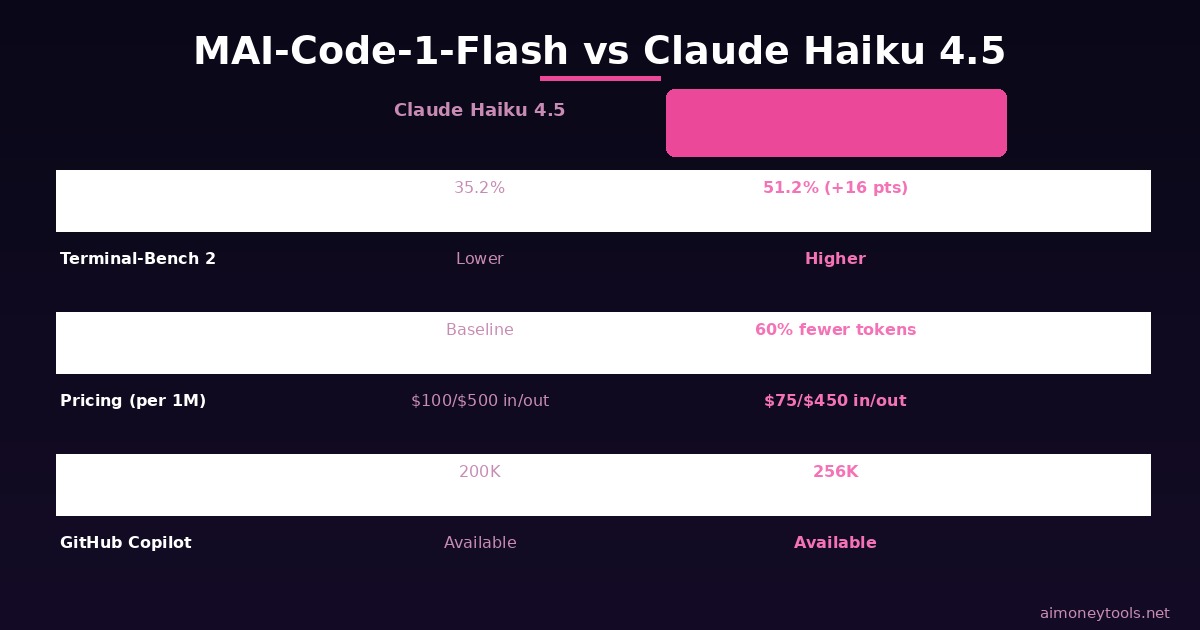
| Benchmark | MAI-Code-1-Flash | Claude Haiku 4.5 |
|---|---|---|
| SWE-Bench Verified | Higher pass rate, 60% fewer tokens | Baseline |
| SWE-Bench Pro | 51.2% | 35.2% (+16 pts advantage) |
| SWE-Bench Multilingual | Higher pass rate | Baseline |
| Terminal Bench 2 | Higher pass rate | Baseline |
The +16-point lead on SWE-Bench Pro is the most meaningful number. SWE-Bench Pro uses real-world GitHub repository issues — it measures whether the model can actually solve production-level software bugs, not just produce code that looks right.
But How Does It Stack Up Against GPT-5.4-mini?
This is where the picture is more complicated. A community comparison (sourced from GitHub Copilot pricing docs and OpenAI benchmarks) surfaced during the GitHub Copilot Reddit discussion:
| Model | Context Size | SWE-Bench Pro | Terminal-Bench 2.0 |
|---|---|---|---|
| GPT-5.4-mini | 400K | 54.4% | 60.0% |
| MAI-Code-1-Flash | 256K | 51.2% | 54.8% |
GPT-5.4-mini scores higher on both benchmarks while also offering a larger context window. Both models are priced the same on GitHub Copilot's API billing (~$75/$450 per million input/output tokens).
The honest read: MAI-Code-1-Flash is a clear step above Claude Haiku 4.5. Whether it is better than GPT-5.4-mini in real developer workflows is still being tested by the community, but on published numbers it trails slightly in both benchmark categories.
Pricing on GitHub Copilot
Pricing on GitHub Copilot's premium model billing:
- Input: $75 per million tokens
- Output: $450 per million tokens
- Cache: $7 per million tokens
This puts it cheaper than Claude Haiku 4.5 ($100/$500/$10) and at roughly the same price as GPT-5.4-mini.
For GitHub Copilot users on the legacy annual plan, MAI-Code-1-Flash carries a 0.33x multiplier — meaning it consumes about one-third of the token/request allowance compared to heavier models. For users on constrained legacy plans, this is a notable advantage.
How to Try MAI-Code-1-Flash

Getting access is straightforward if you are on the Individual GitHub Copilot plan:
Step 1 — Open GitHub Copilot Chat in VS Code
If you do not have GitHub Copilot installed, download VS Code and install the GitHub Copilot extension from the VS Code Marketplace. You will need an active GitHub Copilot Individual subscription.
Step 2 — Switch the model to MAI-Code-1-Flash
In the GitHub Copilot Chat panel, click on the model selector dropdown (currently defaults to GPT-5.4 or Claude depending on your settings). MAI-Code-1-Flash will appear as an option under Microsoft models.
Step 3 — Use it for inline and chat tasks
You can use MAI-Code-1-Flash for both inline completions (typing inside a file and letting Copilot suggest the next line) and for Chat mode (asking a question about your codebase, requesting refactors, debugging explanations). The model is optimized for both use cases within VS Code.
Step 4 — Compare it with your usual model
Give it a week with your normal coding tasks. If you are already using GPT-5.4-mini, the differences will be subtle. If you have been using Claude Haiku 4.5, the upgrade on complex tasks should be noticeable.
Business and Enterprise users: A GitHub employee confirmed in the Reddit thread that expansion to Business and Enterprise Copilot plans is planned. No timeline was given.
Who Should Use It?
Good fit:
- GitHub Copilot Individual subscribers who want a fast, cheap coding model
- Developers on legacy annual plans (0.33x multiplier makes it attractive)
- Teams looking to reduce token burn on everyday coding tasks (autocomplete, variable naming, small refactors)
Not ideal for:
- Complex multi-file architecture planning (GPT-5.5 or Claude Opus 4.8 are better choices)
- Developers who need the full 400K context window for very large codebases
- Business or Enterprise Copilot users (not yet available)
- Use cases outside VS Code/Copilot (no standalone API access at launch)
What This Signals for Microsoft's AI Strategy
MAI-Code-1-Flash is notable for what it represents beyond the model itself: Microsoft is now building its own AI models instead of relying entirely on OpenAI.
This is a meaningful shift. Microsoft has been OpenAI's largest infrastructure investor and distribution partner since 2019. The partnership includes GPT models in Azure, Copilot, and Bing. MAI-Code-1-Flash is not a replacement for those models — but it signals that Microsoft wants model diversity on its own platform, including models it controls entirely.
The "MAI" label (Microsoft AI) is likely the beginning of a model family. A "Flash" suffix implies there will be larger variants at some point. MAI-Code-1 would presumably be the full-size version, though Microsoft has not announced it.
For developers and for anyone building on GitHub Copilot, this means more model choices, more competition on price and performance, and — over time — potentially better tools.
Frequently Asked Questions
What is MAI-Code-1-Flash?
It is Microsoft's first in-house AI coding model, launched at Microsoft Build on June 2, 2026. It is designed for fast, cost-efficient developer workflows in GitHub Copilot for VS Code. The "Flash" name indicates it is a small, speed-focused model — not a large frontier model.
Is MAI-Code-1-Flash available in ChatGPT or other Microsoft products?
No. At launch, it is only available inside GitHub Copilot in Visual Studio Code for Individual plan subscribers. It is not in ChatGPT, Bing, or Azure as a standalone API offering yet.
How does it compare to Claude Haiku 4.5?
It outperforms Claude Haiku 4.5 on all four coding benchmarks Microsoft tested, including a 16-point lead on SWE-Bench Pro (51.2% vs. 35.2%). It also uses up to 60% fewer tokens for equivalent tasks, making it faster and more cost-efficient than Haiku.
How does it compare to GPT-5.4-mini?
Based on published benchmarks, GPT-5.4-mini scores slightly higher — 54.4% on SWE-Bench Pro vs. 51.2% for MAI-Code-1-Flash, and 60.0% on Terminal-Bench 2.0 vs. 54.8%. GPT-5.4-mini also has a larger context window (400K vs. 256K). Both are priced similarly in GitHub Copilot.
Is MAI-Code-1-Flash available for GitHub Copilot Business or Enterprise?
Not yet. At launch it is only available for Individual Copilot plan users. A GitHub spokesperson in the Reddit thread confirmed Business and Enterprise availability is planned but gave no specific timeline.
How much does it cost?
On GitHub Copilot's premium model API billing: $75 per million input tokens, $450 per million output tokens, $7 per million cached tokens. For legacy annual plan users, it carries a 0.33x multiplier — making it one of the most token-efficient options on Copilot.
Should I switch from GPT-5.4-mini to MAI-Code-1-Flash in GitHub Copilot?
If you are on a legacy annual plan with limited request budgets, yes — the 0.33x multiplier makes a meaningful difference. If you are on standard API billing at the same price, GPT-5.4-mini scores higher on the two benchmarks that have been publicly compared. It is worth trying MAI-Code-1-Flash on your own workloads, since benchmark numbers do not always reflect every developer's real experience.
What is Microsoft's plan for the MAI model family?
Microsoft has not published a roadmap. MAI-Code-1-Flash is the first public model under the MAI label. The "Flash" naming convention (used by Gemini, OpenAI, and Anthropic for their smaller tiers) implies a larger MAI-Code-1 model may follow, but nothing has been confirmed.

Alex the Engineer
•Founder & AI ArchitectSenior software engineer turned AI Agency owner. I build massive, scalable AI workflows and share the exact blueprints, financial models, and code I use to generate automated revenue in 2026.
Related Articles
How to Start an AI-Assisted Resume Writing Side Hustle in 2026 (Beginner's Guide)
A step-by-step guide to using AI resume tools to offer a paid resume and cover letter writing service — what to charge, which tools to use, and how to find your first clients.
How to Build and Sell AI Voice Receptionists to Local Businesses in 2026
A beginner's guide to building AI voice agents that answer business phone calls — the tools to use, what to charge, and how to find your first client.
How to Make Money on Fiverr with AI Tools in 2026: 7 Gigs You Can Start This Week
Discover 7 real Fiverr gigs you can launch using free and low-cost AI tools in 2026 — no experience required. Real pricing data, step-by-step setup, and tools that actually work.