
Kimi K2 Thinking Review: The Free Open-Source AI Beating GPT-5 (And How to Try It)
Kimi K2 Thinking is an open-source AI from Moonshot AI that outscores GPT-5 and Claude Sonnet 4.5 on key benchmarks — and it's completely free to try. Here's what it is and how to use it.
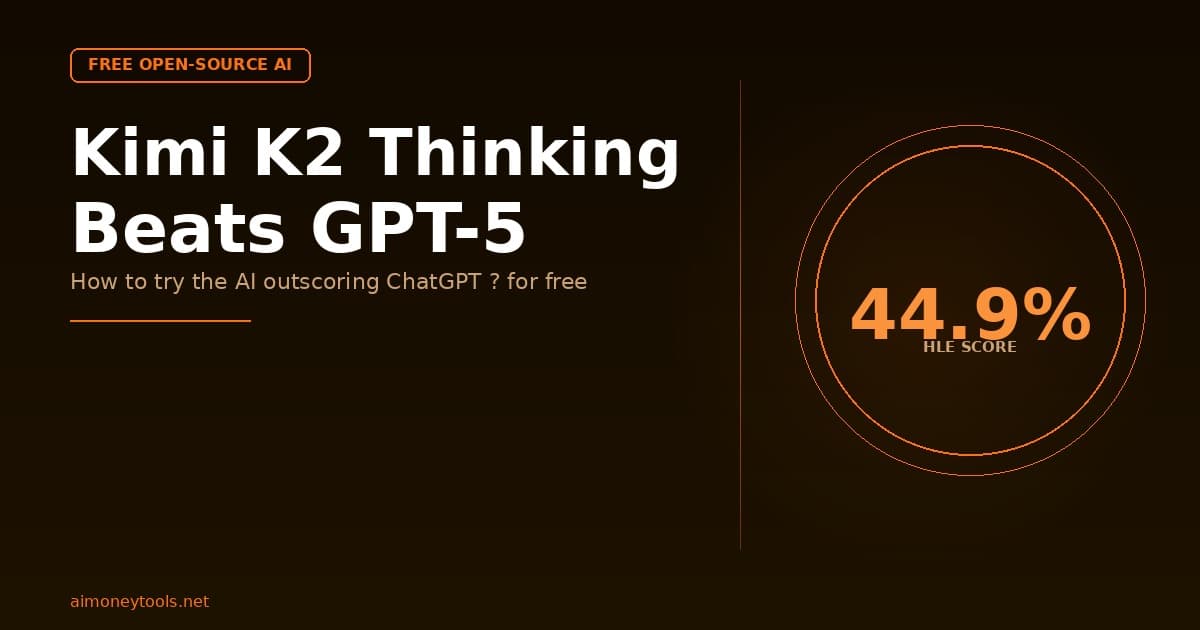
There's a new open-source AI that's quietly beating ChatGPT and Claude on several major benchmarks — and barely anyone outside of the AI research community has heard of it.
It's called Kimi K2 Thinking, made by Chinese AI company Moonshot AI. It's free to use, available right now at kimi.com, and independently verified to outperform OpenAI's GPT-5 and Anthropic's Claude Sonnet 4.5 on tasks involving reasoning and coding.
This guide breaks down what Kimi K2 Thinking actually is, what it's good at, how it compares to ChatGPT, and how you can start using it today — no coding required.
What Is Kimi K2 Thinking?
Kimi K2 Thinking is an AI model built by Moonshot AI, a Beijing-based AI company that's been quietly building some of the most capable open-source models in the world.
The "Thinking" in the name refers to the model's architecture: it uses chain-of-thought reasoning, meaning it works through problems step-by-step before giving an answer — similar to how OpenAI's o1 and o3 models work. This approach tends to produce far more accurate answers on complex tasks like math, logic puzzles, and multi-step coding challenges.
Under the hood, Kimi K2 Thinking is a Mixture-of-Experts (MoE) model with 1 trillion total parameters, but only 32 billion are active at any given time. This design is similar to Google's Gemma 4 and DeepSeek V4 — it lets the model punch well above its "effective" size while staying efficient to run.
The model is open-source and available on Hugging Face under an open license, which means researchers and developers can download and run it locally. For regular users, the easiest access is through kimi.com, which offers a free chat interface — no account required to start.
How Does It Compare to GPT-5 and Claude?
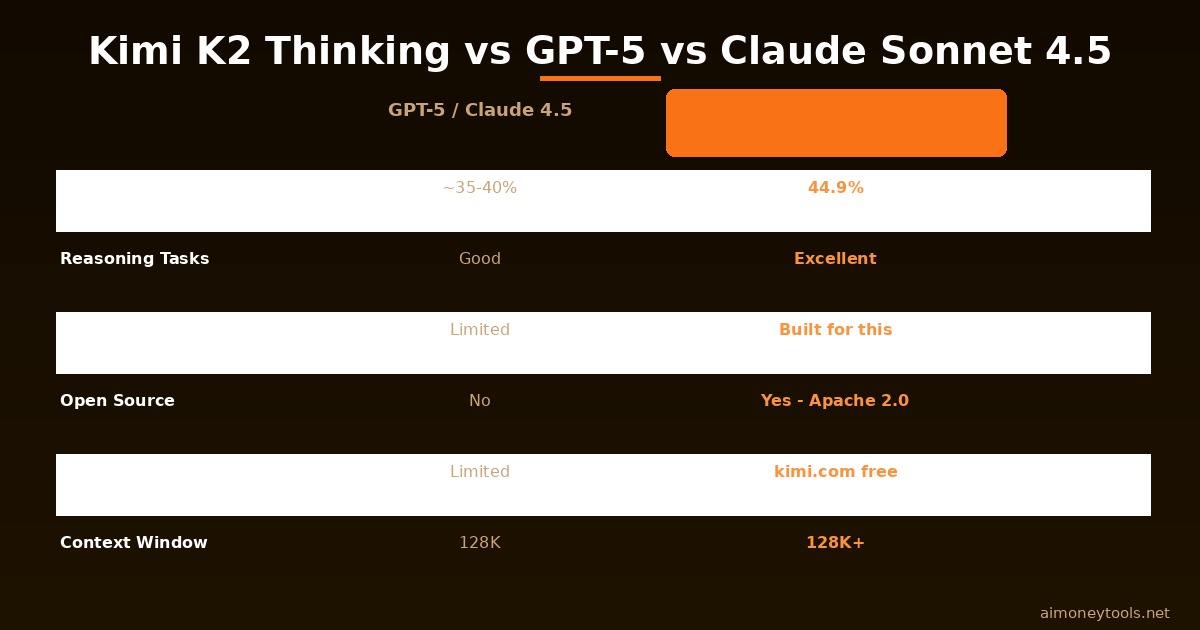
This is where things get interesting. Independent evaluations have placed Kimi K2 Thinking ahead of GPT-5 and Claude Sonnet 4.5 on several standard AI benchmarks:
HLE (Humanity's Last Exam) with Tools: This is one of the hardest AI benchmarks in existence — a set of expert-level questions from PhDs in STEM fields. Kimi K2 Thinking scores 44.9% with tool access. For context, most frontier models score in the 30–40% range.
Reasoning and Agentic Tasks: The model was specifically designed as a "thinking agent" — it doesn't just answer questions, it can plan multi-step tasks, use tools, and execute workflows. This makes it particularly strong for anything involving analysis, research breakdowns, or debugging.
What This Means for Non-Coders: Benchmarks are interesting, but the practical takeaway is simpler: Kimi K2 Thinking tends to give more thoughtful, structured answers than standard chatbots on complex questions. If you've ever found ChatGPT too surface-level on something like "help me figure out why my business isn't growing" or "explain the difference between these two contracts," a reasoning-focused model like K2 Thinking often digs deeper.
That said, for casual tasks (summarizing an email, writing a quick social post), the difference is minimal. Thinking models show their advantage on problems that require actual deliberation.
What Is Kimi K2 Thinking Actually Good At?
Based on hands-on testing reported by the AI community, here's where Kimi K2 Thinking genuinely shines:
Complex reasoning and analysis. Give it a 10-page document and ask it to find inconsistencies, or ask it to reason through a business decision with multiple variables. The step-by-step thinking process is visible, which also makes it easier to spot where it might be going wrong.
Coding and debugging. Kimi K2 Thinking has strong performance on coding benchmarks. For non-developers, this is useful because it can explain code in plain English, help you follow a tutorial when you get stuck, or generate working scripts for repetitive tasks without needing you to understand the syntax.
Research and summarization. It handles long contexts well and is good at synthesizing information from multiple sources into a clear summary. This is useful if you're trying to research a business decision, compare products, or get up to speed on a new topic quickly.
Where it's weaker: Like most open-source models, image understanding and real-time web browsing are limited compared to ChatGPT Plus. For creative tasks like writing marketing copy or social captions, GPT-5 and Claude tend to have more natural-sounding output. Kimi K2 Thinking is more of a "precision tool" than an "everything tool."
How to Use Kimi K2 Thinking for Free
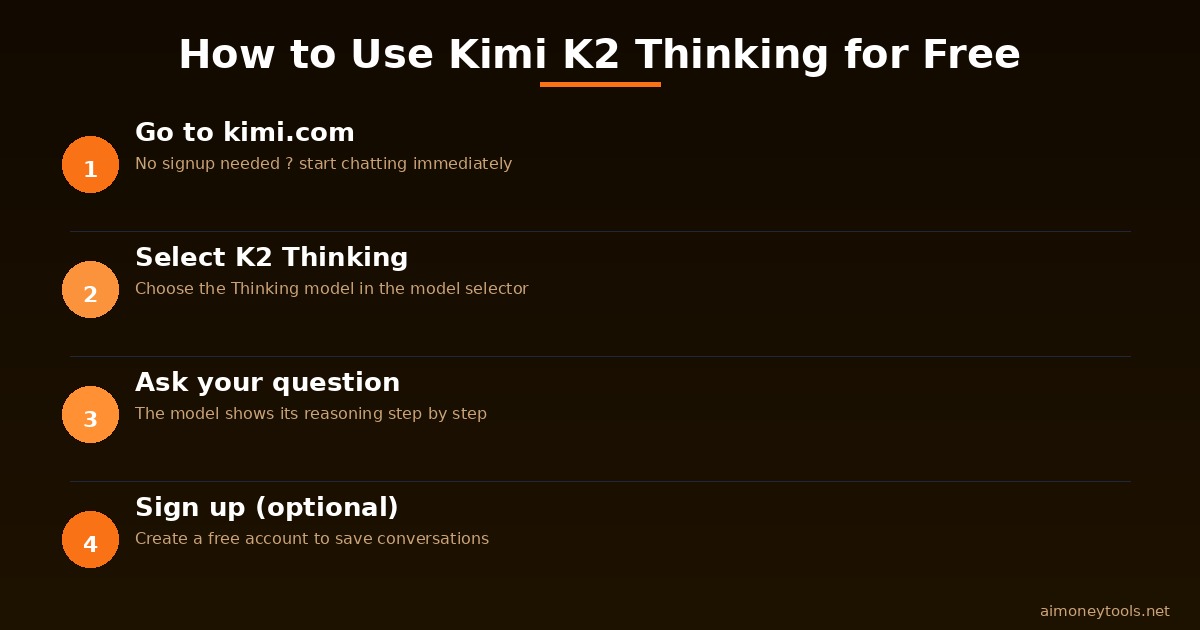
Getting started with Kimi K2 Thinking takes about two minutes.
Option 1: Use it in your browser (easiest)
- Go to kimi.com
- You can start chatting immediately without an account, or sign up for free to save your conversations
- Look for the model selector and choose K2 Thinking if it's not already selected
- Ask your question — the model will show its reasoning process as it works
The free tier at kimi.com includes access to K2 Thinking with reasonable usage limits. For most personal or research use, the free plan is enough.
Option 2: API access (for developers and power users)
Moonshot AI offers API access to Kimi K2 Thinking through their platform. This lets you integrate the model into your own tools, automate tasks, or build custom applications. Pricing is competitive with other frontier model APIs.
If you're a business owner thinking about building a custom AI assistant trained on your own content, CustomGPT.ai is still the easier route — it handles the infrastructure for you without requiring any coding or API setup.
Option 3: Run it locally (advanced)
Kimi K2 Thinking is available on Hugging Face as an open-weight model. Running the full 1T parameter model locally isn't realistic for most people (you'd need dozens of high-end GPUs), but quantized versions are being made available for those who want offline use. If you're considering this route, check the VRAM requirements carefully — our Gemma 4 system requirements guide shows the same principles that apply here.
For serious local deployment or inference, Ampere.sh is an affordable cloud GPU option that lets you run large open-source models without buying your own hardware.
Is It Better Than ChatGPT for Everyday Use?
Honest answer: it depends on what you're doing.
For structured reasoning tasks — analyzing a contract, reviewing a business plan, debugging a process, solving a logic problem — Kimi K2 Thinking is competitive with or better than GPT-5 on many of these tasks. The "thinking" output shows you how it arrived at its answer, which is useful when you need to trust the reasoning.
For creative tasks — writing, brainstorming, casual Q&A — ChatGPT and Claude are still more polished. They've had more fine-tuning on tone and style for general-purpose use.
The practical move is to keep ChatGPT or Claude as your daily driver, and reach for Kimi K2 Thinking when you have a problem that requires genuine step-by-step analysis. Since it's free, there's no reason not to have both.
One more practical note: because Kimi K2 Thinking is open-source, it doesn't have the same content restrictions as ChatGPT. It's more flexible on edge-case prompts, which some users find useful.
Why You're Hearing About It Now
Kimi K2 Thinking was released in late 2025, but it's surfacing in wider tech circles now as independent benchmarks have validated the performance claims. VentureBeat recently ran a detailed analysis showing it outperforming several OpenAI and Anthropic models on agentic tasks, which prompted a wave of reviews from the AI community.
This is a pattern we've seen with other Chinese open-source releases — Qwen 3.6, DeepSeek V4 — where the models quietly match or beat Western frontier models at a fraction of the cost. Kimi K2 Thinking continues that trend.
Key Takeaways
- Kimi K2 Thinking is a free open-source AI from Moonshot AI that outperforms GPT-5 and Claude Sonnet 4.5 on reasoning benchmarks
- It uses chain-of-thought reasoning: the model shows its work, which is useful for complex problems
- 1 trillion parameter MoE architecture, 32B active parameters — same design philosophy as Gemma 4 and DeepSeek V4
- HLE with tools score: 44.9% — among the top scores for any model on this benchmark
- Access it free at kimi.com — no signup required to start
- Best for: analysis, reasoning, coding, research. Less ideal for: creative writing, casual chat
- Open-source weights on Hugging Face for those who want to run it locally or via cloud GPU
FAQ
Is Kimi K2 Thinking free to use? Yes. You can chat with Kimi K2 Thinking for free at kimi.com without creating an account. Free tier usage limits apply for extended sessions. API access has a cost structure similar to other frontier model providers.
Who made Kimi K2 Thinking? Moonshot AI, a Chinese AI company also known for the Kimi chat product. They've released several open-source models including Kimi K2, K2 Thinking, K2.5, and K2.6.
Is Kimi K2 Thinking really better than ChatGPT? On specific benchmarks like HLE (expert reasoning) and certain coding tasks, yes — Kimi K2 Thinking outscores GPT-5 and Claude Sonnet 4.5. For everyday creative or conversational tasks, ChatGPT is still more polished. The practical answer is that they're suited to different types of tasks.
Can I run Kimi K2 Thinking locally on my PC? The full model is too large for most consumer hardware. Quantized versions are available on Hugging Face for those with high-end setups. For practical offline use, check the system requirements for local AI models — the same VRAM principles apply.
Is Kimi K2 Thinking safe to use? Is it censored? As an open-source model, it has fewer content restrictions than commercial models like ChatGPT. It's generally safe for research, analysis, and productivity tasks. As with any AI tool, don't share sensitive personal data in your prompts.
What's the difference between Kimi K2 and Kimi K2 Thinking? Kimi K2 is the base model. Kimi K2 Thinking is a variant fine-tuned specifically for chain-of-thought reasoning — it produces better results on multi-step problems at the cost of slightly slower responses (since it generates reasoning steps first before answering).
How does the 1 trillion parameter claim compare to other models? The 1T number refers to total parameters in the MoE architecture, but only 32B are active during any given inference. For comparison, Gemma 4's 31B dense model activates all 31B parameters — different design philosophies for different use cases. More parameters don't always mean better results; the architecture and training matter more.

Alex the Engineer
•Founder & AI ArchitectSenior software engineer turned AI Agency owner. I build massive, scalable AI workflows and share the exact blueprints, financial models, and code I use to generate automated revenue in 2026.
Related Articles
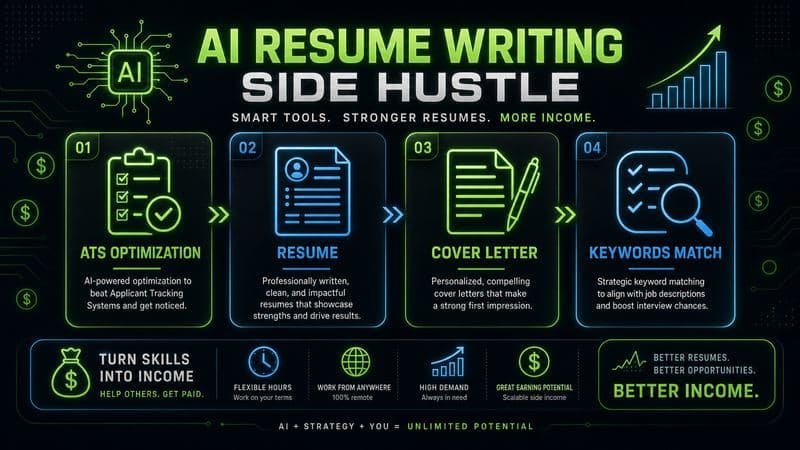
How to Start an AI-Assisted Resume Writing Side Hustle in 2026 (Beginner's Guide)
A step-by-step guide to using AI resume tools to offer a paid resume and cover letter writing service — what to charge, which tools to use, and how to find your first clients.
How to Build and Sell AI Voice Receptionists to Local Businesses in 2026
A beginner's guide to building AI voice agents that answer business phone calls — the tools to use, what to charge, and how to find your first client.

How to Make Money on Fiverr with AI Tools in 2026: 7 Gigs You Can Start This Week
Discover 7 real Fiverr gigs you can launch using free and low-cost AI tools in 2026 — no experience required. Real pricing data, step-by-step setup, and tools that actually work.