Google's AI Brain Drain: Nobel Scientist John Jumper Joins Anthropic (What It Means for Claude)
Nobel Prize winner John Jumper just left Google DeepMind for Anthropic — days after Gemini's co-lead left for OpenAI. Here's why the world's best AI scientists are abandoning Google, and what it means for the AI tools you use.
Something big happened in AI this week — not a new model, not a product launch, but a quiet signal that says more about the future than any benchmark chart.
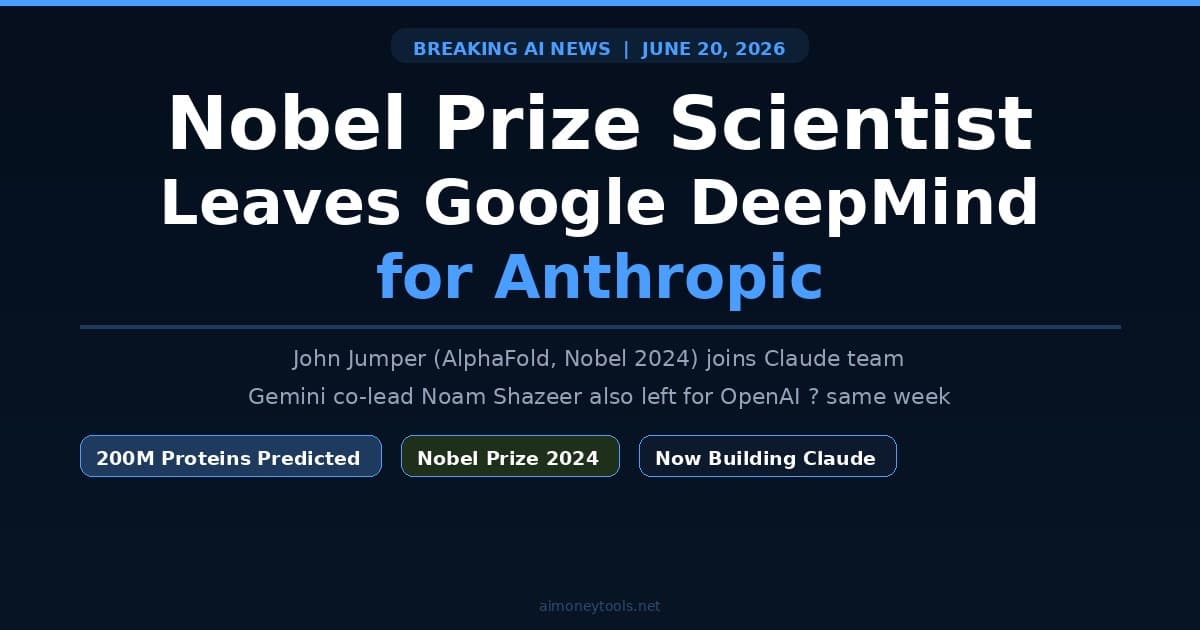
John Jumper, one of the greatest scientists in AI history, just left Google.
He co-created AlphaFold — a system that predicted the structure of 200 million proteins and won the Nobel Prize in Chemistry in 2024. After nearly nine years at Google DeepMind, he's joining Anthropic to work on Claude.
That same week, Noam Shazeer — the engineer who led the development of Google's Gemini models — also left to join OpenAI.
Two of Google's most important AI minds. Gone. In the same week.
If you're a beginner trying to figure out which AI tools are worth your time, this matters more than any spec sheet.
Who Is John Jumper (And Why Should You Care)?
John Jumper is a chemist and computer scientist who spent nearly a decade at Google DeepMind. He's best known for building AlphaFold, an AI system that solved one of biology's biggest unsolved problems.
Here's the problem he solved: figuring out how proteins fold.
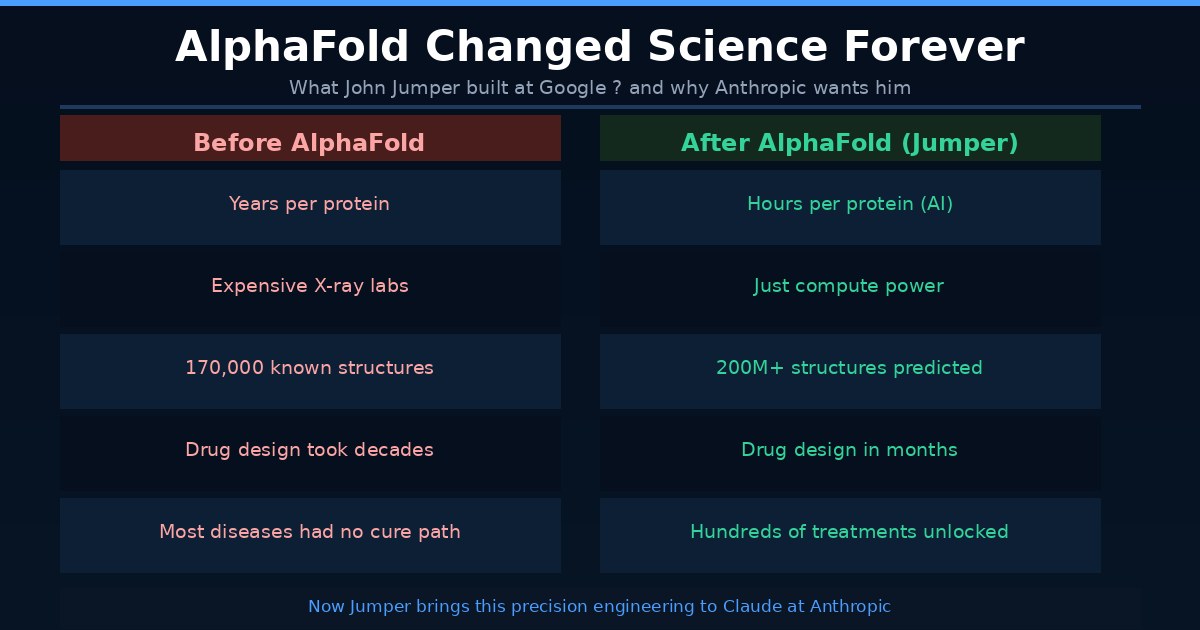
Proteins are the building blocks of life. A protein's shape determines what it does — fight disease, carry oxygen, break down food. Scientists needed to know the 3D shape of proteins to design new medicines. But figuring out even one protein's shape could take a lab years.
AlphaFold did it in hours. For all 200 million known proteins.
This wasn't a small improvement. It was like going from hand-drawing maps to satellite GPS. Drug researchers now use AlphaFold to design treatments for cancer, Alzheimer's, and diseases that had no cures for decades.
For this, Jumper (along with DeepMind CEO Demis Hassabis) won the Nobel Prize in Chemistry in 2024.
Now he's taking his talent to Anthropic — the company behind Claude.
The Talent War That's Reshaping AI
### What actually happened?
On June 19, 2026, Jumper posted on X:
"After nearly nine years, I have decided to leave Google DeepMind and join Anthropic."
DeepMind CEO Demis Hassabis responded warmly, calling AlphaFold a discovery that "changed the world." But the departure speaks for itself.
And Jumper wasn't alone. Days earlier, Noam Shazeer — the VP of engineering who co-led development of Google's Gemini AI models — announced he's leaving for OpenAI.
This is a brain drain at Google's AI division, and industry analysts aren't surprised.
"There is so much demand for limited AI research talent that the frontier AI research labs are willing to do whatever it takes to add them. This puts OpenAI and Anthropic at an advantage over large companies like Google because they can promise less bureaucracy and a more focused effort on pursuing Superintelligence."
— Gil Luria, D.A. Davidson analyst (Reuters)
### Why would a Nobel Prize winner leave Google?
Google is one of the most powerful technology companies on Earth. It invented the Transformer architecture that powers essentially every major AI model today. It has virtually unlimited resources.
But size creates friction. Decisions move slowly. Research priorities compete with product goals. Engineers at a company of 180,000 people face more internal approvals than engineers at a focused 2,000-person startup.
Anthropic has roughly 3,000 employees and one mission: build safe, powerful AI. No ads division to worry about. No search engine to protect. No YouTube to optimize.
For a researcher who wants to push the frontier of what AI can do in science and medicine, that focus is worth more than any salary.
What Does This Mean for Claude?
This is the question that matters for anyone using AI tools right now.
Anthropic already has a strong track record. Claude Fable 5 and Mythos 5 launched in June 2026 as arguably the most powerful AI models ever released — so powerful that the U.S. government temporarily restricted access to them.
But Jumper brings something unique: a deep understanding of how AI can solve real-world scientific problems.
Most AI researchers work on language models — systems that handle text, code, and conversation. Jumper's expertise is in structural prediction — using AI to understand physical reality at the molecular level.
Here's what that could mean for Claude:
- Smarter reasoning — AlphaFold's architecture was built for multi-step scientific reasoning, not just pattern matching. That mindset could influence how future Claude models think through problems.
- Scientific accuracy — One of Claude's biggest advantages already is accuracy and lower hallucination rates. Jumper's work on protein structure required extreme precision. Expect that standard to carry over.
- Health and science tools — Anthropic is hosting a science event on June 30, 2026. Jumper joining right before that event is almost certainly not a coincidence.
For everyday users: Claude is likely to become significantly more reliable at tasks that require precise, multi-step thinking — writing research, analyzing data, solving complex problems.
The Comparison: Claude vs. ChatGPT Right Now
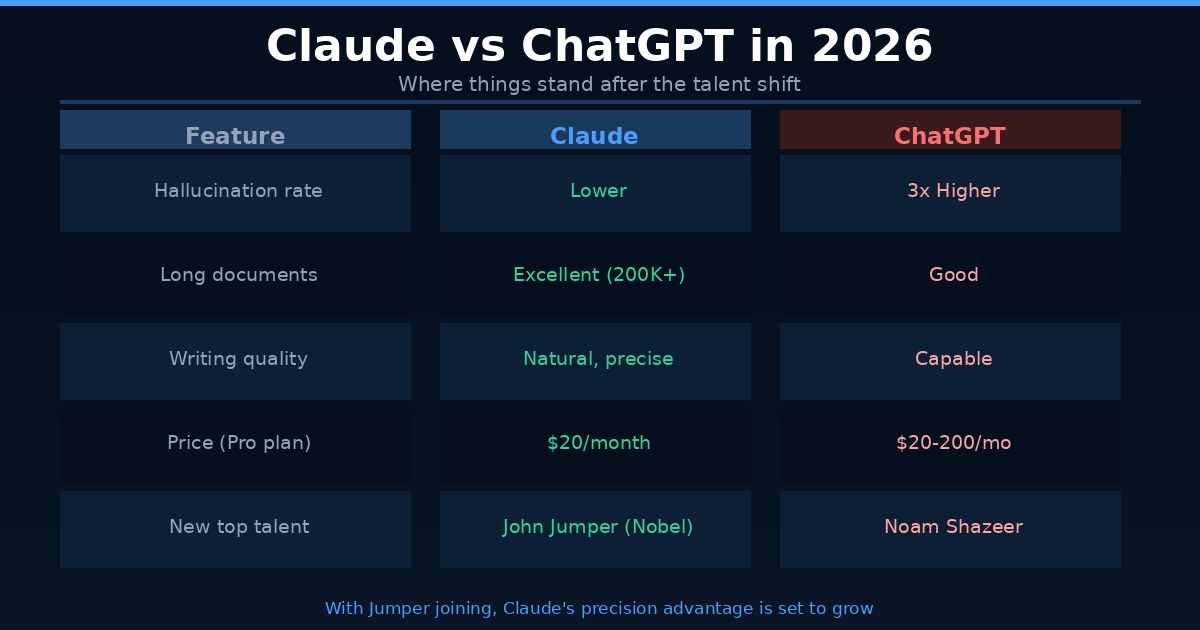
If you're deciding between AI tools, here's where things stand today:
| Feature | Claude (Anthropic) | ChatGPT (OpenAI) |
|---|---|---|
| Hallucination rate | Lower | Higher (GPT-5.5 hallucinates 3x more than GLM-5.2) |
| Long documents | Excellent (200K context) | Good |
| Code quality | Strong | Strong |
| Tone/writing | Natural, nuanced | Capable but occasionally robotic |
| Price (Pro plan) | $20/month | $20–200/month |
| Open source option? | No | No |
| Free alternative | Claude.ai free tier | ChatGPT free tier |
The hallucination gap is real. Independent benchmarks published this week showed that GPT-5.5 hallucinates approximately 3x more frequently than open-source alternatives like GLM-5.2 on structured tasks.
Claude's reputation for careful, accurate responses is already one of its strongest selling points. With Jumper joining, that advantage is likely to grow.
Is Google's AI in Trouble?
Not exactly — but this is worth watching.
Google still employs thousands of top AI researchers. Gemini 3.5 Pro remains one of the most capable models for many tasks. And Google has infrastructure advantages that no startup can match.
But the pattern is concerning. Over the past year:
- Noam Shazeer (Gemini co-lead) → OpenAI
- John Jumper (Nobel Prize, AlphaFold) → Anthropic
- Several other senior researchers have quietly moved to startups
When elite talent consistently chooses smaller, more focused organizations over Google's scale, it signals something about culture and direction — not just compensation.
For you as an AI user, the net result is probably positive: more talent concentrated at Anthropic and OpenAI means faster improvements to the tools you're already paying for.
What Should You Do With This Information?
If you're a beginner trying to decide which AI tools to invest time learning, here's the practical takeaway:
Claude is getting stronger fast. If you haven't tried it, now is a good time. The free tier at claude.ai gives you access to solid capabilities, and the Pro plan ($20/month) unlocks the full Fable 5 model.
The open-source wave is real. While these talent moves strengthen Anthropic and OpenAI, models like GLM-5.2 are proving that you don't have to pay premium prices to access frontier-level AI. MIT-licensed, free to run, and beating GPT-5.5 on several key benchmarks.
Google is still strong. Don't write off Gemini. But the talent signal is one worth tracking if you're making longer-term decisions about which AI platforms to build skills on.
Frequently Asked Questions
### Who is John Jumper and why is he famous?
John Jumper is a computer scientist and chemist who co-created AlphaFold at Google DeepMind. AlphaFold predicted the 3D structure of over 200 million proteins — a breakthrough that accelerated drug discovery by decades. He shared the 2024 Nobel Prize in Chemistry with DeepMind CEO Demis Hassabis for this work.
### Why did John Jumper leave Google DeepMind?
Jumper said in an X post that after nearly nine years, he decided to leave for Anthropic. Industry analysts note that smaller AI labs like Anthropic can offer researchers more focus, less bureaucracy, and a direct path toward pursuing AGI — advantages that large corporations like Google struggle to match.
### What will John Jumper do at Anthropic?
Anthropic has not announced his specific role, but his expertise in structural AI reasoning and scientific problem-solving will likely influence Claude's capabilities in precision, multi-step reasoning, and potentially AI for science and medicine. Anthropic is hosting a science event on June 30, 2026.
### Does this mean Claude is better than ChatGPT?
It depends on the task. Claude already has lower hallucination rates than GPT-5.5 on several benchmarks. For writing, research, and document analysis, many users prefer Claude's more careful, nuanced responses. ChatGPT remains strong for coding and general tasks. With Jumper's arrival, Claude's precision advantage is likely to grow.
### Who is Noam Shazeer and why did he leave Google?
Noam Shazeer was VP of engineering at Google and co-led development of the Gemini models. He left to join OpenAI. His departure, combined with Jumper's move to Anthropic in the same week, has drawn significant attention to Google's ability to retain AI talent.
### Is this bad news for Google and Gemini?
Google still has enormous AI talent and infrastructure. Gemini remains highly capable. However, losing two high-profile researchers in one week — including a Nobel laureate — signals that some of the world's best AI minds are finding more compelling opportunities at focused AI startups.
### What free AI tools should beginners use right now?
For everyday tasks, Claude.ai's free tier and ChatGPT's free tier are both solid starting points. For technical users who want to run powerful AI locally without paying, GLM-5.2 offers frontier-level performance under an MIT license — you can download and run it for free.
### What does this mean for AI tool prices?
Competition between labs usually drives prices down. OpenAI, Anthropic, and open-source alternatives are all competing for users. GLM-5.2 already offers API access at $5.80/million tokens combined — compared to $35/million for GPT-5.5. Expect continued pressure on pricing as the talent war intensifies.

Alex the Engineer
•Founder & AI ArchitectSenior software engineer turned AI Agency owner. I build massive, scalable AI workflows and share the exact blueprints, financial models, and code I use to generate automated revenue in 2026.