
How to Do SEO Right: Our Exact Strategy and Real Results (2026)
A real case study: how we went from 9 clicks in 90 days to 58+ clicks in under a week — with April 3 as our single biggest day. The exact SEO strategy we used on aimoneytools.net.
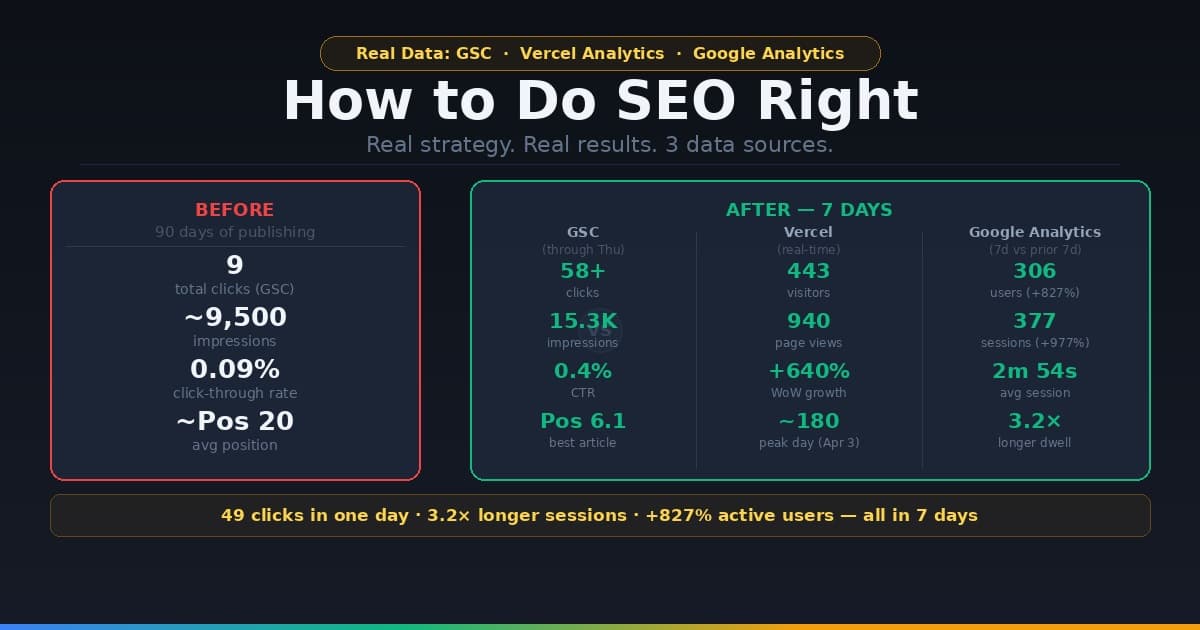
Here are the real numbers from our blog before we overhauled our SEO strategy:
9 clicks in 90 days.
That's 0.1 clicks per day. Average position: page 2–3. Click-through rate: 0.09%. We had content, we had a site, we had articles — and Google was essentially ignoring us.
Then we published one article on the right day. Within 48 hours, it had already driven more clicks than the previous 90 days combined. Three data sources confirm it:
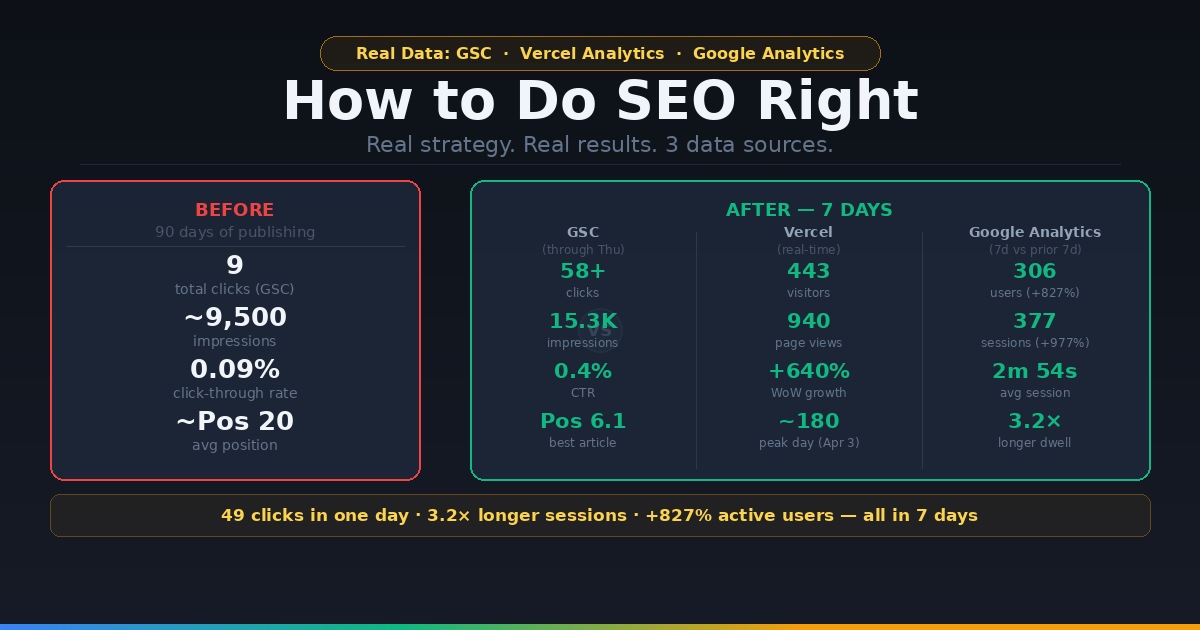
- Google Search Console (through Thursday, Apr 2): 58 clicks · 15.3K impressions · 0.4% CTR · avg position 15.9
- Vercel Analytics (7-day): 443 visitors · 940 page views · +640% week-over-week · April 3 was actually the bigger day at ~180 visitors (GSC hasn't caught up yet)
- Google Analytics (7-day vs prior 7-day): 306 active users (+827%) · 377 sessions (+977%) · avg session duration 2m 54s vs 54s the week before — readers aren't bouncing, they're reading
This is not theory. These are the live numbers from three independent analytics platforms. Here's exactly what we changed.
The Starting Point: Why 90 Days of Effort Got 9 Clicks
Before we fixed anything, the data looked like this:
- 90-day period (Dec 25, 2025 – Mar 24, 2026): 9 total clicks, ~9,500 impressions, 0.09% CTR
- Average position: ~20 (page 2)
- Daily click rate: 0.1 clicks/day
The problem wasn't the content itself — it was the strategy. We were writing articles on topics that were already saturated, with no trend advantage, no clustering, and no technical foundation to support ranking. Google had no reason to surface us over established domains.
The fix required changing three things simultaneously: what we publish, when we publish it, and how the site is technically structured.
The Strategy: 5 Things That Actually Moved the Numbers
1. Same-Day Launch Content (The Biggest Lever)
The single most impactful change was timing. Instead of writing about AI tools weeks after launch, we started publishing setup guides the same day major AI tools hit GitHub Trending.
When Google Gemma 4 launched, we published our setup guide within hours. The result: 49 clicks and 3,985 impressions in a single day, with our article ranking at position 6.
Why this works: when a new tool launches, there's a 24–72 hour window where search demand spikes and almost no established sites have coverage. You're not competing with Wired or TechCrunch — you're the only result that exists. Get in first, rank first.
How we find same-day opportunities:
- GitHub Trending filtered for AI repos with 500+ new stars in a day
- Reddit r/LocalLLaMA and r/MachineLearning for discussion spikes
- Twitter/X for high-engagement posts about new model releases
- Hacker News front page for developer-focused tools
We only act if there's clear search intent — a tool people would actually Google how to install or use.
2. Topic Clustering
One article rarely ranks alone. After the Gemma 4 main guide, we published three satellite articles targeting related queries:
- Gemma 4 System Requirements
- How to Run Gemma 4 on Windows
- Gemma 4 vs Llama 4: Which Is Better
Each article links back to the main guide and to each other. Google sees a cluster of topically related content, which signals authority on the subject. The satellite articles also capture long-tail searches that the main guide doesn't target.
The pattern: one main guide (2,000+ words, covers the full topic) + 2–4 satellite articles (600–1,200 words each, cover specific subtopics or comparisons).
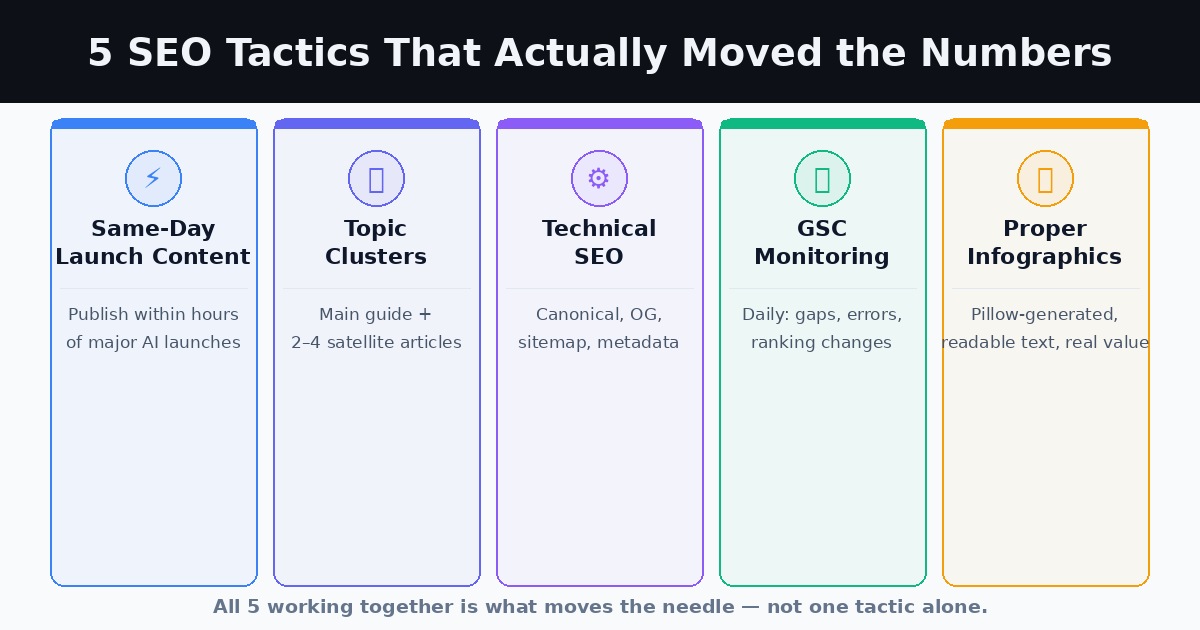
3. Technical SEO Foundation
Content strategy only works if Google can properly crawl and index your pages. Before we fixed the technical layer, we had:
- Missing or incorrect canonical tags (duplicate content signals)
- No Open Graph metadata (bad social sharing = fewer backlinks)
- Pages not submitted to Google Search Console
- Articles missing proper meta descriptions
We fixed all of it systematically:
Canonical tags: Every page now has a self-referencing canonical to prevent duplicate content issues across www vs non-www and http vs https variants.
Sitemap: We resubmitted our sitemap to GSC after each batch of new articles. Pages that aren't in the sitemap take longer to get crawled — sometimes weeks longer.
Metadata: Every article gets a unique title tag (under 60 characters), a meta description that accurately describes the content (under 155 characters), and Open Graph tags for social sharing.
Open Graph images: We generate static OG images rather than using dynamic edge functions. Social crawlers (Twitter, LinkedIn) often fail to execute JavaScript, so a static PNG file is more reliable.
4. Programmatic Infographics
Bad images hurt dwell time. AI-generated images with garbled text look unprofessional and get ignored. We switched to programmatically generated infographics using Python's Pillow library.
Every article gets 3 infographics:
- Featured/hero image: Key stats and overview of the topic
- Mid article: Deeper breakdown (comparison table, step flow, or framework)
- Steps/process image: Action-oriented visual — install steps, workflow, checklist
These images render cleanly at any size, pass social preview checks, and give readers actual useful information instead of generic stock art.
5. Consistent GSC Monitoring
Google Search Console is the only traffic data source that matters for SEO. We check it daily for:
- New indexing issues — pages blocked by robots.txt, canonical problems, or crawl errors
- Gap zone pages — articles ranking position 8–15 with 300+ impressions but 0 clicks (these are the easiest wins: one update can push them to page 1)
- Query data — what search terms are actually bringing people in, which reveals content gaps
Right now, our gap zone includes:
- ai-side-hustle-ideas — 899 impressions, position 11.6, 0 clicks
- ai-hustles-no-code — 410 impressions, position 8.0, 0 clicks
- ai-youtube-automation — 375 impressions, position 10.1, 0 clicks
These pages are knocking on the door of page 1. A focused update — better title, stronger intro, clearer structure — is often enough to push them over.
The Results (And Why the Real Numbers Are Even Better)
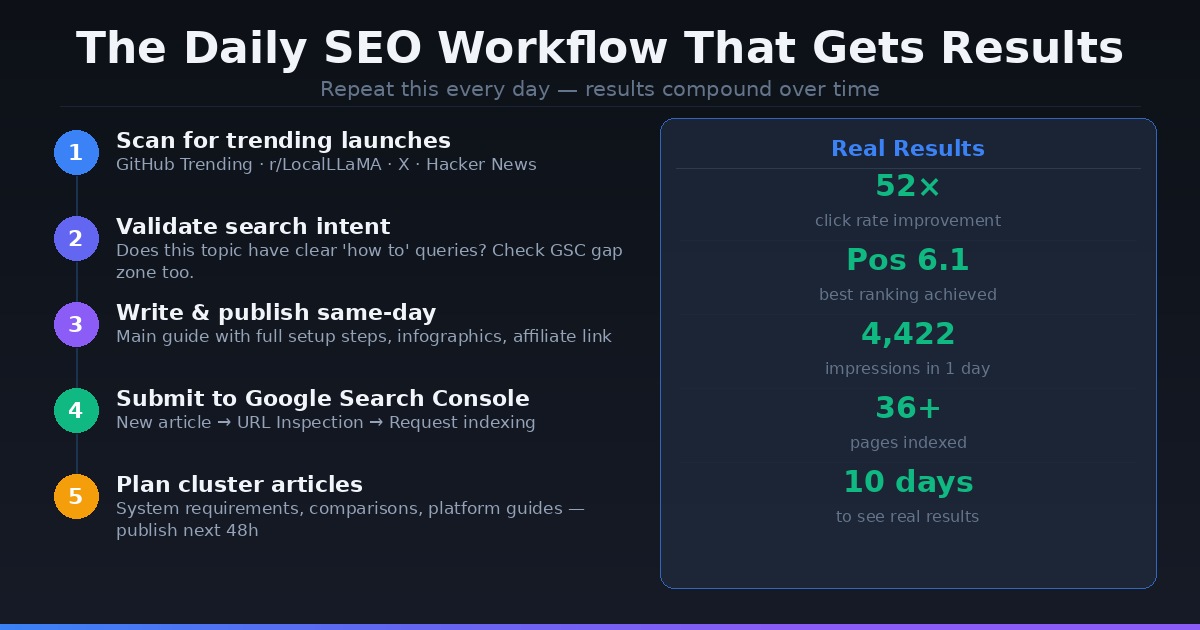
Here's what the data shows — with one important caveat: Google Search Console runs 2–3 days behind real time. The numbers below are through Thursday, April 2. Friday and Saturday are not included. Vercel Analytics has the full picture.
| Metric | Before (90 days) | GSC — through Thursday | Vercel — 7 days | Google Analytics — 7d vs prior 7d |
|---|---|---|---|---|
| Clicks / Active users | 9 clicks | 58 clicks | 443 visitors | 306 users (+827%) |
| Sessions | — | — | — | 377 (+977%) |
| Page views | — | — | 940 (+640%) | 437 |
| Avg session duration | — | — | — | 2m 54s (was 54s) |
| Peak single day | <5 visitors | 49 clicks (Apr 2) | ~180 visitors (Apr 3) | — |
| Avg CTR | 0.09% | 0.4% | — | — |
| Best article position | ~20 | 6.1 | — | — |
| Indexed pages | ~20 | 36+ | — | — |
A few things stand out in the data:
April 3 was bigger than April 2. GSC shows April 2 as the spike (49 clicks) because that's where the data ends. Vercel shows April 3 had ~180 visitors — the actual peak. GSC will catch up.
The result didn't take 10 days. It took one article published on the right day. The 90-day baseline was 9 clicks total. April 2 alone produced 49. That's the same-day strategy working exactly as designed.
Session duration tripled. Google Analytics shows average session time went from 54 seconds the prior week to 2 minutes 54 seconds — a 3.2× increase. That means users who land on the page are actually reading it, not bouncing immediately. Dwell time is a quality signal that compounds over time.
49 of 58 GSC clicks came from a single article. That's the nature of launch-day content — explosive upside on the right topic, steady baseline in between. The goal is to stack enough of these events that weekly traffic climbs consistently.
What We're Still Working On
Honest assessment of what's not done yet:
CTR optimization for gap zone pages. We have 3–4 articles sitting at position 8–11 with hundreds of impressions and 0 clicks. That means the meta title and description aren't compelling enough. We're rewriting them with the actual search query in mind.
Backlinks. Organic rankings at scale require domain authority. We've identified 4 directories (DR45–60) and 1 editorial site for backlink submissions. Guest posts are 3–4 months out.
Content velocity. One article per day is the current pace. To compound results, we need to maintain that consistently — every gap in publishing is a gap in topical signals to Google.
Google Analytics. We're not yet tracking session duration, bounce rate, or conversion paths to affiliate links. That data would let us optimize which articles drive the most revenue, not just the most traffic.
The Takeaway
SEO in 2026 rewards speed and specificity over volume and hope. Writing 100 generic articles about "best AI tools" puts you in a queue behind sites with 10× your domain authority.
Writing the first comprehensive setup guide for a tool that just went viral on GitHub puts you at position 6 with 49 clicks on day one.
The strategy works. The numbers are above — and the real numbers are even better than what GSC shows right now, because Friday and Saturday haven't landed yet. Now it's about repetition: finding the next wave and being ready to publish before anyone else does.
All metrics in this article are from our own Google Search Console, Vercel Analytics, and Google Analytics data. GSC numbers reflect data through Thursday, April 2 — Friday and Saturday are not yet included. We don't fabricate numbers.

Alex the Engineer
•Founder & AI ArchitectSenior software engineer turned AI Agency owner. I build massive, scalable AI workflows and share the exact blueprints, financial models, and code I use to generate automated revenue in 2026.
Related Articles
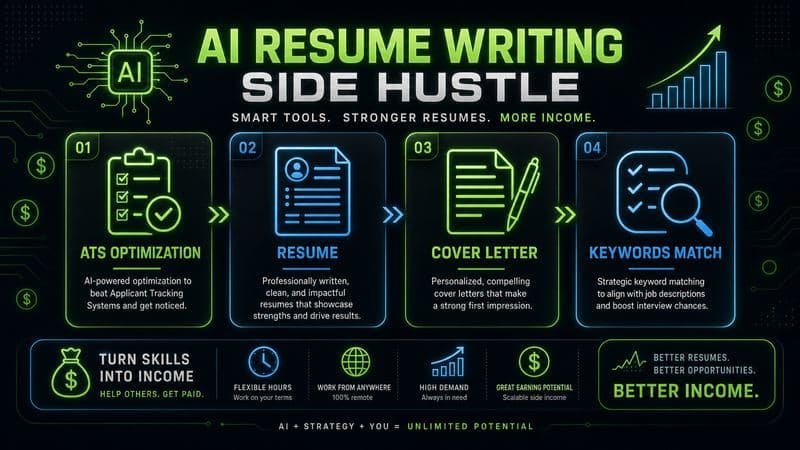
How to Start an AI-Assisted Resume Writing Side Hustle in 2026 (Beginner's Guide)
A step-by-step guide to using AI resume tools to offer a paid resume and cover letter writing service — what to charge, which tools to use, and how to find your first clients.
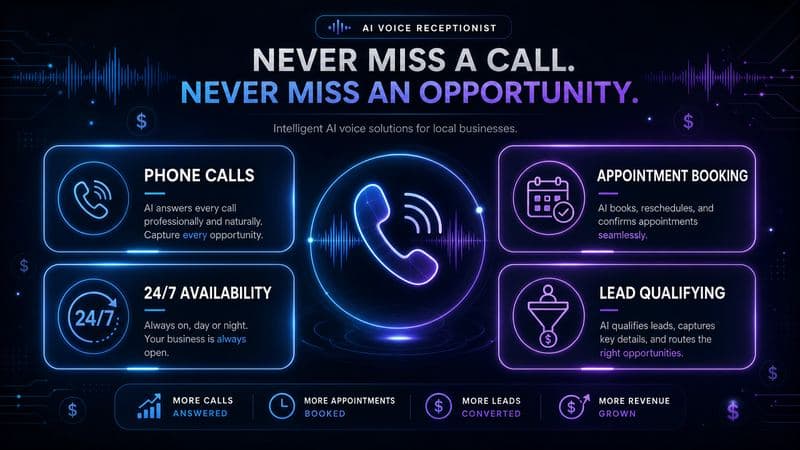
How to Build and Sell AI Voice Receptionists to Local Businesses in 2026
A beginner's guide to building AI voice agents that answer business phone calls — the tools to use, what to charge, and how to find your first client.
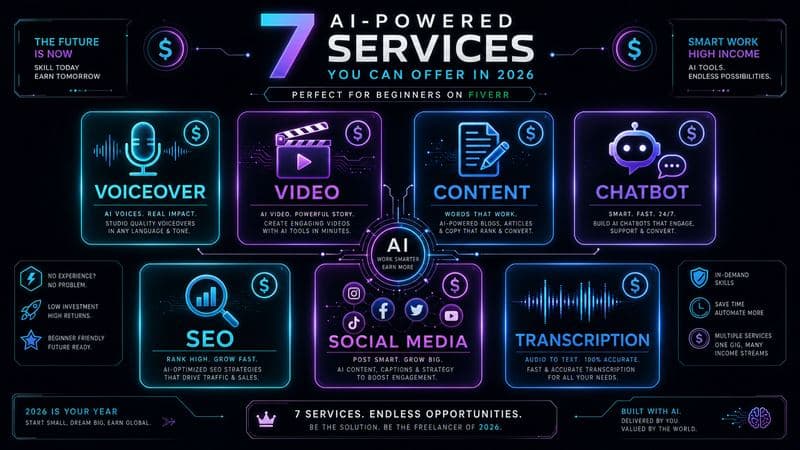
How to Make Money on Fiverr with AI Tools in 2026: 7 Gigs You Can Start This Week
Discover 7 real Fiverr gigs you can launch using free and low-cost AI tools in 2026 — no experience required. Real pricing data, step-by-step setup, and tools that actually work.