
Claude Opus 4.7 Is Out: What's New and Should You Switch?
Claude Opus 4.7 launched today (April 16, 2026) with better coding, higher-resolution vision, and new cybersecurity safeguards. Here's what's actually new — explained for regular users.

Anthropic just released Claude Opus 4.7. It went live today, April 16, 2026 — and it's not a vague "coming soon" upgrade. It's available right now across Claude.ai, the API, Amazon Bedrock, Google Cloud Vertex AI, and Microsoft Foundry.
Here's what actually changed, why it matters, and whether you need to care.
What Is Claude Opus 4.7?
Claude Opus 4.7 is Anthropic's latest mid-to-high tier model. It sits below Claude Mythos Preview (their most powerful model), but above Claude Sonnet in the lineup. Think of it as a serious workhorse — capable of handling complex, long-running tasks with less hand-holding than the previous version.
The "Opus" line has always been Anthropic's pick for hard technical work. 4.7 continues that pattern, with improvements across three areas: software engineering, visual understanding, and professional document creation.
What's Actually New
Coding and Software Engineering
This is the headline upgrade. Opus 4.7 is notably better at advanced software engineering tasks — specifically the hard ones that previously required constant supervision.
Real-world testers report:
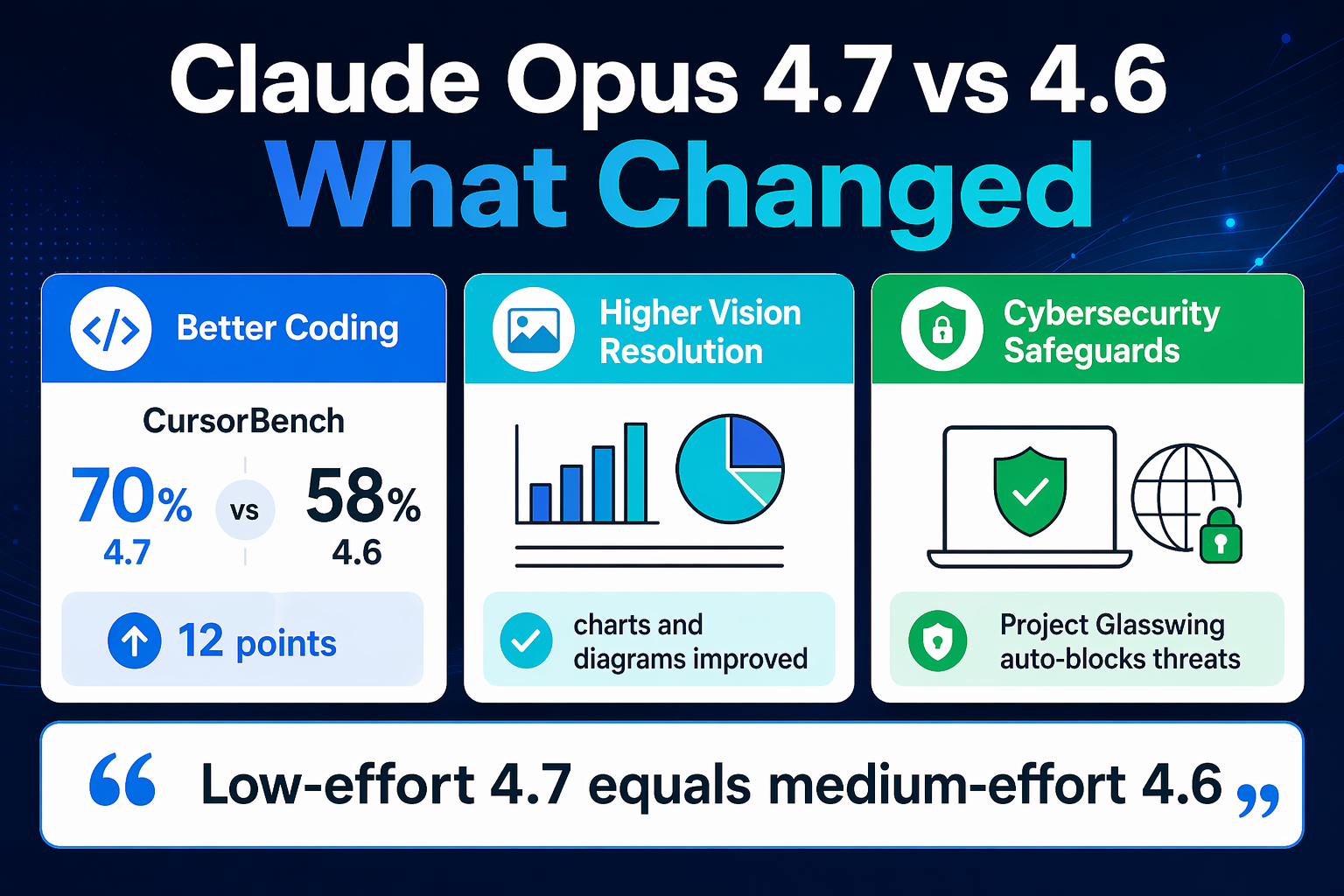
- Cursor: 70% resolution rate on CursorBench vs 58% for Opus 4.6 — a meaningful 12-point jump
- Notion: +14% improvement over Opus 4.6, with a third fewer tool errors in multi-step workflows
- Devin: "Works coherently for hours, pushes through hard problems rather than giving up"
- Replit: "Achieving the same quality at lower cost — more efficient and precise at tasks like analyzing logs, finding bugs, and proposing fixes"
For non-developers: these numbers mean that if you use Claude to help with any kind of technical work — writing code, analyzing files, automating tasks — it's noticeably more reliable than 4.6 was.
One particularly useful summary from Hex, a data platform: "Low-effort Opus 4.7 is roughly equivalent to medium-effort Opus 4.6." In plain terms: you get better results with less prompting effort.
Better Vision (Higher Image Resolution)
Opus 4.7 can now see images at substantially higher resolution. This matters for anyone working with:
- Technical diagrams and charts
- Screenshots of interfaces or documents
- Complex visual data (medical images, scientific figures, legal exhibits)
One company in the announcement, Solve Intelligence, specifically calls out improvements in reading chemical structures and interpreting complex technical diagrams for life sciences patent work. For everyday users, this means fewer times when Claude misses details in an image you uploaded.
More Creative for Professional Documents
The model has improved on professional output quality — better interfaces, slides, and documents. If you're using Claude to help draft presentations, create mockup layouts, or produce polished written deliverables, the quality has gone up.
This isn't a massive leap for casual writing, but for professional creative tasks it's a noticeable upgrade.
New Cybersecurity Safeguards
This one is different from a typical "capability upgrade." Anthropic is rolling out Opus 4.7 as the first model to include safeguards developed through Project Glasswing — their framework for managing AI and cybersecurity risks.
In practice: Opus 4.7 automatically detects and blocks requests related to prohibited or high-risk cybersecurity uses. If you're a legitimate security professional (penetration tester, vulnerability researcher, red-teamer), you can apply to Anthropic's new Cyber Verification Program to get access to cybersecurity-related prompts.
For regular users, this won't change anything about how the model behaves. It's a backend safeguard that won't interfere with normal use.
How to Access Claude Opus 4.7
If you use Claude.ai: It's already available. Look for "Opus 4.7" in the model selector.
If you use the API: The model string is claude-opus-4-7. Update your code to reference this version. Documentation is available at platform.claude.com.
If you use it through AWS, Google Cloud, or Azure: Available today on Amazon Bedrock, Google Cloud Vertex AI, and Microsoft Foundry.
Pricing: Same as Opus 4.6 — $5 per million input tokens and $25 per million output tokens. No price increase for the upgrade.
If you're building tools that use Claude via the API, Ampere is worth looking at for managing API costs and infrastructure as you scale.
Is Opus 4.7 the Most Powerful Claude Model?
No — and this is worth being clear about. Anthropic explicitly states that Opus 4.7 is "less broadly capable than our most powerful model, Claude Mythos Preview." Mythos Preview is their top-tier model, currently in limited release.
Opus 4.7 is better than Opus 4.6 on specific benchmarks, but it's not the flagship. If you've been using Opus 4.6 and thought it was Anthropic's best, Mythos Preview would be a bigger step up. Opus 4.7 is the new default for serious work — not the ceiling.
Opus 4.7 vs Opus 4.6: Quick Comparison
| What changed | Opus 4.7 | Opus 4.6 |
|---|---|---|
| Coding benchmark (Cursor) | 70% | 58% |
| Multi-step task reliability | +14% (Notion) | Baseline |
| Image resolution | Higher | Standard |
| Professional doc quality | Improved | Standard |
| Cybersecurity safeguards | Yes (Project Glasswing) | No |
| Pricing | $5 / $25 per 1M tokens | $5 / $25 per 1M tokens |
| Availability | All platforms | All platforms |
Who Should Upgrade?
Upgrade immediately if you:
- Write, debug, or review code with Claude
- Work with technical images or diagrams
- Run multi-step automated workflows
- Use Claude via the API for any serious project
No rush if you:
- Use Claude only for casual writing or questions
- Are happy with Opus 4.6 outputs on your specific tasks
The pricing is unchanged, so there's no real downside to switching.
What About Beginners?
If you're new to Claude or just starting to use AI tools, Claude Opus 4.7 is available in the free tier of Claude.ai (with limits). The free tier gives you access to capable models but may not always route you to Opus 4.7 — the paid plan (Claude Pro) gives priority access.
For most beginner tasks — summarizing documents, answering questions, helping with writing — the differences between 4.6 and 4.7 are small. Start with whatever's available to you for free and upgrade when you hit the limits.
The Bigger Picture
Opus 4.7 slots into a busy few weeks for Anthropic. It comes after Project Glasswing — a new initiative involving Amazon, Apple, Google, Microsoft, NVIDIA, and others to secure critical software infrastructure. The cybersecurity safeguards in Opus 4.7 are a direct result of that work.
The pace of releases is also worth noting: Opus 4.5 dropped November 2025, 4.6 followed 73 days later in February 2026, and 4.7 is out now in April. Anthropic is moving faster, and the improvements are real each time.
Frequently Asked Questions
Is Claude Opus 4.7 free to use?
Yes, with limits. Claude.ai offers a free tier that gives access to Claude models. Paid access (Claude Pro) gives priority access to Opus 4.7 without rate limits. API access is paid — $5/M input tokens, $25/M output tokens — same price as Opus 4.6.
What is the difference between Claude Opus 4.7 and Sonnet?
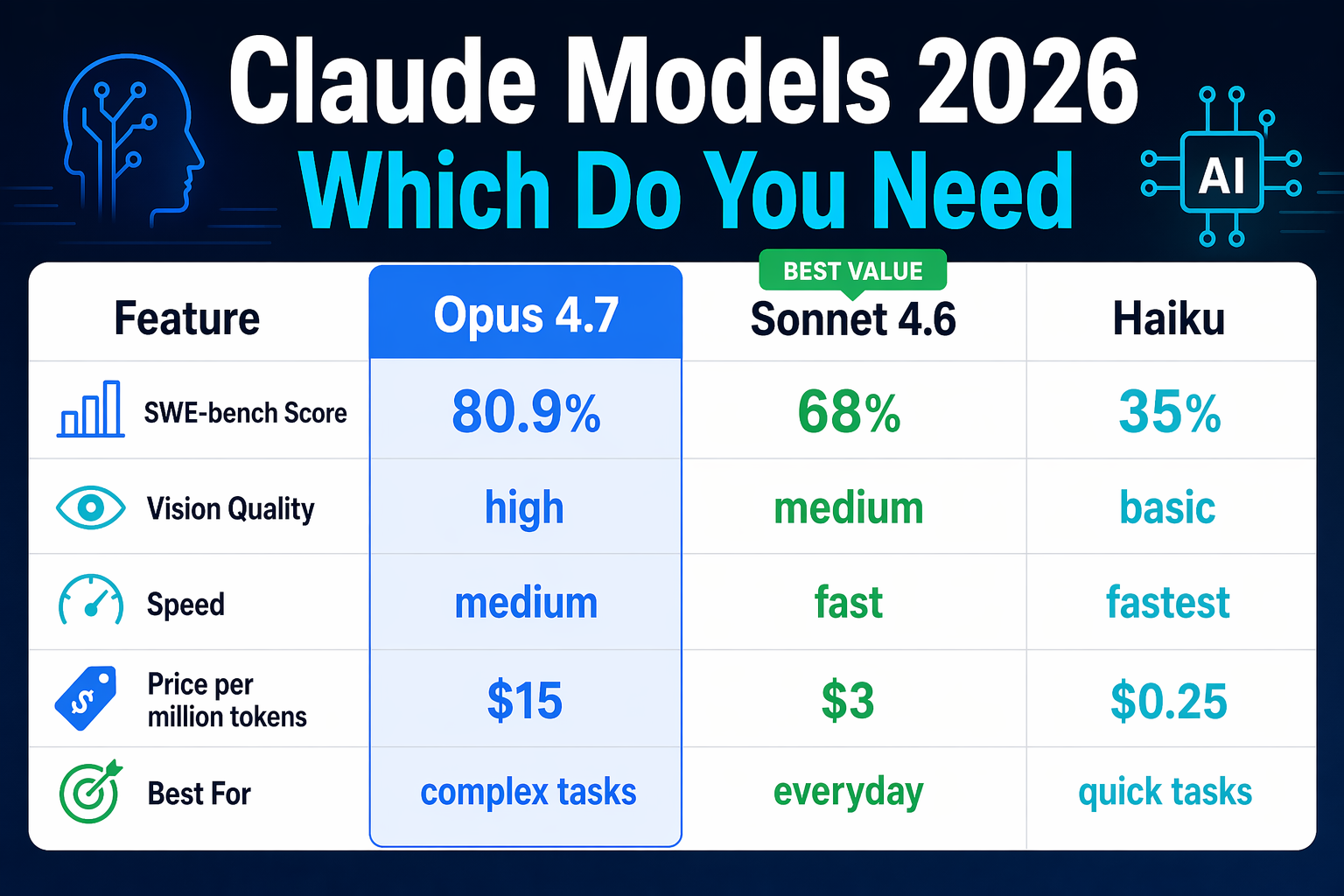
Claude Sonnet 4.6 is faster and cheaper. Claude Opus 4.7 is more capable on complex tasks, particularly advanced coding and multi-step workflows. Use Sonnet for quick, lightweight tasks and Opus for anything requiring deep analysis or sustained effort.
Is Claude Opus 4.7 better than ChatGPT?
For software engineering and coding tasks, early benchmarks favor Opus 4.7. For general conversation and everyday writing, they're comparable. The right choice depends on your specific use case — both are strong models.
What is the Claude Opus 4.7 API model string?
Use claude-opus-4-7 in your API calls. Full documentation is at platform.claude.com.
What is Project Glasswing and how does it affect Opus 4.7?
Project Glasswing is Anthropic's initiative to manage AI and cybersecurity risks, involving major tech companies. Opus 4.7 includes the first real-world deployment of safeguards developed through this project — specifically, automatic detection and blocking of high-risk cybersecurity requests. Legitimate security professionals can apply to the Cyber Verification Program for access.
Is Claude Opus 4.7 the most powerful Claude model?
No. Claude Mythos Preview is Anthropic's most powerful model, currently in limited release. Opus 4.7 is better than Opus 4.6 but is explicitly described as less capable than Mythos Preview overall.
When was Claude Opus 4.7 released?
April 16, 2026. It is generally available today across Claude.ai, the API, Amazon Bedrock, Google Cloud Vertex AI, and Microsoft Foundry.

Alex the Engineer
•Founder & AI ArchitectSenior software engineer turned AI Agency owner. I build massive, scalable AI workflows and share the exact blueprints, financial models, and code I use to generate automated revenue in 2026.
Related Articles

How to Start an AI-Assisted Resume Writing Side Hustle in 2026 (Beginner's Guide)
A step-by-step guide to using AI resume tools to offer a paid resume and cover letter writing service — what to charge, which tools to use, and how to find your first clients.

How to Build and Sell AI Voice Receptionists to Local Businesses in 2026
A beginner's guide to building AI voice agents that answer business phone calls — the tools to use, what to charge, and how to find your first client.

How to Make Money on Fiverr with AI Tools in 2026: 7 Gigs You Can Start This Week
Discover 7 real Fiverr gigs you can launch using free and low-cost AI tools in 2026 — no experience required. Real pricing data, step-by-step setup, and tools that actually work.