
9 Best AI Side Hustles to Make Money in 2026
Start earning extra income with the best AI side hustles. Learn how to use automated tools for content, video, and chatbots to build a profitable business.

The AI side hustle market has matured. Early adopters made money just by offering anything "with AI." In 2026, the winners are people who deliver real results — faster turnaround, better output, and more consistency than clients can get by doing it manually.
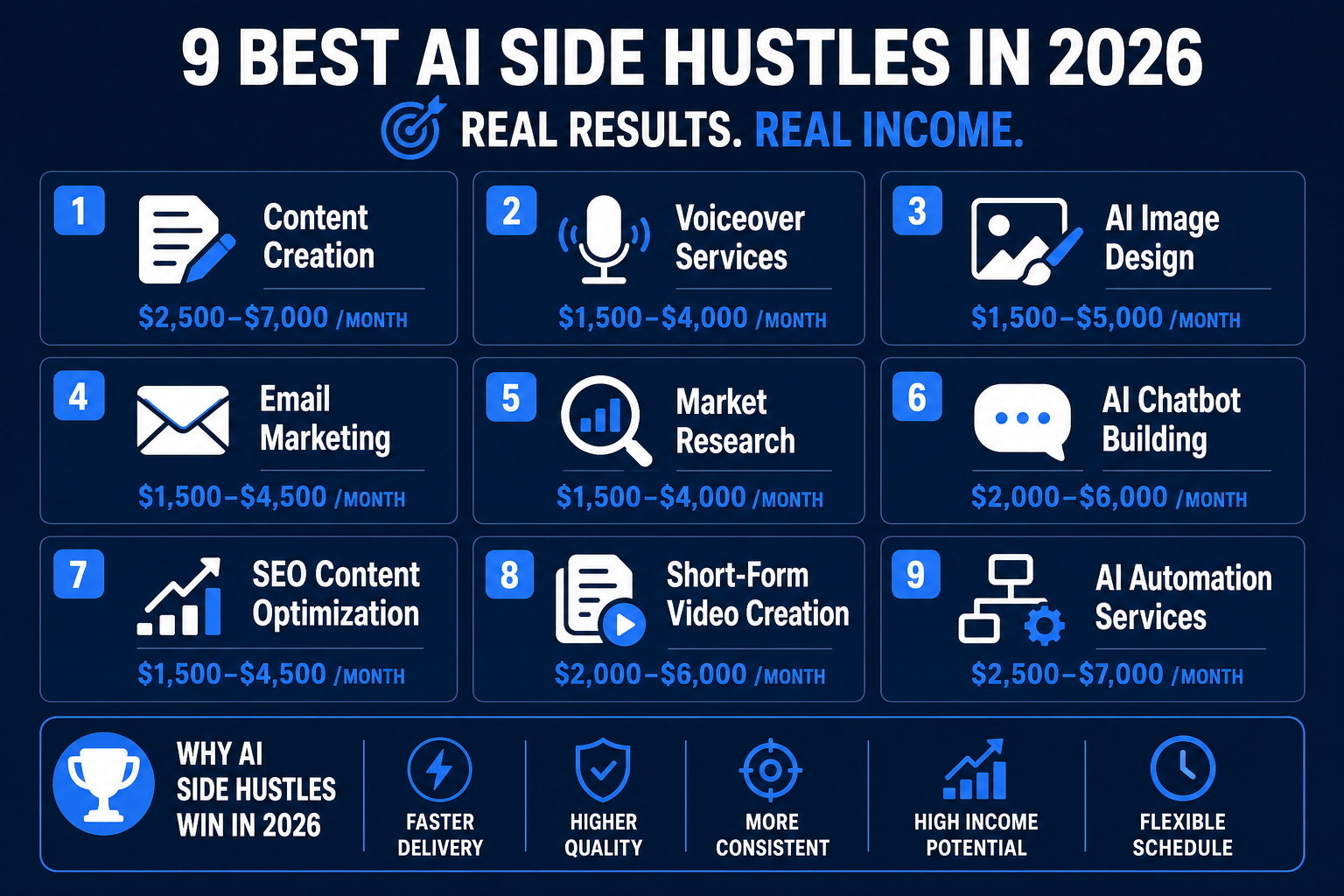
This guide covers nine side hustles where AI tools provide a genuine edge, along with realistic income expectations and specific steps to start each one.
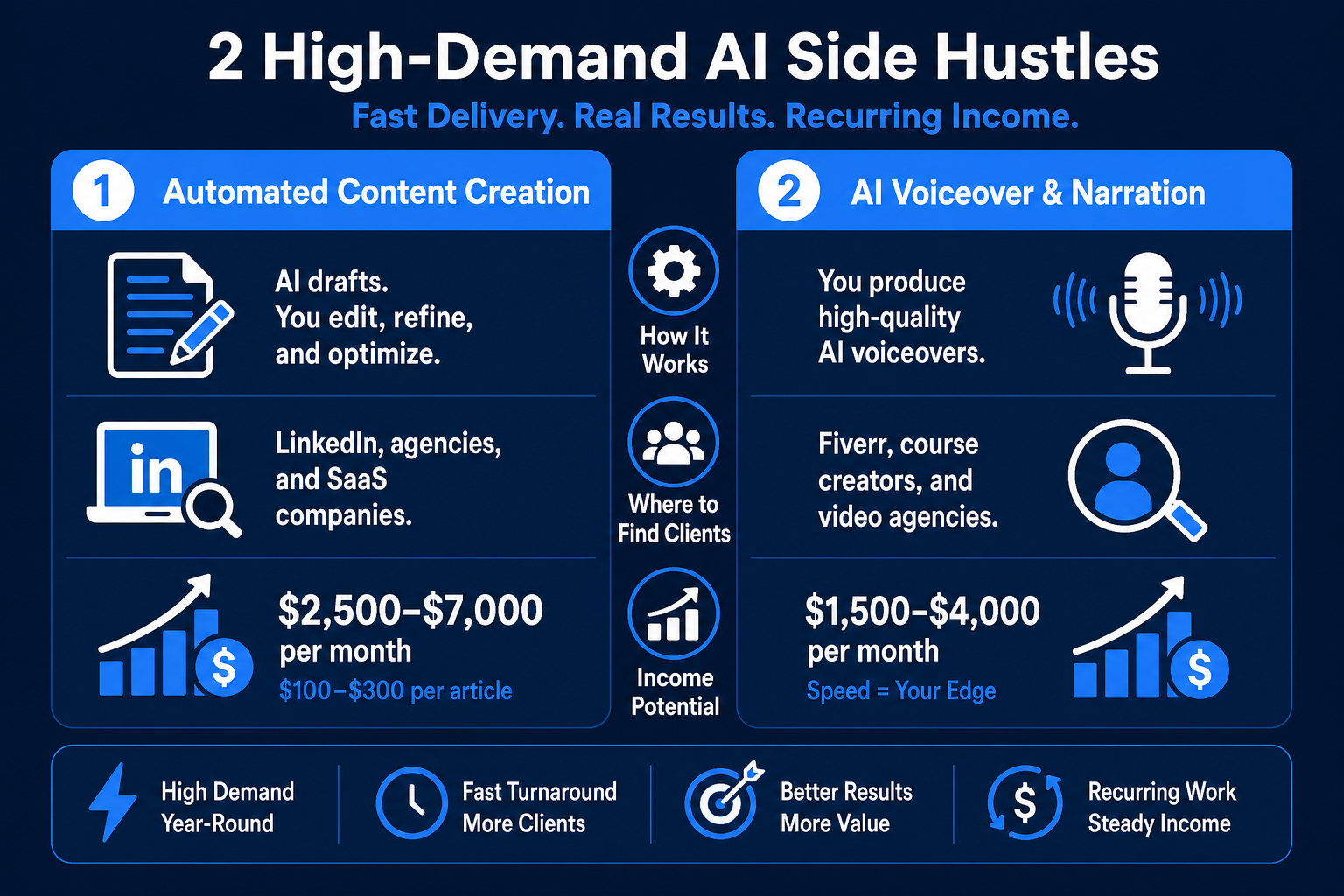
1. Automated Content Creation Services
Businesses consistently need more content than their in-house teams can produce: blog posts, product descriptions, email sequences, case studies. The demand is structural, not trend-driven.
The key distinction in 2026 is that clients don't want raw AI output — they want edited, fact-checked, brand-aligned content that reads like it was written by someone who actually knows the topic. That's where you add value.
How it works: Use an AI writing tool (Jasper, Claude, or ChatGPT) to produce first drafts. Spend your time editing for accuracy, brand voice, and depth. Position yourself as an "AI-assisted content strategist" — you're a specialist, not someone running copy-paste prompts.
Where to find clients: LinkedIn outreach to marketing managers, content agencies looking for white-label writers, and direct pitching to SaaS companies with blogs.
Income potential: $2,500–$7,000/month at $100–$300 per article with 5–10 regular clients.
2. AI Voiceover and Narration Services
Professional voiceover used to require a recording studio, professional equipment, and booking sessions with voice actors. AI voice tools have eliminated all three requirements.
Murf.ai is the strongest option for commercial-grade voice production — 120+ voices, pitch and pace controls, and audio quality that holds up in corporate and e-learning contexts. ElevenLabs is the right choice if you need voice cloning or multilingual output.
How it works: Clients provide scripts or rough audio; you produce the final narration. E-learning is the best-paying vertical — courses on Teachable or Udemy frequently need their audio updated when instructors re-record sections. Corporate explainer videos and presentations are also reliable sources.
Where to find clients: Fiverr (voiceover category), direct outreach to e-learning course creators, and video production agencies that outsource audio.
Income potential: $1,500–$4,000/month. Delivery speed is the main competitive advantage — AI lets you turn around a 10-minute script in 30 minutes.
3. Custom AI Chatbot Development
Most small businesses still have no AI implementation at all. A properly trained chatbot that can answer customer questions, book appointments, or qualify leads 24/7 is a genuinely useful product — and most business owners can't build one themselves.
CustomGPT.ai is the fastest path to a deployable client chatbot. You upload the business's documents, website content, or FAQ, and the system builds a trained assistant in minutes. The chatbot stays within the uploaded knowledge base and doesn't hallucinate off-topic answers.
How it works: Prospect local service businesses (law firms, dental offices, contractors, real estate agents). Show them a demo bot built from their website. Charge for setup ($300–$800) plus a monthly retainer for maintenance and updates ($99–$250).
Where to find clients: Local business associations, LinkedIn, and cold email to businesses with active chat widgets that give obviously generic answers.
Income potential: $2,000–$6,000/month managing 10–20 clients.
4. AI-Enhanced Video Production
Faceless video content remains one of the most scalable content formats available. A single YouTube video can generate ad revenue for years. A Reels or TikTok clip can go viral months after posting.
The production stack: script (ChatGPT/Claude) → voiceover (Murf.ai) → footage (Pexels, Storyblocks) → editing (CapCut with auto-captions) → thumbnail (Canva). A 7-minute video takes 2–3 hours once you've built the workflow.
How it works: Build one channel focused on a high-CPM niche (finance, tech, AI tools, real estate). The goal is YouTube Partner Program threshold (1,000 subscribers + 4,000 watch hours), then ongoing AdSense revenue. Once the channel qualifies, you can also add affiliate links and sponsorships.
Where to find clients: Alternatively, offer the full production pipeline as a service to personal brands who want a YouTube presence without doing the work. Charge $300–$600 per video.
Income potential: Own channel: $500–$3,000/month once monetized (scales over time). Service: $2,000–$5,000/month with 5–8 regular clients.
5. Selling Digital Products on Gumroad and Etsy
AI-generated digital products are a legitimate passive income model when the products are genuinely useful. The key is finding niche formats where quality beats volume.
Strong performers: Midjourney-generated printable art (botanical, minimalist, vintage maps), Canva templates (business card sets, pitch decks, social media kits), AI-written ebooks or guides on specific topics, and prompt packs for Midjourney or ChatGPT.
How it works: Research what's selling on Etsy in your chosen category. Create 30–50 listings with distinct styles and price points ($3–$25 each). Optimize titles and tags for search. Passive income builds slowly — expect 3–6 months before meaningful revenue.
Gumroad works better for higher-ticket digital products ($20–$75) and niche audiences you build through social content.
Where to find buyers: Etsy organic search, Pinterest (high buyer intent), and building a niche Instagram or TikTok audience around the product category.
Income potential: $300–$2,000/month passive after building a catalog of 100+ listings.
6. AI-Optimized Career Coaching and Resume Services
Job seekers pay for help that gets results fast. AI tools have made it possible to produce personalized, ATS-optimized resumes, tailored cover letters, and LinkedIn profile rewrites in a fraction of the time it used to take.
The differentiator isn't just using ChatGPT to "improve" a resume — it's knowing what makes an ATS system rank a resume highly, how to reframe experience for different industries, and what hiring managers actually look for in specific roles.
How it works: Offer packages: resume rewrite ($150–$300), cover letter ($75–$150), full LinkedIn overhaul ($200–$400), or a combined package ($400–$800). Use AI for drafting and structure; use your judgment for positioning and tone.
Where to find clients: LinkedIn (post content about job search tips to attract inbound), Fiverr (high demand category), and career transition communities on Reddit and Facebook.
Income potential: $2,000–$5,000/month working 20–25 hours per week.
7. AI-Powered SEO Consulting
Search engine optimization is being reshaped by AI — generative search, AEO, and programmatic content at scale. Most small businesses and bloggers have no idea how to adapt. There's a real market for consultants who understand both traditional SEO and how AI search tools are changing the game.
How it works: Audit a client's existing content against current ranking factors: topical authority, information gain, structured data, Core Web Vitals. Produce a prioritized action plan. Implement the top-priority fixes. Track results via Google Search Console.
The AI angle: use tools like SurferSEO for content optimization, SEMrush for competitive analysis, and ChatGPT for scaling article briefs and meta descriptions. The strategy is yours; the execution is assisted.
Where to find clients: Blogging communities, LinkedIn outreach to e-commerce store owners, and referrals from web design agencies that don't offer SEO.
Income potential: $1,500–$5,000/month on retainer with 3–6 clients.
8. Building and Selling AI Automation Workflows
Businesses have repetitive processes that eat hours each week: manually moving data between spreadsheets and CRMs, sending follow-up emails, updating project management tools, generating reports. AI automation tools make these tasks disappear.
n8n is the most powerful tool for this — open-source, self-hostable, and with native LLM integrations. For simpler tasks, Zapier or Make (formerly Integromat) work well and require less technical setup.
How it works: Identify a business's most time-consuming manual process. Build an automation workflow that handles it. Common high-value examples: AI email triage and routing, lead enrichment and CRM updates, weekly report generation, and social media content scheduling.
Charge by project ($500–$2,000 for a complete workflow) plus monthly maintenance ($150–$400). You can also sell pre-built workflow templates on Gumroad for passive income.
Where to find clients: Business owners in Facebook communities, direct outreach to operations managers at small companies, and LinkedIn content about automation.
Income potential: $3,000–$10,000/month with 5–15 clients.
9. AI-Generated Social Media Content Services
Brands and personal accounts need consistent social content — multiple posts per week, across multiple platforms, in a consistent voice. Most don't have the time or the skill to produce it.
This is a repeatable service: monthly social media content packages including 12–20 posts per platform, formatted for each network's current best practices, with branded visuals from Canva.
How it works: Use AI to generate post drafts based on the client's brand voice, industry, and monthly content goals. Edit for authenticity and accuracy. Deliver a Canva-designed content calendar. Manage scheduling via Buffer or Later.
Where to find clients: Local restaurants and service businesses are underserved (they need content but rarely have a dedicated social team). Also, any personal brand — coaches, consultants, course creators — who know they should be posting but aren't.
Income potential: $500–$1,500/month per client on retainer; $3,000–$8,000/month with 5–8 clients.
How to Pick Your First Side Hustle
The fastest path to income is the one closest to something you already know. If you have a background in writing, start with content services. If you're technical, automation workflows. If you're a strong communicator, career coaching.
The AI tools reduce the skill gap — but they don't eliminate judgment. Pick the side hustle where you can add the most value above the tool's raw output.
Frequently Asked Questions
Which AI side hustle has the fastest time-to-income? Client services (chatbots, content, voiceovers) can generate income within 2–4 weeks with active outreach. Passive models (digital products, YouTube) take 3–6 months.
Do I need to tell clients I use AI? For most services, no — you're selling results. AI is a production tool, not the product. The exception is when the client has explicitly requested human-only work (some journalism and academic contexts).
What's the difference between this and just using ChatGPT? The side hustles above generate income because of specialization, positioning, and quality control — not because AI does something the client couldn't do themselves. Your value is in knowing how to deploy the tools and ensuring the output actually meets the brief.
Can I stack multiple side hustles? Yes, and many do. A common stack: AI content writing (primary income) + digital product sales (passive) + one automation client. Start with one, stabilize it, then add a second.

Alex the Engineer
•Founder & AI ArchitectSenior software engineer turned AI Agency owner. I build massive, scalable AI workflows and share the exact blueprints, financial models, and code I use to generate automated revenue in 2026.
Related Articles
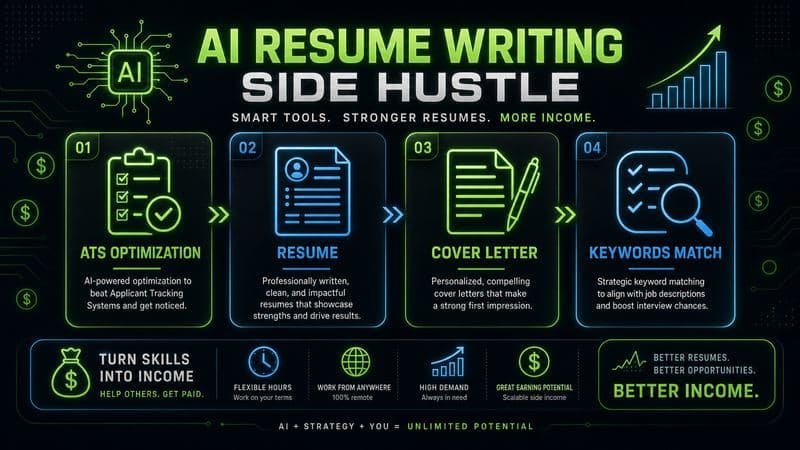
How to Start an AI-Assisted Resume Writing Side Hustle in 2026 (Beginner's Guide)
A step-by-step guide to using AI resume tools to offer a paid resume and cover letter writing service — what to charge, which tools to use, and how to find your first clients.
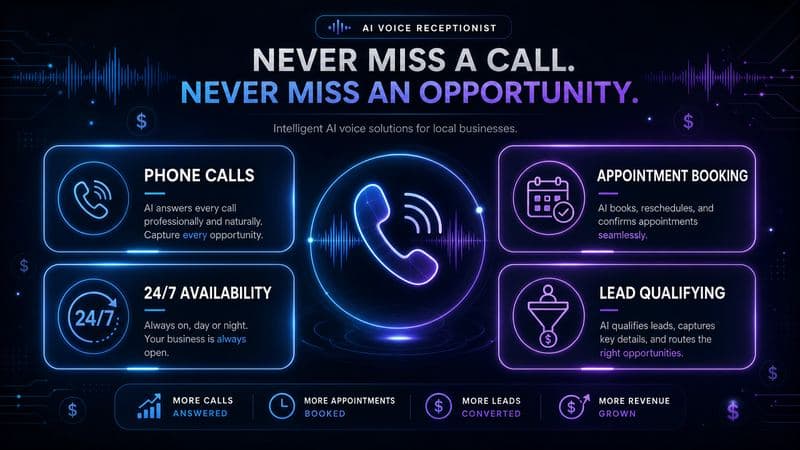
How to Build and Sell AI Voice Receptionists to Local Businesses in 2026
A beginner's guide to building AI voice agents that answer business phone calls — the tools to use, what to charge, and how to find your first client.
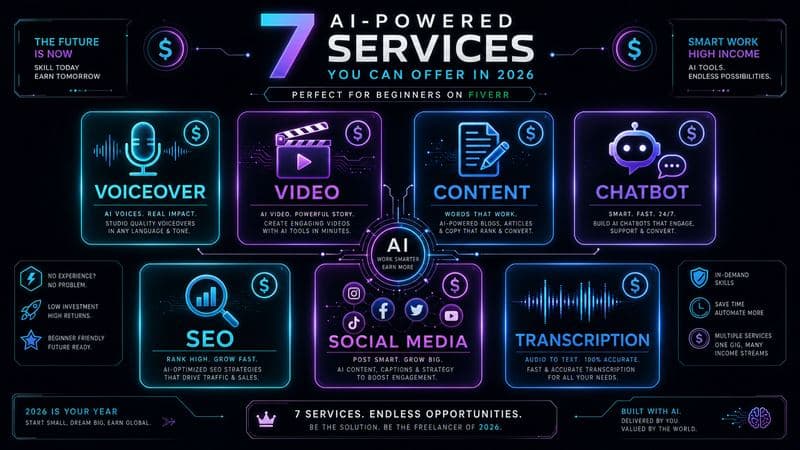
How to Make Money on Fiverr with AI Tools in 2026: 7 Gigs You Can Start This Week
Discover 7 real Fiverr gigs you can launch using free and low-cost AI tools in 2026 — no experience required. Real pricing data, step-by-step setup, and tools that actually work.