
How AI Is Making Cyberattacks More Sophisticated in 2026 (And How to Stay Safe)
AI tools are enabling a new generation of cyberattacks — faster, cheaper, and harder to detect. Here's what's actually happening and five practical steps to protect yourself in 2026.
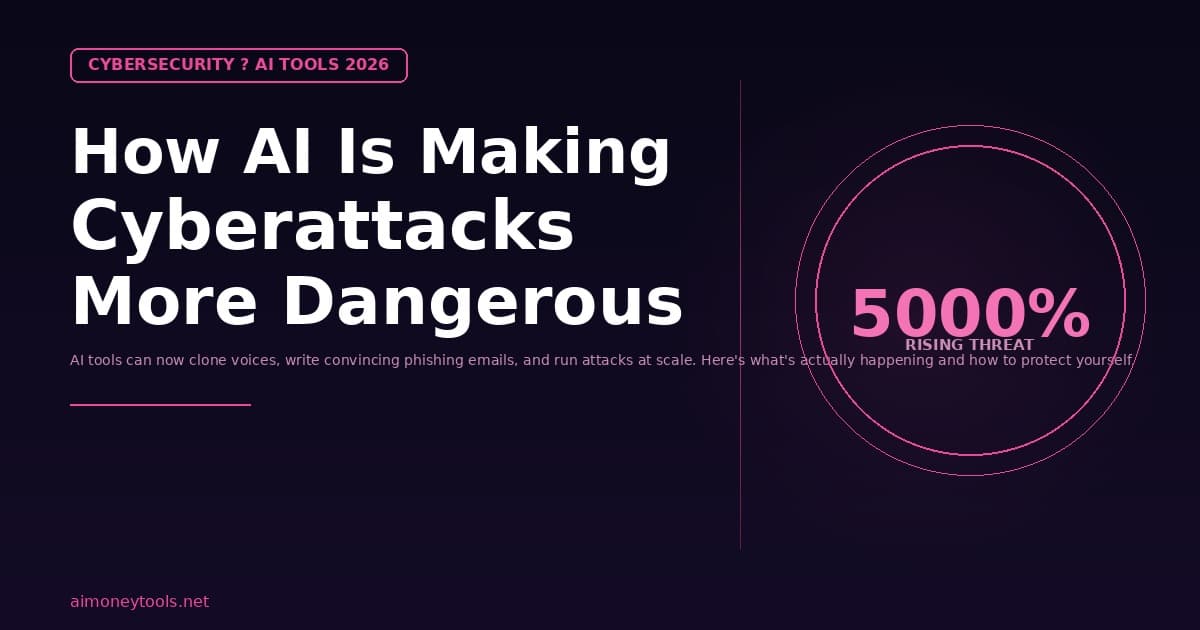
Cyberattacks are getting harder to spot — and AI tools are the reason why.
In 2026, the same AI capabilities that help businesses write emails, generate content, and automate tasks are being used on the other side: to craft more convincing phishing messages, bypass security filters, generate realistic deepfake audio and video, and run attacks at a scale that was not possible before.
This is not a future problem. It is happening right now. Here is what has actually changed, what the realistic risks are for regular people, and five concrete steps you can take today.
What Has Changed: AI Is Lowering the Cost of Attack
Historically, a convincing cyberattack required skill. Writing a believable phishing email in fluent English, creating a realistic fake invoice, impersonating someone's voice — these took time, expertise, and often large criminal organizations to pull off at scale.
AI tools have removed most of those barriers.
A single person with access to any major language model can now:
- Generate dozens of personalized phishing emails per hour aimed at specific targets
- Clone a voice using 10–30 seconds of audio from a public video or voicemail
- Create a convincing fake identity complete with a profile photo, a consistent backstory, and written correspondence that passes basic human review
- Automate the process of finding targets, sending messages, and tracking responses
The skill floor dropped dramatically. What once required a team can now be done by one person in an afternoon.
The Four Attack Types Getting More Dangerous
1. Spear Phishing at Scale
Standard phishing (mass generic emails pretending to be your bank) has existed for decades and most people have learned to spot it. Spear phishing — targeted attacks that reference specific personal details — used to require manual research.
With AI, that research step is automated. An attacker can scrape your LinkedIn, your company website, recent news mentions, and public social media, then generate a highly personalized email referencing your actual job title, a real project you worked on, and a colleague's name — all in under a minute.
Detection becomes much harder when the email knows things about you.
2. Voice Cloning and Fake Audio
Voice cloning AI (tools like ElevenLabs and its equivalents) can replicate a person's voice from a short audio sample. Attackers use this to:
- Call a family member pretending to be someone in an emergency, requesting an urgent wire transfer
- Impersonate a CEO or manager in a voice message instructing an employee to take an action
- Leave convincing voicemails that override text-based skepticism ("I heard the voice, so it must be real")
The "grandparent scam" — calling elderly people pretending to be a grandchild in trouble — has become substantially more effective with cloned voices that actually sound like the claimed person.
3. Deepfake Video in Real-Time
Real-time deepfake video tools allow a person to appear on a video call as someone else. This is now accessible enough that it has been used in business email compromise (BEC) scams where attackers impersonate executives on video calls to authorize financial transfers.
This attack vector is particularly dangerous because video was previously treated as a high-trust verification method. If a "colleague" appears on camera, people tend to trust it.
4. Automated Vulnerability Scanning
AI tools can scan for security vulnerabilities in websites, APIs, and systems at a speed and depth that human attackers could not match. This means even small websites and small businesses — previously not worth the manual effort to attack — are now viable targets for automated exploitation.
5 Steps to Protect Yourself in 2026

Step 1: Establish a Verbal Code Word with Close Contacts
For any situation where someone might contact you urgently requesting money, action, or sensitive information, agree on a secret code word in advance with family members and trusted colleagues. If someone calls claiming to be them and cannot provide the code word, treat it as suspicious regardless of how convincing they sound.
This is low-tech but highly effective against voice cloning attacks.
Step 2: Verify All Urgent Financial Requests Out-of-Band
If you receive any message — email, text, voice, or even video — requesting an urgent financial transfer or access credential, call back on a phone number you independently look up (not the one provided in the message). This one step defeats the majority of BEC and impersonation scams.
This applies to messages appearing to come from family, employers, financial institutions, and government agencies.
Step 3: Use a Password Manager and Hardware MFA
AI-assisted credential stuffing (trying breached username/password combinations across multiple sites) is faster than ever. If you reuse passwords, one breach exposes everything.
A password manager generates and stores a unique password for every site. Hardware MFA (a physical security key) prevents account takeover even when credentials are compromised, because the attacker would need the physical device.
Bitwarden is a solid free option for password management. YubiKey is the most widely supported hardware security key.
Step 4: Slow Down on Urgency Signals
AI-generated attacks are specifically engineered to trigger urgency: "Your account will be suspended," "Someone is transferring your money now," "I need this in the next 10 minutes." Urgency bypasses critical thinking — and attackers know it.
Build a personal rule: any message creating time pressure for a financial or access decision gets a deliberate pause. At minimum, a 10-minute wait and a verification call before acting.
Step 5: Check Your Digital Footprint
The more personal information available about you publicly, the better attackers can personalize an attack. A quick audit:
- Search your name and email address online — what comes up?
- Review what your LinkedIn and social media profiles reveal about your employer, colleagues, current projects, and location
- Remove specific project details, internal team names, and location data from public profiles where possible
You do not need to disappear from the internet. You just need to make personalized targeting harder.
What Businesses and Teams Should Know
For business owners and people who manage small teams, AI-assisted attacks create a few specific responsibilities:
Brief your team on deepfake video. If your company ever uses video calls to authorize financial decisions, implement a policy that video alone is not sufficient verification. Any video-call request for a wire transfer, credential change, or major action requires a follow-up call on a known number.
AI email security tools exist and work. Tools like Abnormal Security and Darktrace use AI to detect AI-generated phishing by analyzing patterns that humans cannot catch. If you are managing email security at the business level, these are worth evaluating.
Update your incident response process. The speed of AI-assisted attacks means that the window between a successful credential theft and actual damage is often minutes, not days. Have a clear process for reporting suspicious contacts and locking accounts quickly.
The Bigger Picture
It is easy to read this and feel that the internet is simply broken. It is not. But the threat landscape has changed in a meaningful way over the past two years, and the old mental model of "I can tell a scam because it has bad grammar" is no longer accurate.
AI tools are powerful for productivity and for creating content. The same power, applied to deception, requires updated defenses — mostly behavioral (verify, slow down, use code words) rather than technical.
The people most at risk are not those who are particularly naive. They are the people who have not yet updated their mental model to account for what AI can now fake convincingly.
Frequently Asked Questions
Is AI being used in real cyberattacks right now, or is this speculative? It is actively happening. Security firms including Recorded Future, CrowdStrike, and IBM X-Force have documented AI-generated phishing campaigns, AI-assisted voice scams, and automated vulnerability exploits in real incidents. The scale of attacks has increased significantly since late 2024.
Do I need to buy expensive security software to protect myself? For individuals, the most effective protections are behavioral (verify urgency requests, use unique passwords, set code words). A free password manager and free email already provide substantial protection. Hardware MFA keys cost around $50 and provide the strongest available second-factor protection.
Can I detect deepfake video on a call? Current deepfakes sometimes show artifacts — slight lag in expressions, unnatural blinking, edge distortion around hair and ears. But detection is becoming harder as the technology improves. The safest approach is not to rely on visual detection at all, but to use out-of-band verification for any high-stakes call.
My business received a suspicious call from someone claiming to be from our bank. What do I do? Hang up and call your bank directly using the number on their official website or the back of your card. Never call back on a number provided in the suspicious communication. Report the incident to your bank's fraud line.
What are AI tools attackers are actually using? Most attackers use the same tools available to anyone: commercial LLMs for writing, open-source voice cloning models (RVC, StyleTTS2), and tools built on top of these that are sold or shared in grey-market communities. Very sophisticated attacks may use fine-tuned models, but most attacks are simpler.
Is there any upside to AI in cybersecurity? Yes — AI is also being used defensively. Security tools that detect anomalous behavior, flag unusual login patterns, and scan email for AI-generated phishing patterns are now standard in enterprise security stacks. The attack and defense sides are both accelerating.
How do I report a suspected AI-assisted scam? In Canada: report to the Canadian Anti-Fraud Centre (cafc.ca). In the US: report to the FTC at reportfraud.ftc.gov. Also notify your bank or any institution impersonated. If money was transferred, contact your bank immediately as some transfers can be reversed if caught quickly.
Will this get worse before it gets better? Most security researchers expect the threat to increase over the next 2–3 years as tools become more accessible, then gradually stabilize as defensive AI and better verification standards become more widespread. The near term requires heightened vigilance.

Alex the Engineer
•Founder & AI ArchitectSenior software engineer turned AI Agency owner. I build massive, scalable AI workflows and share the exact blueprints, financial models, and code I use to generate automated revenue in 2026.
Related Articles
How to Start an AI-Assisted Resume Writing Side Hustle in 2026 (Beginner's Guide)
A step-by-step guide to using AI resume tools to offer a paid resume and cover letter writing service — what to charge, which tools to use, and how to find your first clients.
How to Build and Sell AI Voice Receptionists to Local Businesses in 2026
A beginner's guide to building AI voice agents that answer business phone calls — the tools to use, what to charge, and how to find your first client.
How to Make Money on Fiverr with AI Tools in 2026: 7 Gigs You Can Start This Week
Discover 7 real Fiverr gigs you can launch using free and low-cost AI tools in 2026 — no experience required. Real pricing data, step-by-step setup, and tools that actually work.