
What Is Meta Muse Spark? Everything You Need to Know About Meta's New AI Model
Meta's Muse Spark is the first model from Meta Superintelligence Labs — a closed, reasoning-first AI that tops visual reasoning benchmarks and is already live on meta.ai. Here's what it is, how it performs, and what changed.
For the past year, Meta's AI story has been one of expensive missteps. Llama 4 underperformed. The benchmarks were gamed. The talent pipeline bled out. And Mark Zuckerberg's response — a $14.3 billion investment in Scale AI, a complete organizational overhaul, and the hiring of Alexandr Wang as chief AI officer — looked more like panic than strategy.
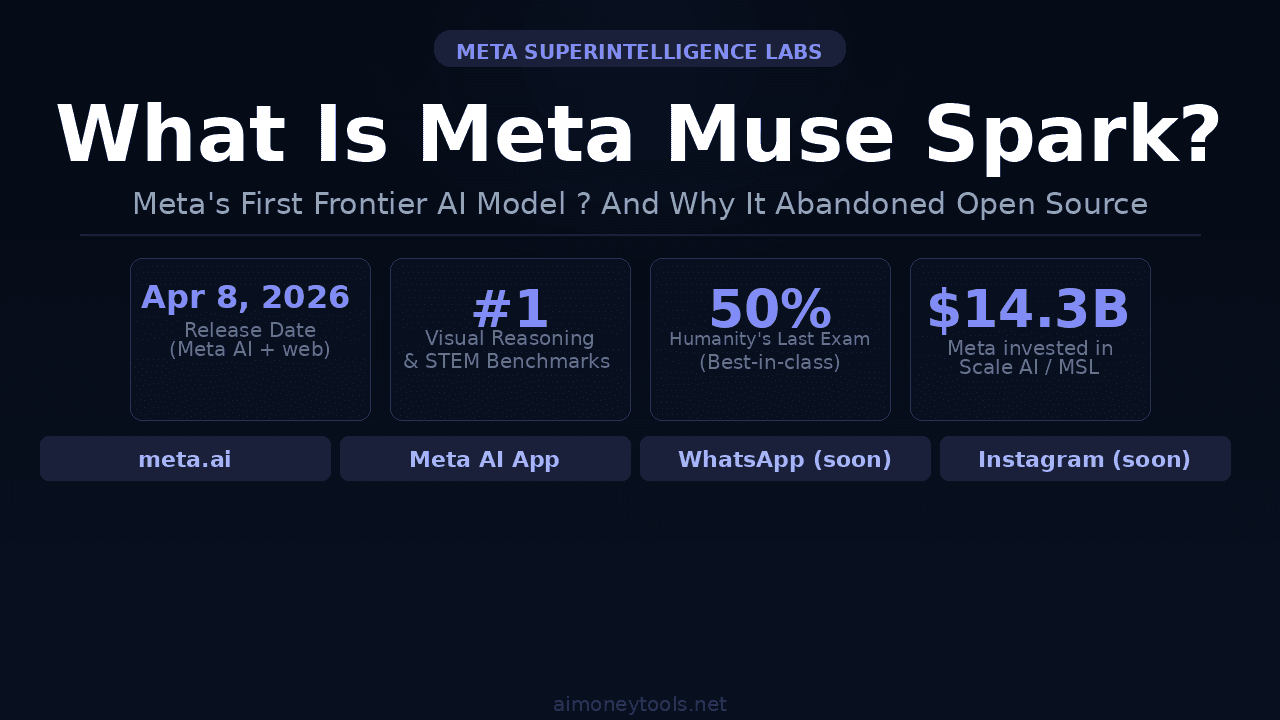
On April 8, 2026, Meta released Muse Spark. It's the first model to come out of Meta Superintelligence Labs, and by most early measures, it's genuinely competitive with the top models from OpenAI, Google, and Anthropic. The question isn't whether the model is good — it appears to be. The question is whether you can trust the benchmarks, what this model can actually do, and why Meta quietly abandoned its entire open-source strategy to build it.
What Is Meta Muse Spark?
Muse Spark is Meta's new flagship AI model, built by Meta Superintelligence Labs (MSL) — the reorganized AI research division Zuckerberg created after he became frustrated with the company's progress in 2025.
Unlike Meta's previous AI work (the Llama family), Muse Spark is:
- A reasoning model — the first time Meta has built an AI that reasons step-by-step, tries multiple strategies when one fails, and produces more deliberate answers rather than instant pattern-matching outputs
- Multimodal — it handles text and images natively, and performs especially well on visual and scientific questions
- Closed and proprietary — it is not open-source. You cannot download Muse Spark, fine-tune it, or run it locally. This is a significant departure from Meta's Llama strategy
The model is now live at meta.ai and in the Meta AI app. It will roll out to WhatsApp, Instagram, Facebook, Messenger, and Meta's Ray-Ban AI smart glasses over the coming weeks. API access is available through a private preview for select partners.
The Meta Superintelligence Labs Origin Story
Understanding Muse Spark requires understanding why it exists at all.
In early 2025, Meta's AI strategy was falling apart. Llama 4 — its open-source flagship — was widely criticized. The benchmarks Meta published for Llama 4 later turned out to have been generated using specialized fine-tuned versions of the model that most users never had access to. The actual general-purpose model that users downloaded didn't perform nearly as well. The embarrassment was significant.
Zuckerberg's response was to essentially dismantle his existing AI team structure and rebuild. He recruited Alexandr Wang — the 29-year-old co-founder and CEO of Scale AI — to lead a new division: Meta Superintelligence Labs. To secure Wang, Meta invested $14.3 billion in Scale AI for a 49% stake. Meta then went on a hiring spree, pulling researchers from OpenAI, Anthropic, and Google.
Muse Spark is the first product from that rebuilt lab. The model is described as "small and fast by design, yet capable enough to reason through complex problems" — designed to be deployed at scale across Meta's global product surface, not just as a research artifact.
How Does Muse Spark Perform?
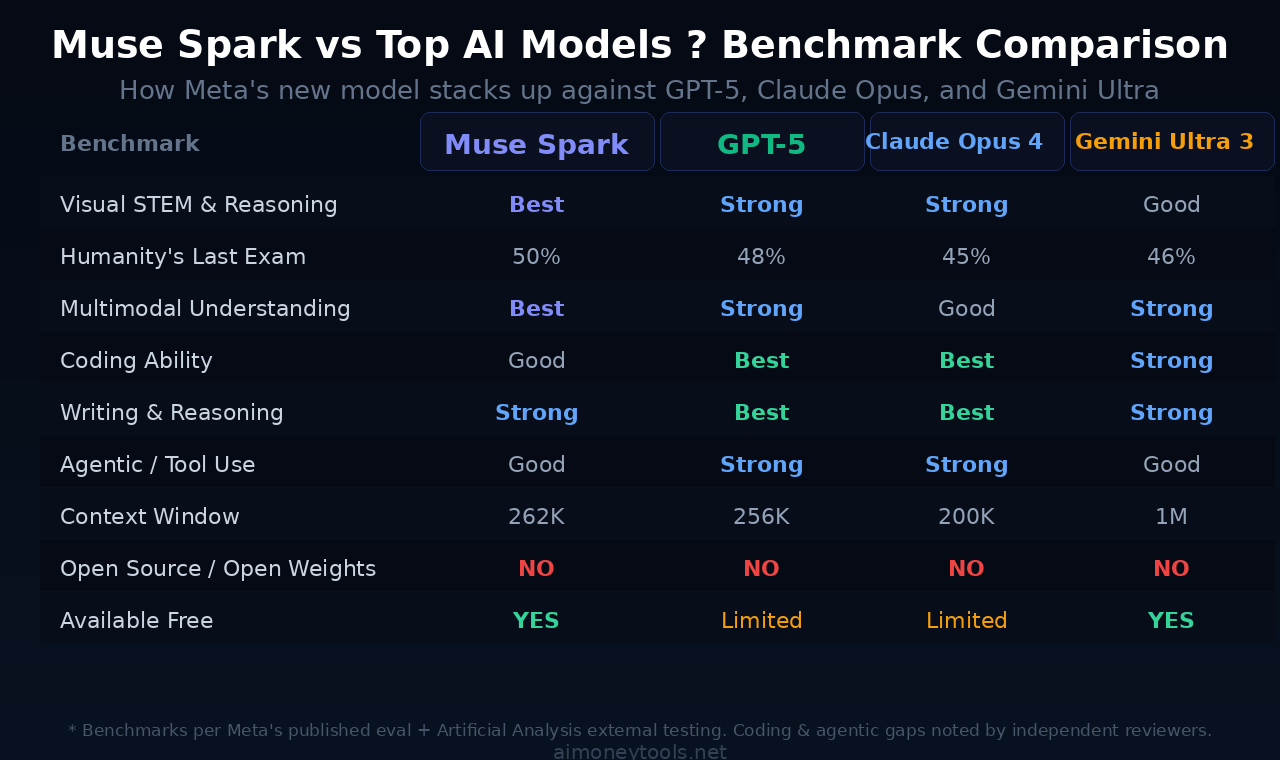
Based on the benchmarks Meta published — which should be read with appropriate skepticism given the Llama 4 history — Muse Spark places at or near the top across several categories.
Where Muse Spark leads:
- Visual STEM and reasoning — Meta claims Muse Spark is the best model available at tasks involving visual problem-solving, interactive experiences, and scientific image analysis
- Humanity's Last Exam — 50%, which appears to be among the top scores publicly reported for this notoriously difficult benchmark
- Multimodal understanding — strong cross-modal reasoning combining text and visual inputs
Where it still lags:
- Coding ability — all three major sources (NYT, Fortune, TechCrunch) note this explicitly. Coding is currently the primary battleground in the AI race, and Muse Spark is not yet competitive with the best coding-focused models from Anthropic or OpenAI
- Agentic tasks — still early; more capable agentic behavior is expected in "Contemplating mode" (not yet released)
The independent researcher community has started evaluating the model, and early results are more mixed than the official benchmarks suggest — consistent with Meta's history. That said, the visual reasoning and multimodal results appear to hold up better under external scrutiny than the coding claims.
Key Features and What Makes Muse Spark Different
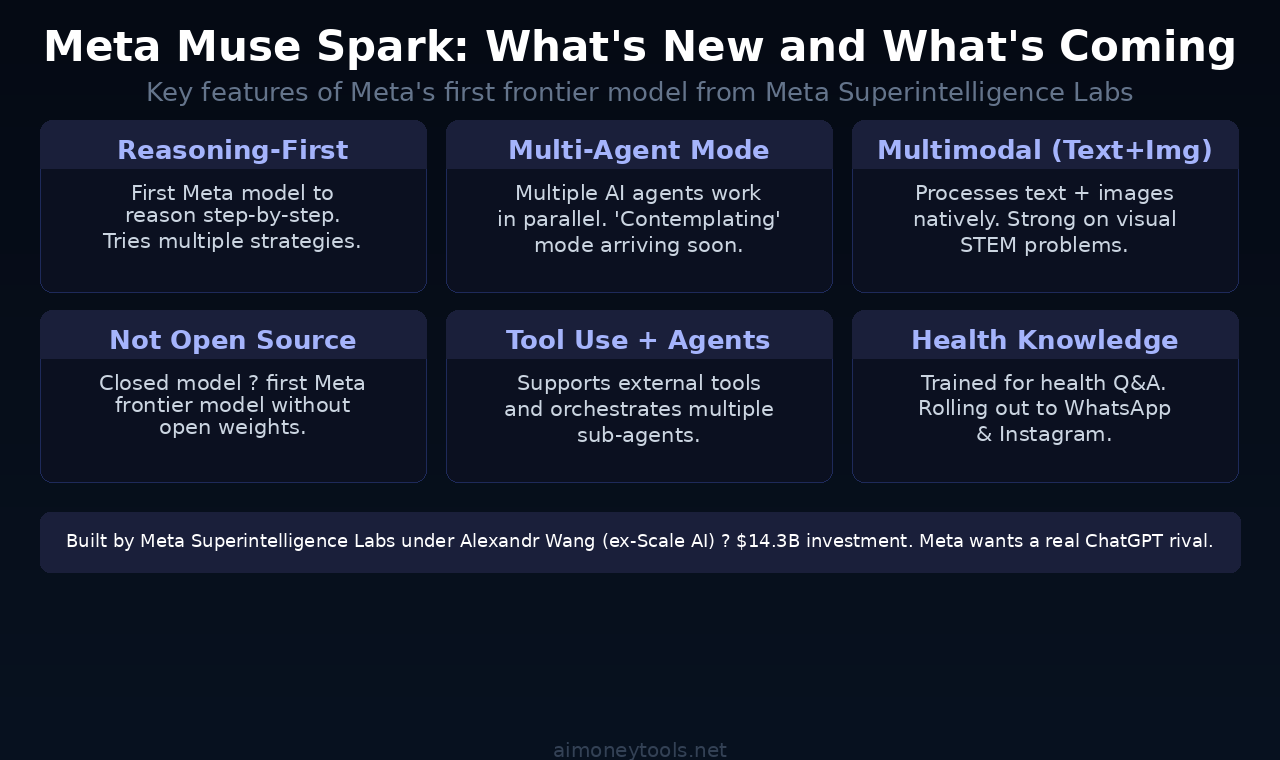
Reasoning-first architecture Muse Spark is Meta's first model built around chain-of-thought reasoning. Instead of producing an immediate output, it works through problems methodically. This is the same fundamental shift OpenAI made with the o1/o3 models and Anthropic made with Claude's extended thinking mode.
Multi-agent "Contemplating" mode (coming soon) Meta's most interesting technical claim: for harder problems, Muse Spark can spawn multiple AI agents working in parallel on the same problem. Rather than one model thinking longer (which increases latency), multiple agents tackle the problem simultaneously and converge. Meta calls this "Contemplating mode" — it's not yet available, but it's the technical architecture that most distinguishes Muse Spark's approach from competitors.
Visual STEM and interactive experiences Muse Spark is specifically trained for visual science problems. Meta describes practical use cases like "creating fun minigames" from visual prompts, or "troubleshooting home appliances" by analyzing photos. This tracks with the model's benchmark strengths and suggests Meta is positioning it for consumer-facing use in its visual products (Instagram, Ray-Ban glasses).
Health knowledge integration Meta explicitly mentions health questions as a focus area — users can ask Muse Spark medical questions. This is consistent with what Google has done with Gemini in Google Search (AI-generated health answers), and what Apple is exploring. It will generate privacy and accuracy scrutiny.
Requires Meta account login This is worth flagging: to use Muse Spark, you must log in with a Facebook or Instagram account. Meta doesn't explicitly state what user data informs the model, but given Meta's data practices and its history of training on user-generated content, this is a reasonable concern for privacy-conscious users.
Why Did Meta Abandon Open Source?
This is the most significant strategic shift embedded in the Muse Spark announcement.
Meta's previous AI models — the entire Llama family — were open-weight. Anyone could download them. Developers could run them locally, fine-tune them, or build products on top of them. Meta's justification was partly philosophical (open AI benefits everyone) and partly strategic (commoditize competitors' moats; build a developer ecosystem).
Muse Spark is closed. You cannot download it. There is no license. The only access is through Meta's own products or the private API.
Zuckerberg indicated this is temporary: "Looking ahead, we plan to release increasingly advanced models that push the frontier of intelligence and capabilities, including new open source models." But the first frontier model isn't open-source — and that's not a small thing.
The most plausible explanation is competitive: at the frontier level, open-sourcing a model immediately helps every competitor. Meta may want to establish a commercial use case for Muse Spark before releasing open weights, or may be reconsidering the strategy entirely given how OpenAI has monetized proprietary models.
How to Use Muse Spark
Muse Spark is already accessible in two places:
- meta.ai — the web interface, available now. Log in with a Facebook or Instagram account.
- Meta AI app — available on iOS and Android.
Rollout to WhatsApp, Instagram, Facebook, and Messenger is happening over the coming weeks. If you use any of those products with the Meta AI assistant, you'll eventually be using Muse Spark without needing to do anything.
For developers: API access is by private preview application. Meta has not published public API pricing or a timeline for general API availability.
What This Means for the AI Market
The week of April 7–10, 2026 saw two of the biggest AI announcements in years: Anthropic's Claude Mythos (too dangerous to release publicly) and now Meta's Muse Spark (first frontier model from a $14B-funded lab rebuild).
Both announcements point to the same thing: the frontier is moving faster than the industry can safely deploy. Meta's response is to build a competitive product and lock it down. Anthropic's response is to lock it down even harder.
For businesses and developers, the practical implication is straightforward: the tools you can actually use — APIs, platforms, and accessible models — are increasingly behind paywall access tiers, safety filters, and enterprise agreements. The freely available open-source models (Llama 3, Mistral, DeepSeek V3) remain capable, but the gap between the frontier and what's accessible is widening.
For consumers, Muse Spark is the most consequential change in Meta AI's history. If the model's quality holds up under independent testing, it will meaningfully improve Meta's AI assistant across WhatsApp, Instagram, and Facebook — apps used by several billion people. That reach makes Muse Spark arguably more impactful than models with better benchmarks but narrower distribution.
Key Takeaways
- Muse Spark is Meta's first frontier AI model from Meta Superintelligence Labs, available on meta.ai and the Meta AI app now
- It leads on visual reasoning and STEM benchmarks (50% on Humanity's Last Exam), but still lags competitors on coding
- It's Meta's first closed-source model — a significant departure from the Llama open-weights strategy
- The multi-agent "Contemplating" mode (multiple parallel agents on hard problems) is coming soon and could be the model's most technically distinctive feature
- Benchmark skepticism is warranted: Meta has manipulated benchmark results before (Llama 4 controversy)
- Using Muse Spark requires a Meta account (Facebook or Instagram) — relevant for privacy-conscious users
Frequently Asked Questions
Is Meta Muse Spark free to use? Yes — Muse Spark is currently available for free at meta.ai and in the Meta AI app. You need to log in with a Facebook or Instagram account to access it. Meta hasn't announced pricing for paid tiers or API access yet.
How is Muse Spark different from Llama? Llama (Meta's previous AI family) was open-source and open-weight — anyone could download it, fine-tune it, or deploy it locally. Muse Spark is closed and proprietary. You cannot download it. It also uses a reasoning-first architecture that Llama models did not have. Muse Spark is Meta's first attempt at a genuine frontier model rather than an open research artifact.
Does Muse Spark support images? Yes. Muse Spark is multimodal — it handles both text and images. Meta specifically highlights visual STEM problems, interactive minigames, and home appliance troubleshooting from photos as example use cases. This is one of the model's benchmark strengths.
Is Muse Spark as good as ChatGPT or Claude? On some benchmarks (visual reasoning, STEM), Muse Spark appears competitive or superior. On coding, it lags both ChatGPT and Claude Opus. Independent evaluation is ongoing and early results are more mixed than Meta's own benchmarks suggest. Given Meta's history with Llama 4 benchmark manipulation, independent results matter more than self-reported scores.
When will Muse Spark come to WhatsApp and Instagram? Meta said it will roll out to WhatsApp, Instagram, Facebook, Messenger, and Ray-Ban AI glasses "in the coming weeks." No specific date has been given. The rollout is gradual — expect the Meta AI assistant in those products to be powered by Muse Spark by mid-2026.
Sources: TechCrunch — Meta debuts Muse Spark, Fortune — Meta unveils Muse Spark, NYT — Meta Unveils New A.I. Model, Meta AI Blog — Introducing Muse Spark

Alex the Engineer
•Founder & AI ArchitectSenior software engineer turned AI Agency owner. I build massive, scalable AI workflows and share the exact blueprints, financial models, and code I use to generate automated revenue in 2026.
Related Articles
How to Start an AI-Assisted Resume Writing Side Hustle in 2026 (Beginner's Guide)
A step-by-step guide to using AI resume tools to offer a paid resume and cover letter writing service — what to charge, which tools to use, and how to find your first clients.
How to Build and Sell AI Voice Receptionists to Local Businesses in 2026
A beginner's guide to building AI voice agents that answer business phone calls — the tools to use, what to charge, and how to find your first client.
How to Make Money on Fiverr with AI Tools in 2026: 7 Gigs You Can Start This Week
Discover 7 real Fiverr gigs you can launch using free and low-cost AI tools in 2026 — no experience required. Real pricing data, step-by-step setup, and tools that actually work.