
Blog Earning Guide 2026: How to Monetize Your Content
Start your blog earning journey with this practical 2026 guide. Learn to pick profitable niches, use AI tools, and scale revenue through proven methods.
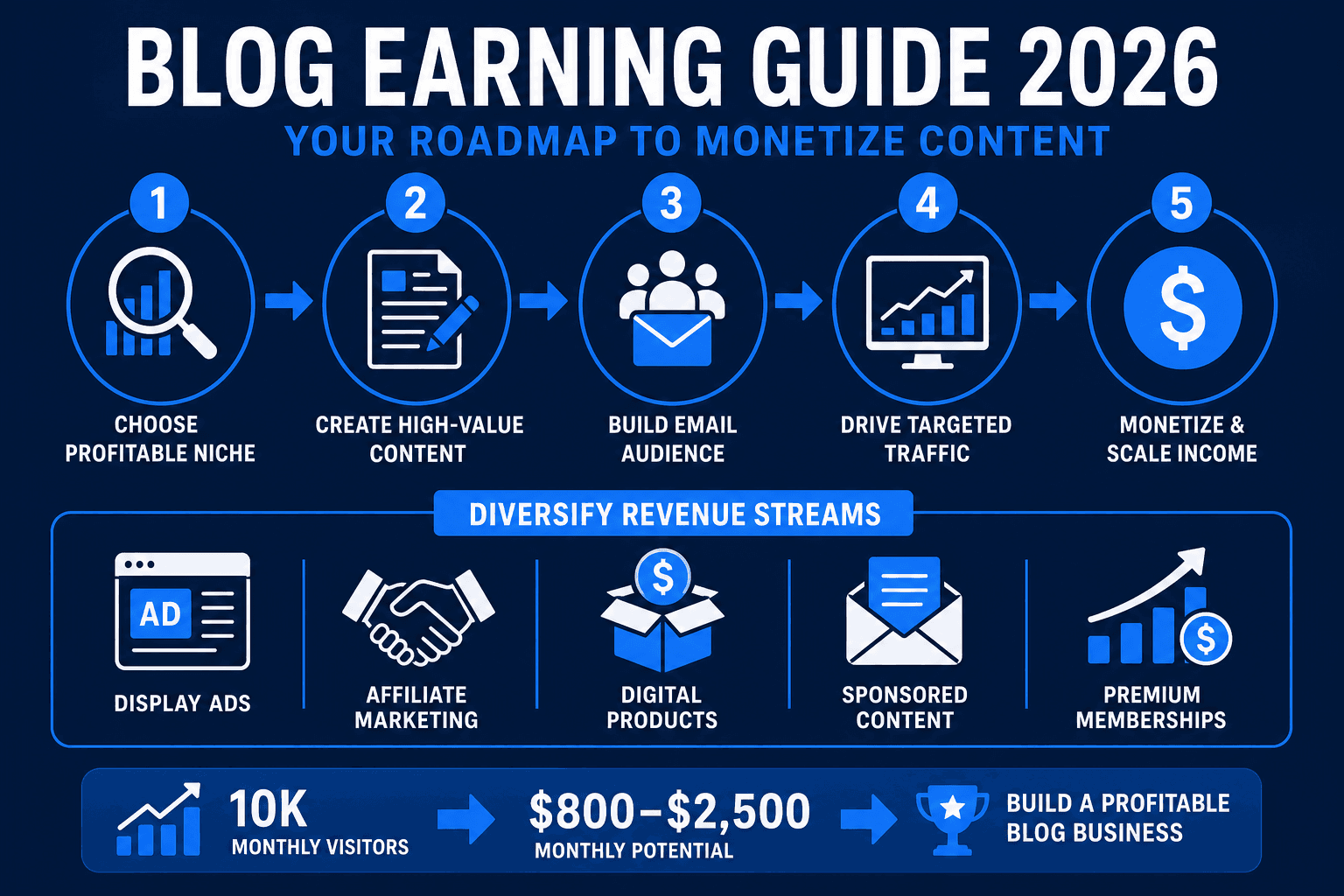
You can start earning a full-time income from blogging by combining high-value content with automated monetization systems. This guide—last updated in April 2026—provides a direct roadmap for beginners to transition from hobbyist writing to professional digital asset management. By the end of this article, you will know exactly how to structure your site for maximum revenue in the current AI-driven economy.
The Reality of Blog Earning in 2026
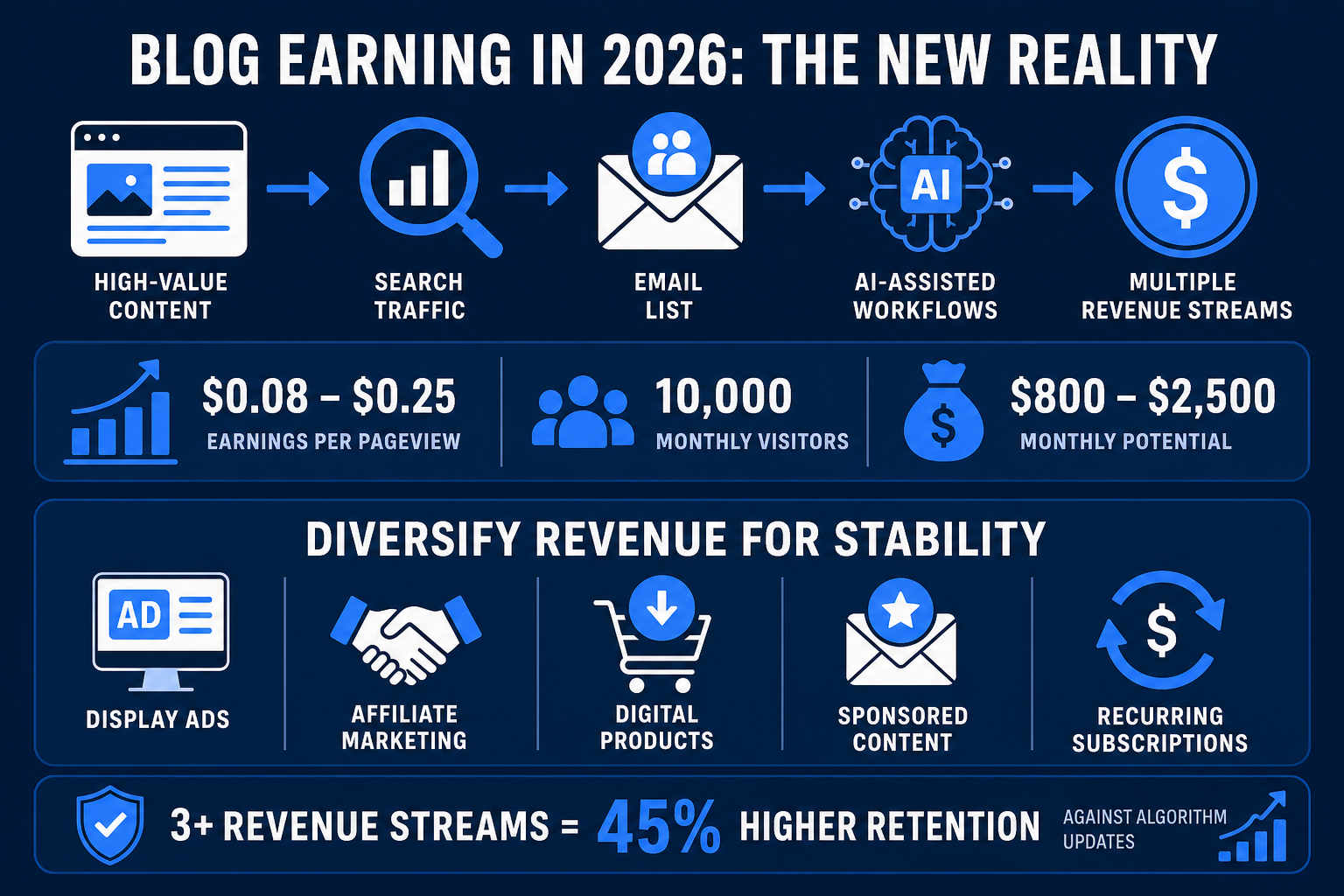
Modern blog earning requires a multi-channel approach where search traffic, email lists, and AI-assisted workflows intersect. While the barrier to entry is lower than ever, the competition for attention is higher, making strategy more important than raw output.
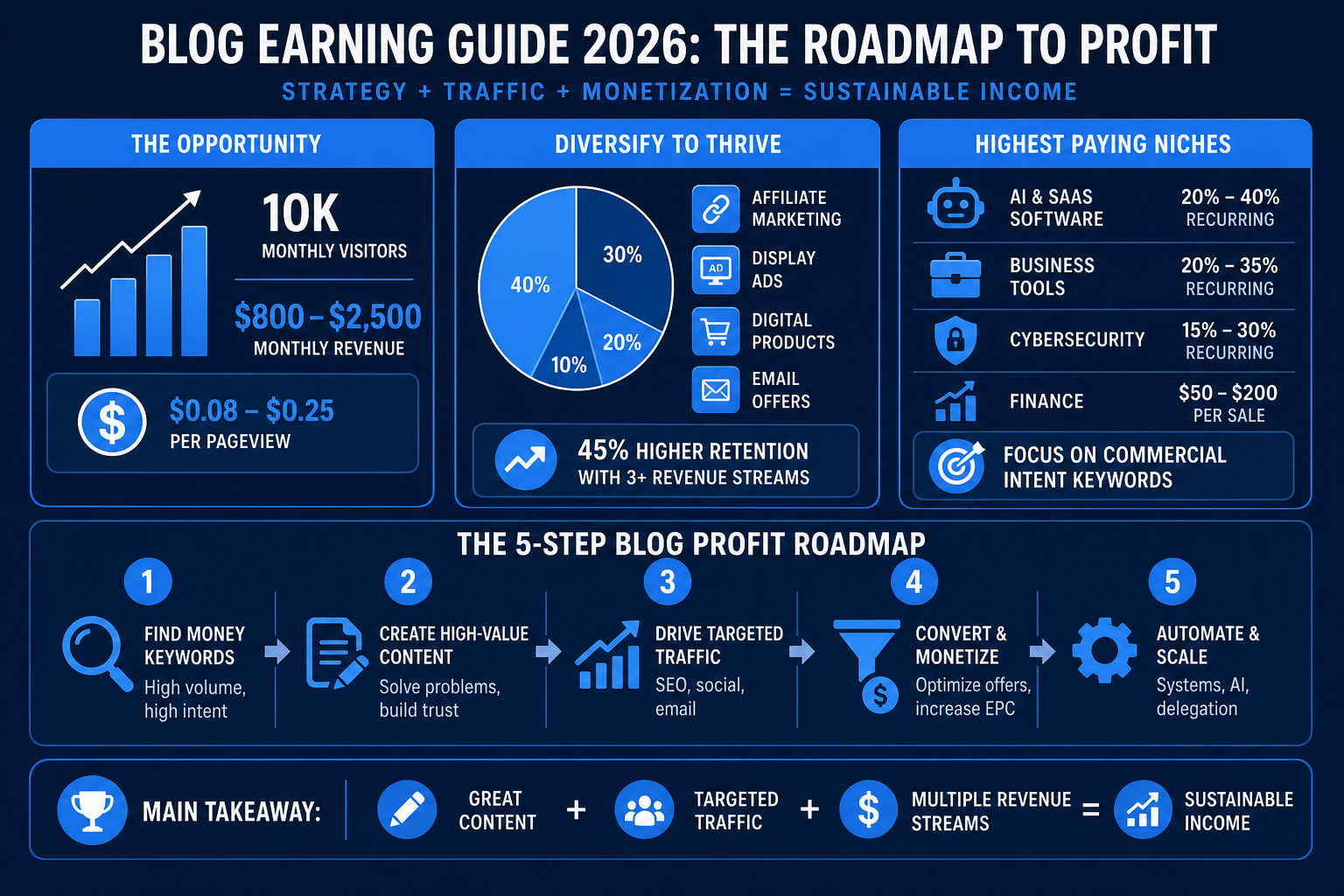
Data from the 2025 Creator Economy Report shows that professional bloggers in the "Business & Tech" niche now earn an average of $0.08 to $0.25 per pageview when combining affiliate revenue with premium display ads. This means a relatively small audience of 10,000 monthly visitors can generate $800–$2,500 in monthly revenue if the niche is correctly optimized.
How Monetization has Shifted
In previous years, bloggers could survive solely on display ads. Today, successful creators must master monetizing your blog with AI to stay competitive. Diversifying into digital products and specialized affiliate programs is mandatory. Creators using three or more revenue streams see a 45% higher retention rate against search engine algorithm updates compared to those relying on ads alone.
Profitability by Niche
Not all topics offer the same financial upside. According to current market rates, B2B SaaS and AI software reviews currently command the highest affiliate commissions, often ranging from 20% to 40% recurring lifetime payouts. When selecting a topic, look for "commercial intent"—questions where the reader is looking to solve a problem with a purchase.
Choosing a Niche with High Revenue Potential
Selecting a niche is the most critical decision in your blog earning journey. A niche with high search volume but low commercial value will result in "hollow traffic" that doesn't convert into cash.
Identifying "Money Keywords"
Focus on keywords that indicate a readiness to spend. For example, "How to save money" is informational, whereas "Best high-yield savings accounts 2026" is transactional. To maximize your income, follow these three steps:
- Use a tool like Ahrefs or Semrush to find keywords with a Cost-Per-Click (CPC) of $2.00 or higher.
- Filter for "How-to" keywords that can be solved by a specific software tool.
- Aim for a 70/30 split: 70% helpful informational content to build trust, and 30% transactional content to drive revenue.
Validating Market Demand
Before buying a domain, check if companies are currently buying ads in that space. If you see sponsored results on Google for your target keywords, it’s a sign that the niche is profitable. Tools like CustomGPT.ai can help you analyze large datasets of competitor content to find gaps in the market that you can fill with unique AI side hustle ideas.
Technical Setup for Maximum Conversions
Your blog’s technical foundation impacts how much you earn by affecting user stay-time and search rankings.
Platform and Hosting Essentials
WordPress.org remains the gold standard. For 2026, your site must pass the "Interaction to Next Paint" (INP) metric with a score under 200ms. If your host is slow, your bounce rate will skyrocket, and Google will deprioritize your content in favor of faster competitors.
User Experience (UX) for Revenue
- Contextual CTAs: Instead of generic sidebar banners, use "in-line" buttons. Placing a button after the first 300 words of a post typically increases click-through rates by 15%.
- Mobile-First Indexing: Over 70% of readers in 2026 access content via mobile. Ensure your affiliate links are large enough to be "thumb-friendly."
- Transparency: Use a bolded affiliate disclosure at the top of every post to satisfy both FTC requirements and GEO/generative engine optimization signals for trust.
Creating Content That Drives Revenue
Content is the vehicle for your income. Quality is defined by "Experience, Expertise, Authoritativeness, and Trustworthiness" (E-E-A-T).
Solving Problems vs. Chasing Traffic
Don't just write about popular topics; write about expensive problems. If you help a business owner save five hours a week using AI productivity tools, they are highly likely to click your affiliate link. This "utility-first" approach is the fastest way to see a return on investment.
Integrating AI for Efficiency
You can use AI to handle the heavy lifting of research and outlining. For instance, if you are building a voice-over niche blog, Murf.ai can generate high-quality audio versions of your articles, increasing the time readers spend on your site and improving your SEO. To keep your quality high, always use prompt engineering to give your AI specific brand voice guidelines.
Diversifying Your Income Streams
To protect your business, you should never rely on a single source of revenue.
Display Ads and Affiliate Marketing
Once you reach 10,000–50,000 monthly sessions, apply for premium networks like Mediavine.
- Affiliate Programs: Join AI affiliate programs which offer some of the highest margins in the digital space.
- Digital Products: Instead of just writing, start selling digital products online. A $47 "Prompt Pack" can often out-earn $1,000 worth of display ad traffic.
The Power of Direct Monetization
Newsletters allow you to bypass social media algorithms. By owning your audience's email addresses, you can promote new passive income with AI tools directly to their inbox, ensuring a steady flow of income regardless of Google's latest update.
Scaling Your Blog into a Business
Scaling involves moving from "doing the work" to "managing the system."
- Audit your top 10 posts: Identify which ones have the highest conversion rate (not just traffic).
- Automate Distribution: Use platforms like Ampere.sh to host AI agents that can automate your social media customer interactions.
- Expand into Services: If your blog ranks well for "AI automation," consider launching an AI automation agency to serve the clients who are already reading your content.
Frequently Asked Questions
What is the average monthly income for a new blog in 2026?
While results vary, a blog focusing on "High-Ticket" niches (like Enterprise AI or Fintech) can realistically reach $500–$1,500 per month within 6–9 months by focusing on how to make money with AI strategies. General lifestyle blogs typically take longer to monetize effectively.
How do I prevent my blog from being flagged as "AI Content"?
Focus on adding "Information Gain." This means including personal screenshots, original data points, or unique case studies that an AI cannot hallucinate. Use ChatGPT for content creation as a draft assistant, but always edit the final output to include your own expert perspective.
Which affiliate programs pay the most for bloggers?
Software-as-a-Service (SaaS) and AI tools currently lead the market. For example, some AI video tools pay $50+ per referral, whereas physical products on Amazon may only pay $0.50 to $2.00 for a similar sale.
How much should I spend on a blog setup initially?
You can start for under $100. This covers a domain name ($12/year), basic hosting ($5–$10/month), and a free WordPress theme. Do not buy expensive "masterclasses" until you have at least 20 posts published and are seeing initial traffic.
Is SEO still the best way to get traffic?
SEO remains the highest-quality traffic source because it captures "intent," but it should be paired with growing on X/Twitter to build a brand. A hybrid approach ensures that if one platform changes its rules, your income doesn't disappear overnight.
Related Articles:

Alex the Engineer
•Founder & AI ArchitectSenior software engineer turned AI Agency owner. I build massive, scalable AI workflows and share the exact blueprints, financial models, and code I use to generate automated revenue in 2026.
Related Articles
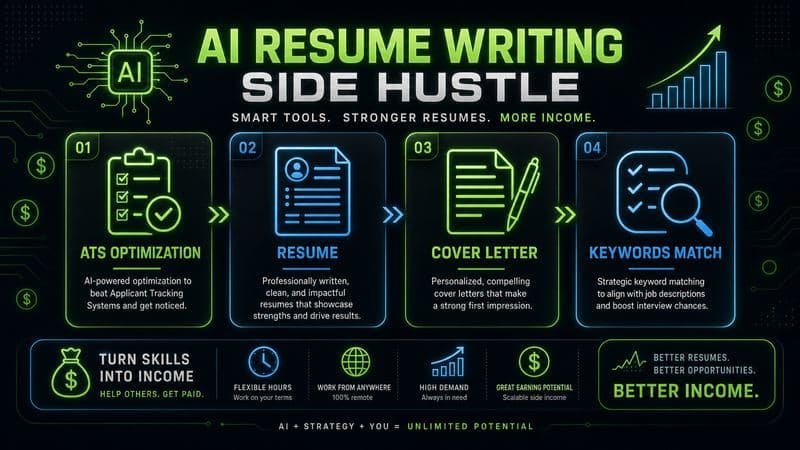
How to Start an AI-Assisted Resume Writing Side Hustle in 2026 (Beginner's Guide)
A step-by-step guide to using AI resume tools to offer a paid resume and cover letter writing service — what to charge, which tools to use, and how to find your first clients.
How to Build and Sell AI Voice Receptionists to Local Businesses in 2026
A beginner's guide to building AI voice agents that answer business phone calls — the tools to use, what to charge, and how to find your first client.
How to Make Money on Fiverr with AI Tools in 2026: 7 Gigs You Can Start This Week
Discover 7 real Fiverr gigs you can launch using free and low-cost AI tools in 2026 — no experience required. Real pricing data, step-by-step setup, and tools that actually work.