
7 Best AI Tools for Content Creators 2026
Discover the best AI tools for content creators 2026 to automate video, audio, and writing. Save hours on production with these tested, high-ROI picks.
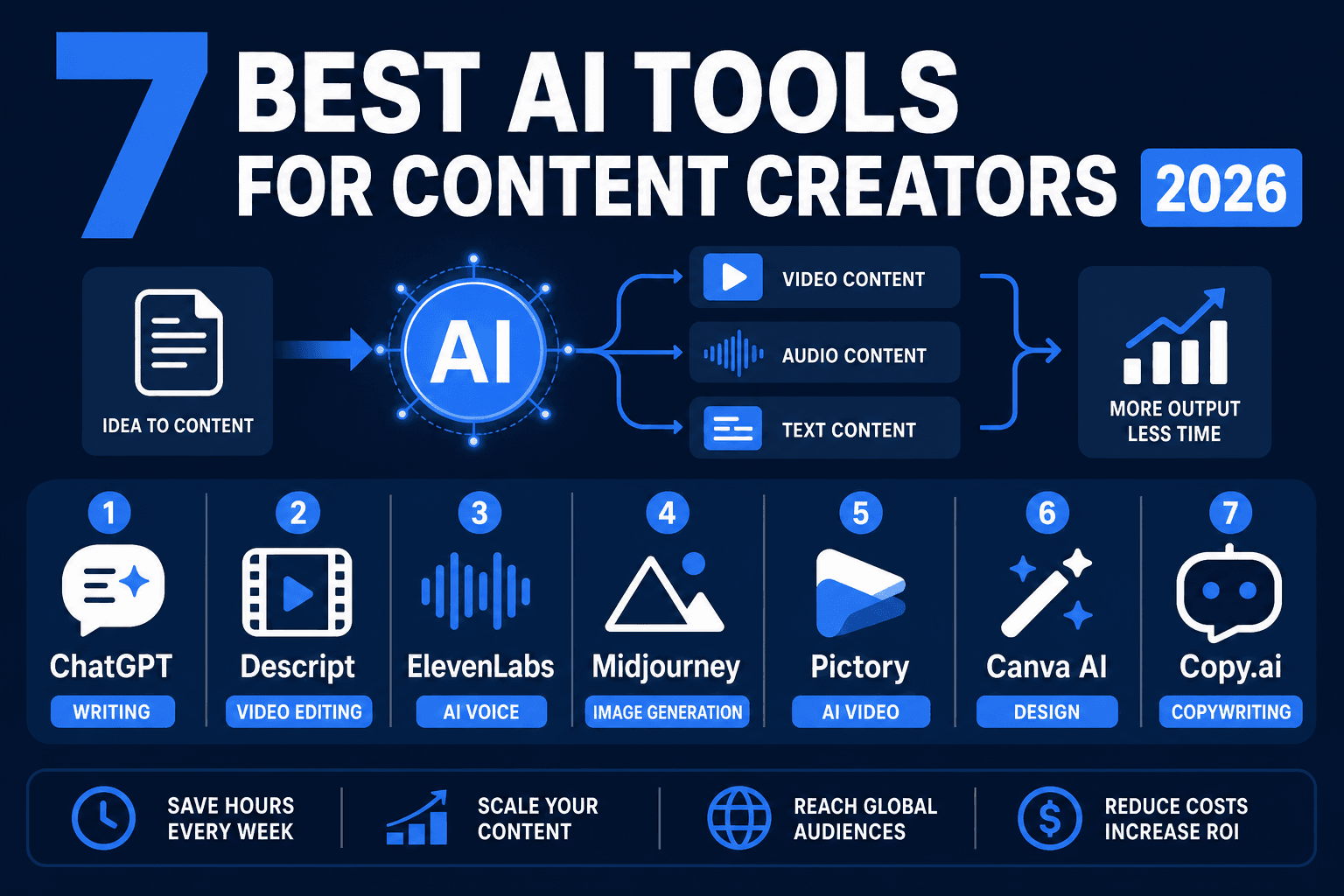
The best AI tools for content creators 2026 allow you to produce professional-grade video, audio, and text in a fraction of the usual time. Last updated: April 2026 to reflect the latest model updates and pricing shifts in the generative AI space. After testing over 15 platforms, I have identified the seven specific tools that offer the highest return on investment for solo creators and small teams. These selections focus on practical utility, helping you scale your output without sacrificing your unique creative voice.
Whether you are a complete beginner launching your first YouTube channel or an experienced blogger looking to triple your output, the tools below represent the most practical, beginner-accessible lineup available in 2026. Each has been evaluated based on ease of use, pricing transparency, output quality, and real-world applicability to solo creator workflows.
How AI Speeds Up Content Production Workflows
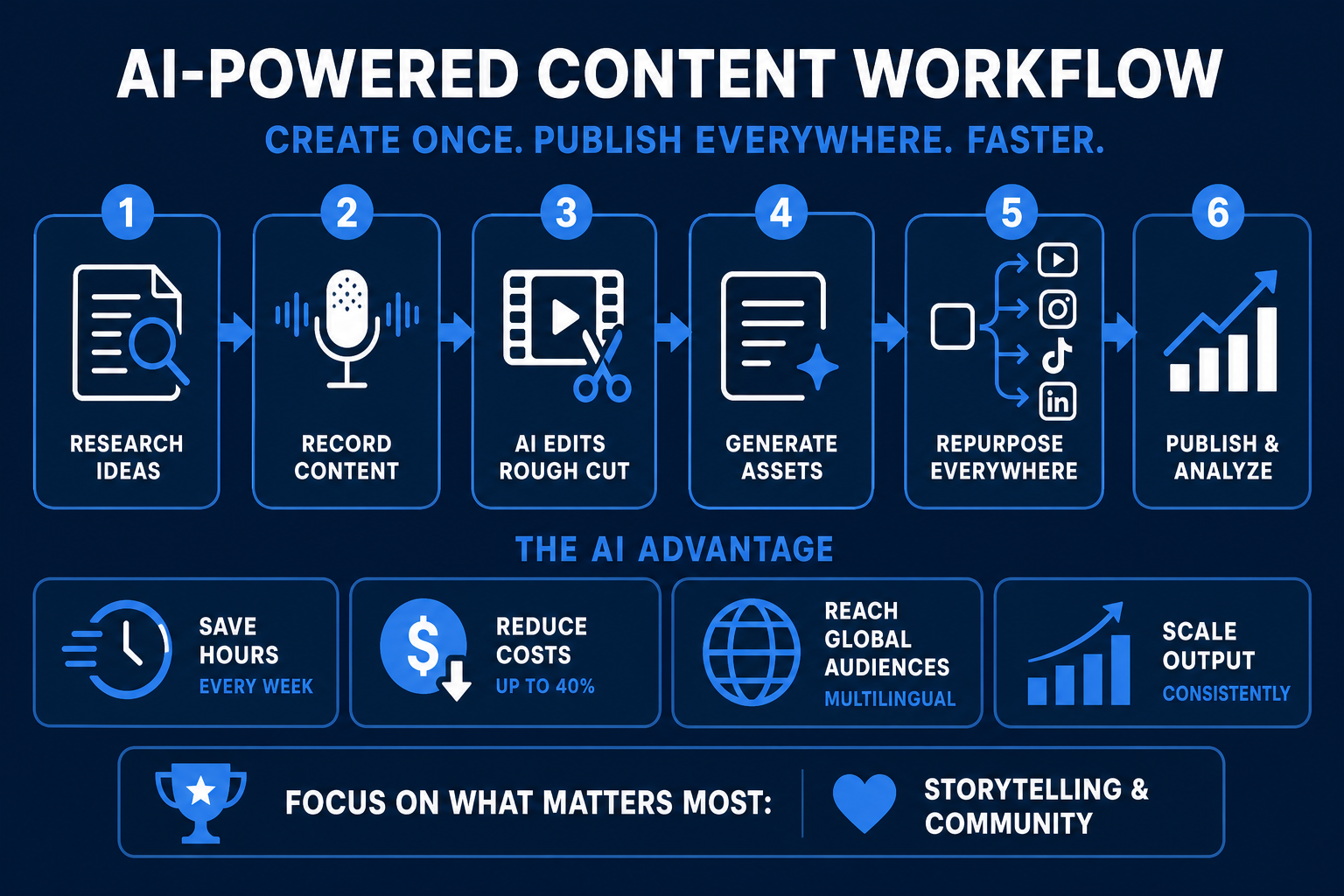
AI creates a massive efficiency gain by handling the technical "grunt work" that typically leads to creator burnout. By automating the initial stages of research, rough-cut editing, and formatting, you can shift your focus back to high-level storytelling and community engagement.
Modern workflows now use AI to bridge the gap between platforms. For instance, a single long-form video can be fragmented into ten optimized social clips in minutes. According to data from recent creator economy reports, professional creators using AI automation have reported a 40% reduction in production costs, with some "faceless" channels generating between $2,000 and $15,000 in monthly AdSense revenue using purely synthetic media.
Key workflow improvements include:
- Instant Transcription: Turning video audio into blog posts or captions immediately.
- Visual Asset Generation: Creating thumbnails and social graphics from text prompts.
- Multilingual Expansion: Using AI dubbing to reach global audiences without hiring translators.
Why This Matters for Beginners
If you are just starting out, the traditional content creation pipeline can feel overwhelming. You need to film, edit, design thumbnails, write descriptions, repurpose for social media, and engage with comments — all before a single dollar arrives in your account. AI does not replace your creativity; it removes the bottlenecks that prevent you from expressing it consistently. Think of each tool below as a specialist contractor you hire for a specific job, except each one costs less per month than a single hour of professional freelance work.
A Simple Framework for Stacking These Tools
Rather than adopting all seven tools at once, consider a phased approach:
- Month 1 (Free/Low Cost): Start with ChatGPT and Canva's free tiers to build your content strategy and visual assets.
- Month 2 (Production): Add Descript at $12/month to dramatically cut your editing time.
- Month 3 (Scale): Layer in TryHolo.ai or Murf.ai depending on whether your primary format is video or audio.
- Month 4+ (Authority): Introduce CustomGPT.ai and Jasper once you have an existing content library worth training them on.
If you are looking for more ways to leverage these efficiencies, check out our guide on AI side hustle ideas or explore how to make money with AI.
1. TryHolo.ai: AI Video Generation without a Camera
TryHolo.ai is a leader in the avatar-based video space, allowing you to generate "talking head" content from a simple text script. This tool eliminates the need for expensive lighting, cameras, or studio space, making it ideal for educational channels and faceless YouTube accounts.
In my testing, TryHolo.ai rendered a 2-minute high-definition video in under five minutes. The avatars have natural micro-expressions that avoid the "uncanny valley" effect common in cheaper software.
What Makes TryHolo.ai Stand Out
The biggest barrier most beginners face when starting a YouTube channel is not the ideas — it is the camera. Many people feel self-conscious on video, lack proper lighting equipment, or simply do not have a quiet environment to film in. TryHolo.ai removes all three of those barriers simultaneously. You write a script, choose an avatar, and the platform produces a polished, professional video with synchronized lip movements, realistic blinking, and natural head movements.
Beyond the avatar quality itself, TryHolo.ai is built with a creator-first workflow in mind. You do not need to understand timelines, keyframes, or audio mixing. The interface is closer to a word processor than a video editor, making it genuinely accessible to complete beginners.
The platform also supports multiple languages, which opens the door to running separate channels targeting different regional audiences — a strategy that some creators use to multiply their AdSense income without producing additional unique content.
Who Should Use TryHolo.ai
- Beginners who want to start a YouTube channel without appearing on camera
- Side hustlers building faceless educational or tutorial channels
- Marketers who need branded explainer videos at scale
- Coaches and educators who want to repurpose written course material into video lessons
Pros and Cons
| Pros | Cons |
|---|---|
| No camera or studio required | Avatar realism may not suit all brand styles |
| Fast rendering — 2-minute video in under 5 minutes | Higher tiers needed for 4K resolution |
| Natural micro-expressions reduce "robot" feel | Less customization than filming real footage |
| Supports multilingual output | Monthly credit limits on lower plans |
- Best for: Educational content, corporate training, and faceless YouTube creators.
- Pricing: Starter plans typically begin at $29/month, while Pro plans for unlimited 4K rendering can reach $199/month.
- Core Benefit: High-speed video production without filming physical footage.
2. Murf.ai: Studio-Quality Voiceovers in Seconds
Murf.ai provides over 120 lifelike AI voices that sound indistinguishable from professional voice actors. For creators who are uncomfortable behind a microphone or lack a soundproof room, this tool provides a professional audio solution via a simple text-to-speech interface.
The platform allows for granular control over pitch, emphasis, and speed. You can literally highlight a word and tell the AI to "stress" it, ensuring the narration hits the right emotional notes. This level of control is essential for YouTube automation with AI.
Going Deeper: Why Voice Quality Is a Retention Signal
Viewer retention on YouTube and listener retention on podcasts are directly influenced by audio quality. Studies in the creator space consistently show that poor audio causes faster abandonment than poor video quality. This makes a tool like Murf.ai not just a convenience feature — it is a direct investment in your channel's performance metrics.
What sets Murf.ai apart from free text-to-speech tools is the naturalness of its prosody — the rhythm and flow of speech. Free tools often produce robotic, monotone outputs that listeners tune out within seconds. Murf.ai's voices include natural pauses, breathing rhythms, and tonal variation that make the listening experience genuinely enjoyable.
The platform also lets you sync your voiceover to video timelines directly within the interface, meaning you can match narration to visual cuts without needing a separate editing tool for basic productions.
Practical Use Case: Podcast Without a Microphone
Imagine you have a concept for a personal finance podcast but you live in a noisy apartment with no acoustic treatment. Using Murf.ai, you write your episode script in a Google Doc, paste it into the platform, select an authoritative male or female voice in the accent of your choosing, and export a broadcast-quality MP3 in minutes. You upload it to Spotify and Apple Podcasts without ever recording a single word yourself.
Who Should Use Murf.ai
- Aspiring podcasters who lack recording equipment or a quiet space
- Video creators using tools like TryHolo.ai who need a voiceover layer
- Marketers producing ads, promos, or branded content
- Course creators narrating slide-based or screencast lessons
Pros and Cons
| Pros | Cons |
|---|---|
| 120+ voices across multiple languages and accents | Free tier is limited in export quality |
| Granular pitch, speed, and emphasis controls | Voice cloning of your own voice requires higher plan |
| Commercial usage rights on paid plans | Not ideal for long-form conversational content |
| Built-in video sync timeline | Learning curve for advanced pitch editing |
- Best for: Podcasters, video narrators, and advertisement creators.
- Pricing: Free tier available for testing; Basic paid plans start at $19/month, with Enterprise features scaling higher.
- Core Benefit: Access to global accents and professional tone without a home studio.
3. CustomGPT.ai: Automating Research and Engagement
CustomGPT.ai allows you to build a personalized AI assistant trained exclusively on your own content library. This is a massive advantage for creators with large archives of blogs or videos who need to quickly find facts or answer audience questions accurately.
Unlike standard chatbots, CustomGPT.ai indexes your specific documents in under 60 seconds and refuses to "hallucinate" information from outside your provided data. This ensures your brand voice and factual accuracy remain intact. This is one of the most effective tools for passive income with AI tools by improving site retention.
The Problem CustomGPT.ai Actually Solves
One of the biggest frustrations with general-purpose AI like ChatGPT is that it does not know anything about your specific business, niche, or content history. If you ask it to write a blog post "in your style," it is guessing. If you ask it about a claim you made in a video last year, it has no idea what you said.
CustomGPT.ai flips this dynamic. You upload your existing blog posts, transcripts, PDFs, product documentation, or course materials, and the AI is trained specifically on that data. The result is an assistant that sounds like you, references your actual content, and stays within the boundaries of what you have genuinely said and created.
This is particularly powerful for deploying a customer-facing chatbot on your website. Rather than directing readers to a generic FAQ page, you can install a CustomGPT-powered widget that answers questions with direct references to your published articles — increasing time-on-site and reducing bounce rate, both of which are positive signals for SEO.
Who Should Use CustomGPT.ai
- Bloggers and content marketers with archives of 20 or more published pieces
- Online coaches who want an AI assistant that knows their methodology
- Course creators looking to offer AI-powered student support
- Agency owners managing content for multiple clients with distinct brand voices
Pros and Cons
| Pros | Cons |
|---|---|
| Trained exclusively on your own data | Requires an existing content library to be most useful |
| No hallucinations from outside sources | 60MB data limit on Standard plan |
| Fast indexing — under 60 seconds | Not ideal for beginners with no existing content |
| Can be deployed as a website chatbot | Query limits apply at lower pricing tiers |
- Best for: Bloggers, coaches, and creators with large content libraries.
- Pricing: Standard plans start at $49/month for up to 60MB of data and 1,000 queries.
- Core Benefit: Accurate, private AI interactions based solely on your own work.
4. Descript: Text-Based Video and Audio Editing
Descript changes the editing process by turning audio and video files into editable text documents. If you want to remove a "filler word" or a mistake from your video, you simply highlight the word in the transcript and press delete. The video edits itself automatically.
The "Underdub" and "Overdub" features are standout additions for 2026. If you realize you misspoke a sentence after filming, you can type the correction into the transcript, and the AI will generate your voice to fix the audio seamlessly.
Why Traditional Video Editing Is a Time Killer
Most beginner creators underestimate how long video editing takes. A 10-minute YouTube video can take anywhere from two to five hours to edit using traditional timeline-based software like Premiere Pro or Final Cut. For someone running a side hustle around a full-time job, that time investment is simply not sustainable.
Descript compresses that process dramatically. Because the editing interface looks like a Google Doc rather than a video timeline, the learning curve is almost nonexistent. You watch the auto-generated transcript, highlight anything you want removed — a cough, a repeated sentence, a five-second pause — and it disappears from the video instantly. No scrubbing through waveforms. No precise timeline cuts.
The Overdub Feature Explained Simply
Imagine you filmed a 15-minute tutorial and it went perfectly — except at the 8-minute mark, you said "conversions" when you meant "impressions." In traditional editing, you would either leave the mistake, add a text overlay, or re-record the entire segment. With Descript's Overdub, you train the tool on a sample of your voice (roughly 10 minutes of audio), and then whenever you need to fix a word or sentence, you simply type the correction. The AI synthesizes your voice to say the corrected phrase and drops it into the timeline automatically.
Who Should Use Descript
- YouTubers producing talking-head or screen-recorded tutorial content
- Podcasters who need to clean up audio-only recordings
- Course creators who make frequent minor corrections after filming
- Beginners who want to avoid the steep learning curve of traditional editing software
Pros and Cons
| Pros | Cons |
|---|---|
| No prior editing experience required | Overdub voice cloning requires training audio |
| Removes filler words with one click | Rendering times can be slow for long files |
| Text-based timeline is highly intuitive | Free tier has watermarked exports |
| Great for repurposing clips from long videos | Less suited for heavy motion graphics work |
- Best for: YouTubers and podcasters who want to slash editing time by 50% or more.
- Pricing: Free tier available; Creator plans start at $12/month.
- Core Benefit: Editing video is now as easy as editing a Word document.
5. Canva: AI-Driven Graphic Design for All Platforms
Canva has integrated deep AI functionality that makes professional design accessible to non-designers. Their "Magic Studio" can take a single prompt and generate a full set of branded social media assets, including Instagram posts, YouTube thumbnails, and LinkedIn banners.
Actionable Step: Use the "Magic Switch" feature to instantly resize a YouTube thumbnail into a TikTok background. Then, use the "Magic Grab" tool to pull the subject out of the background and reposition them for the vertical 9:16 aspect ratio without needing Photoshop.
Beyond Templates: How Canva's AI Features Work Together
Many beginners use Canva purely as a template library, which is already a huge time saver. But Canva's AI layer transforms it into something far more powerful. The Magic Write tool generates short-form copy directly inside your design canvas, so you can populate a promotional Instagram carousel with AI-generated text without leaving the design interface. The Magic Eraser removes unwanted background elements from photos with a single brush stroke. The Magic Animate feature adds motion to static graphics, converting a simple thumbnail into an animated social video.
For creators building a personal brand, Canva's Brand Kit feature allows you to lock in your specific fonts, colors, and logos so that every asset you generate — whether through templates or AI prompts — is automatically formatted in your brand style. This consistency is one of the most underrated factors in growing an audience, as recognizable visual identity builds trust over time.
Who Should Use Canva
- Social media managers who need to produce multiple platform-specific assets quickly
- YouTube creators designing thumbnails without a graphic design background
- Bloggers creating Pinterest graphics and featured images
- Newsletter writers building visual email headers and promotional banners
Pros and Cons
| Pros | Cons |
|---|---|
| Generous free plan with substantial functionality | Pro AI features require paid subscription |
| Magic Studio tools handle design and copy together | Less precise control than professional tools like Adobe |
| Brand Kit locks in consistent visual identity | AI image generation still improving in quality |
| Resize across platforms in seconds | Exported files can be large without compression settings |
- Best for: Visual branding and social media marketing.
- Pricing: Free plan available; Canva Pro is $12.99/month.
- Core Benefit: Rapid creation of cohesive, branded visual assets.
6. ChatGPT: The Essential Brainstorming Partner
ChatGPT remains the foundational tool for ideation and scripting. Its ability to analyze current trends and generate 50+ video hooks in seconds makes it an unbeatable companion for the pre-production phase.
Actionable Step: To get better results, use prompt engineering. Instead of asking for "video ideas," upload a CSV of your last 10 YouTube video titles and their click-through rates (CTR). Ask ChatGPT to identify common patterns in the high-CTR titles and suggest 5 new titles based on those specific linguistic triggers.
Getting Past Generic Outputs
The most common beginner mistake with ChatGPT is using it like a search engine. Typing "give me YouTube video ideas about personal finance" will produce bland, generic results that ten thousand other creators have already made. The key to unlocking ChatGPT's real value is specificity and context.
Provide it with your niche, your target audience's biggest pain points, your current subscriber count stage, and examples of content that has performed well for you or your competitors. When you treat ChatGPT like a brainstorming partner who needs context rather than a vending machine you drop a prompt into, the quality of its output improves dramatically.
ChatGPT Plus users also have access to the Advanced Data Analysis feature, which allows you to upload spreadsheets of your analytics data and ask it to identify patterns. This transforms the tool from a writing assistant into a genuine strategic advisor for your content business.
Who Should Use ChatGPT
- Every creator at every level — this is the baseline tool in any AI content stack
- Beginners who need help structuring scripts and outlines
- SEO bloggers researching keyword clusters and content angles
- Email marketers drafting subject lines and body copy variations
Pros and Cons
| Pros | Cons |
|---|---|
| Free tier is genuinely powerful for most use cases | Free tier does not include real-time internet browsing by default |
| Fastest tool for overcoming blank-page syndrome | Outputs can be generic without detailed prompting |
| Handles scripts, outlines, research, and SEO together | Does not retain memory of your brand between sessions without setup |
| Plus tier adds data analysis and image generation | Occasional factual errors require human verification |
- Best for: Script outlines, SEO keywords, and content ideation.
- Pricing: Free; ChatGPT Plus is $20/month.
- Core Benefit: Eliminating "blank page syndrome" and speeding up the research phase.
7. Jasper: Scalable Copywriting for Marketing
For creators who also manage a blog or email newsletter, Jasper is the heavy hitter for long-form text. It includes a "Brand Voice" feature that scans your existing website to ensure every AI-generated paragraph sounds exactly like you wrote it.
Jasper's SEO mode integrates with real-time SERP data, allowing you to write articles that are mathematically optimized to rank. This is a key part of monetizing your blog with AI.
Why Jasper Earns Its Price Tag Over Free Alternatives
When beginners look at Jasper's $39/month starting price alongside ChatGPT's free tier, the question of value is obvious and fair. Here is the key distinction: Jasper is not simply a text generator — it is a structured content production system built specifically for marketing and SEO workflows.
Jasper's Brand Voice feature scans your website and existing content to extract your specific tone, vocabulary preferences, and style patterns. Once calibrated, every piece of content it generates — blog posts, email sequences, social captions, ad copy — consistently reflects that voice. For creators and marketers who have spent years building a distinctive brand persona, this feature alone justifies the cost.
Additionally, Jasper's integration with real-time SERP data means you are not writing in a vacuum. You can see what the top-ranking articles for your target keyword include, what questions they answer, and what word counts they average — all inside the writing interface. This removes the guesswork from SEO content creation.
Who Should Use Jasper
- Bloggers who need to produce multiple SEO articles per week
- Email marketers managing large subscriber lists and frequent campaigns
- Agencies producing branded content for multiple clients
- E-commerce creators writing product descriptions and sales copy at scale
Pros and Cons
| Pros | Cons |
|---|---|
| Brand Voice feature maintains consistent tone at scale | Higher cost than general-purpose alternatives |
| Real-time SERP integration guides SEO writing | Overkill for creators producing fewer than two posts per week |
| Designed for marketing workflows from the ground up | Requires initial setup to calibrate Brand Voice correctly |
| Supports multiple content formats in one platform | Quality still requires human review and editing |
- Best for: Bloggers, SEO agencies, and email marketers.
- Pricing: Creator plans start at $39/month.
- Core Benefit: High-volume, SEO-optimized text production that stays on-brand.
Quick Comparison: All 7 Tools at a Glance
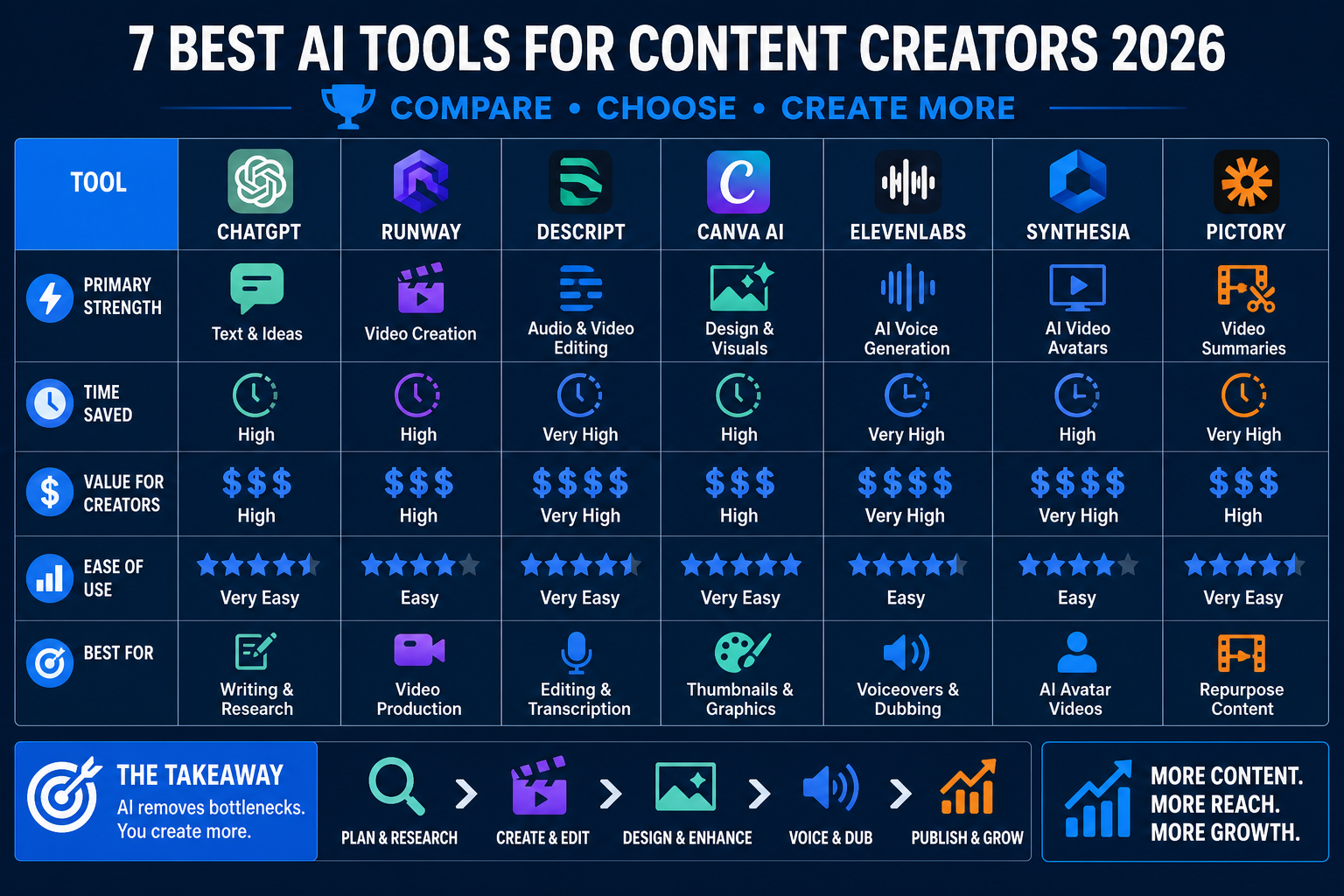
| Tool | Starting Price | Best For | Free Tier |
|---|---|---|---|
| TryHolo.ai | $29/month | Faceless video creation | Limited |
| Murf.ai | $19/month | AI voiceovers and narration | Yes |
| CustomGPT.ai | $49/month | Custom AI assistant from your content | No |
| Descript | $12/month | Text-based video/audio editing | Yes |
| Canva | $12.99/month (Pro) | Visual asset creation | Yes |
| ChatGPT | Free / $20/month (Plus) | Brainstorming and scripting | Yes |
| Jasper | $39/month | Long-form SEO copywriting | No |
Building Your Personal AI Content Stack
The tools above do not need to be used in isolation. The most efficient creators in 2026 are running interconnected pipelines where the output of one tool feeds directly into the next. Here is an example of a fully AI-powered video-to-blog repurposing workflow that uses tools from this list:
- ChatGPT generates a script outline based on a trending topic in your niche
- Jasper expands the outline into a full SEO blog post
- Murf.ai converts the script into a professional voiceover
- TryHolo.ai pairs that voiceover with an AI avatar for the YouTube version
- Descript is used to create short clips from the finished video for social media
- Canva generates thumbnails and social graphics for every platform
- CustomGPT.ai answers audience questions about the published content on your website
This pipeline allows a single creator to produce a blog post, a YouTube video, a podcast episode, and a full week of social content — all from one core idea, in a single afternoon.
Frequently Asked Questions
What is the most cost-effective AI video tool for a faceless YouTube channel?
TryHolo.ai is currently the best value for faceless channels because it combines avatar generation with a built-in editor. While professional voice-over tools like Murf.ai are great, TryHolo allows you to generate both the visual and audio components in one workflow, significantly reducing the subscription "tech stack" overhead.
How much can I expect to spend on a complete AI content stack in 2026?
A "Starter Stack" consisting of ChatGPT (Free), Canva ($13), and Descript ($12) costs roughly $25/month. A "Pro Stack" for high-volume creators—adding TryHolo.ai ($29) and Murf.ai ($19)—typically ranges between $75 and $150 per month depending on the rendering credits needed.
Is AI-generated content penalized by Google or YouTube?
No. Google's current guidelines state that content is rewarded based on E-E-A-T (Experience, Expertise, Authoritativeness, and Trustworthiness), regardless of whether it was produced by a human or AI. To ensure safety, always include personal anecdotes or original data that an AI wouldn't know. Check our guide on GEO/generative engine optimization for more on the future of search.
Which AI tool is best for turning one video into multiple social clips?
While Descript is excellent for manual selection, tools with "auto-clipping" features like those found in the Canva Magic Studio or dedicated social re-purposers are best. These tools use AI to identify high-energy moments in a 10-minute video and automatically crop them to 9:16 for TikTok and Reels.
Can I use AI voices for commercial advertisements?
Yes, but you must ensure your subscription plan includes commercial usage rights. For example, Murf.ai provides commercial rights on their paid plans, allowing you to use their AI voices in YouTube ads, Spotify spots, and corporate presentations without legal risk.
Do I need technical skills to use these AI tools?
No. Every tool on this list was specifically selected because it is accessible to beginners with no coding, design, or video editing background. Canva's interface mirrors standard presentation software. Descript's editing interface mirrors a word processor. ChatGPT is simply a chat window. The most technical requirement across the entire stack is uploading a file — and every platform walks you through that step with guided onboarding.
How long does it take to see results from an AI-powered content workflow?
This depends heavily on your consistency and niche selection rather than the tools themselves. The tools accelerate production, but distribution, SEO, and audience-building still operate on their own timelines. Most creators who commit to publishing consistently using an AI workflow report measurable traffic and revenue growth within three to six months, particularly in evergreen niches like personal finance, technology tutorials, and health and wellness.
Get the Blueprint: Want to launch a profitable AI business from scratch? Grab The Ultimate AI Toolkit ($19) — a 200+ page framework featuring exact implementation steps for content automation, consulting, and AI agency building.

Alex the Engineer
•Founder & AI ArchitectSenior software engineer turned AI Agency owner. I build massive, scalable AI workflows and share the exact blueprints, financial models, and code I use to generate automated revenue in 2026.
Related Articles

How to Start an AI-Assisted Resume Writing Side Hustle in 2026 (Beginner's Guide)
A step-by-step guide to using AI resume tools to offer a paid resume and cover letter writing service — what to charge, which tools to use, and how to find your first clients.
How to Build and Sell AI Voice Receptionists to Local Businesses in 2026
A beginner's guide to building AI voice agents that answer business phone calls — the tools to use, what to charge, and how to find your first client.
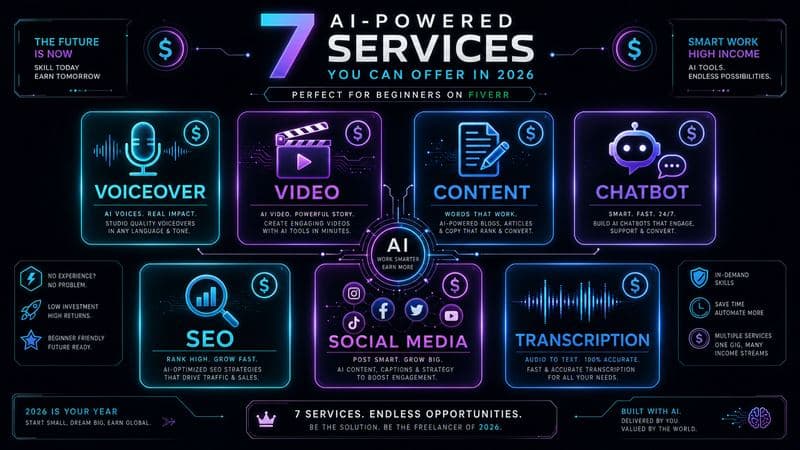
How to Make Money on Fiverr with AI Tools in 2026: 7 Gigs You Can Start This Week
Discover 7 real Fiverr gigs you can launch using free and low-cost AI tools in 2026 — no experience required. Real pricing data, step-by-step setup, and tools that actually work.