
7 AI Income Streams That Run on Autopilot in 2026
7 AI income streams that generate passive income in 2026 — faceless YouTube, digital products, niche blogs, and more. Set up once, earn on autopilot.
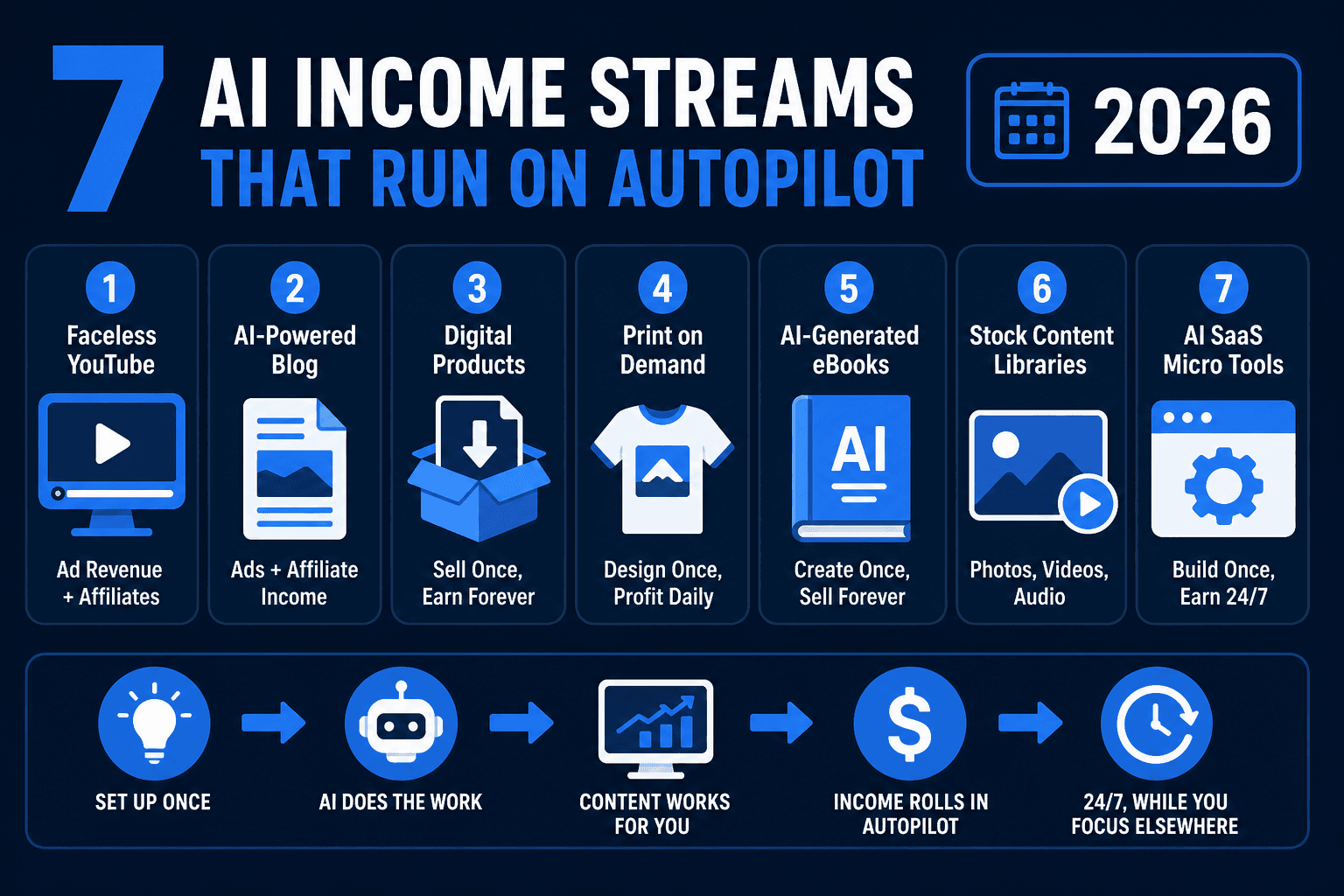
7 AI Income Streams That Run on Autopilot in 2026
There's a quiet revolution happening in how people earn money online — and most people are still sleeping on it.
Three years ago, building a passive income stream required either significant technical skills, a large upfront budget, or months of grinding before seeing a single dollar. You needed video editing software and the skills to use it. You needed a graphic designer. You needed SEO expertise, coding knowledge, or a team of freelancers. The barrier was high, and "passive income" was mostly a myth for regular people — it always required more active work than advertised.
That's changed dramatically.
In 2026, AI tools have matured to the point where a complete beginner can build income systems that genuinely run on autopilot. Not "mostly passive if you squint at it" income — actual set-it-and-earn models where the upfront work creates ongoing revenue without constant client calls, project delivery, or daily hustle.
This article is specifically about automated AI income — the kind where you build something once (or periodically update it), and the system keeps earning. This is NOT about freelancing or agency work. If you want to trade time for money with AI skills, that's a different game. This guide is for people who want income that compounds while they sleep.
Let's break down seven income streams that fit that model in 2026.
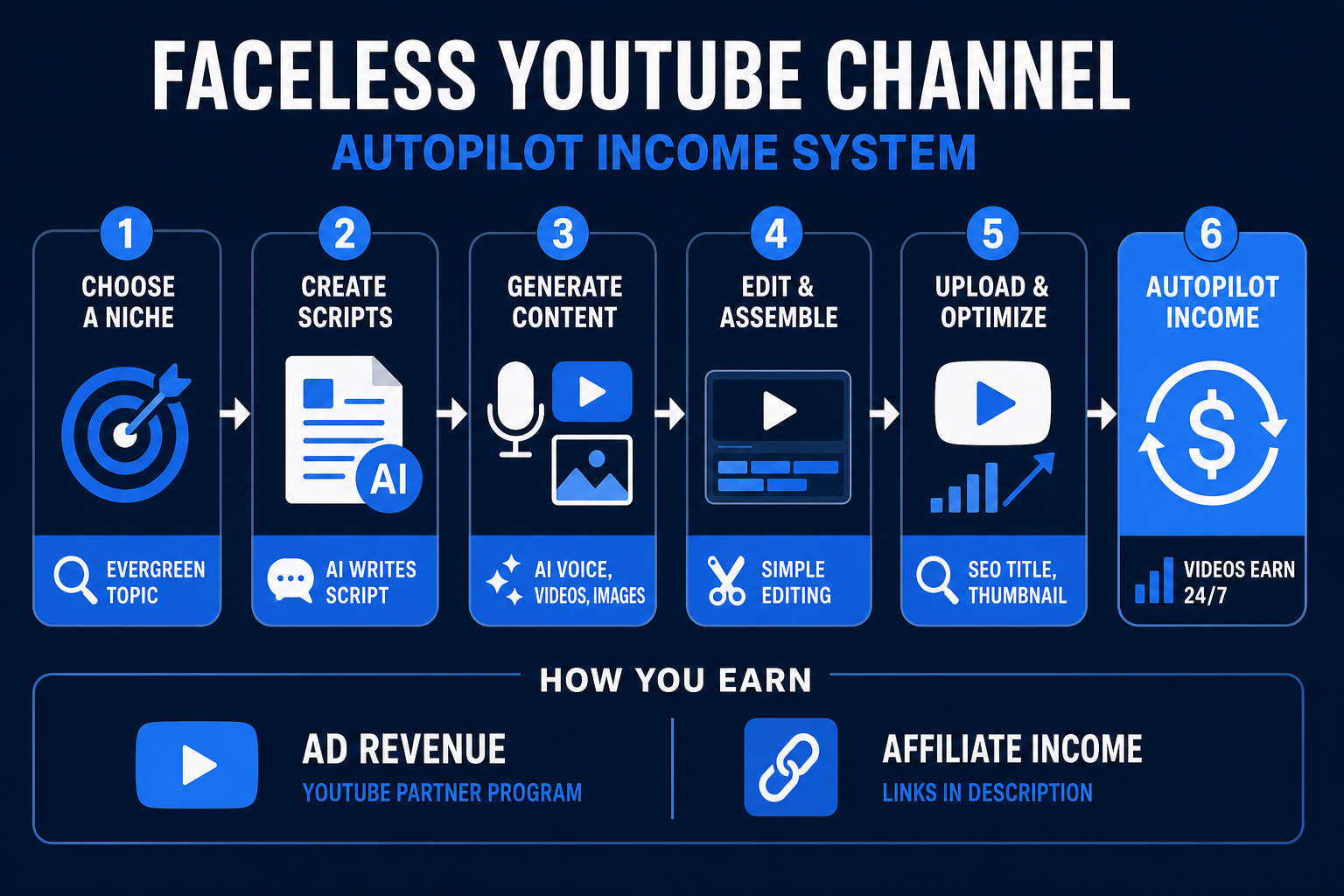
1. Faceless YouTube Channel (Ad Revenue + Affiliates)
What It Is and How It Generates Passive Income
A faceless YouTube channel is exactly what it sounds like — a YouTube channel where you never appear on camera. Instead, content is built around AI-generated voiceovers, AI avatars, stock footage, and simple editing. Channels in niches like personal finance, history, true crime, health tips, and AI news are pulling in consistent monthly revenue through YouTube's Partner Program (ad revenue) and affiliate links placed in video descriptions.
Once a video is uploaded, it keeps earning. A video published six months ago can still generate views and clicks today — that's the compounding nature of YouTube content.
How to Set It Up (Beginner Steps)
- Choose a niche — Pick something evergreen (money, health, productivity, history) with decent advertiser demand. Avoid overly competitive niches when starting out.
- Create your scripts — Use ChatGPT or Claude to write 5–10 minute video scripts. Focus on search-friendly topics using free tools like TubeBuddy or VidIQ to find what people are already looking for.
- Generate voiceovers — Use Murf.ai to convert your scripts into professional-quality AI voiceovers. Murf has dozens of realistic voices across multiple accents and styles, so your content doesn't sound robotic.
- Add an AI avatar (optional but powerful) — TryHolo lets you create a realistic AI presenter to appear on screen without filming yourself. This increases viewer retention and builds a "face" for the channel without any camera work.
- Assemble the video — Use CapCut, Canva, or DaVinci Resolve to layer your voiceover, avatar, and B-roll footage. Free stock footage is available on Pexels and Pixabay.
- Upload consistently — Aim for 2–3 videos per week initially. Once the channel qualifies for monetization (1,000 subscribers, 4,000 watch hours), ad revenue starts flowing.
- Add affiliate links — Sign up for Amazon Associates, ShareASale, or niche-specific programs. Drop relevant links in every video description.
Realistic Monthly Income Range
Estimates vary significantly based on niche, audience size, and affiliate performance. Small channels (10k–50k monthly views) typically earn $100–$800/month in combined ad revenue and affiliate income. Established faceless channels in high-CPM niches can earn $2,000–$10,000+/month — but that takes consistent publishing over 12–18 months.
Time to First Income
Most creators hit YouTube monetization requirements within 3–6 months of consistent publishing. Affiliate income can start sooner if you get even modest traffic.
Tools Needed
- Murf.ai — AI voiceovers
- TryHolo — AI avatars
- ChatGPT or Claude — Script writing
- CapCut or DaVinci Resolve — Video editing (free options available)
2. AI-Generated Digital Products on Gumroad or Etsy
What It Is and How It Generates Passive Income
Digital products — things like prompt packs, Notion templates, AI-generated e-books, Canva templates, and productivity planners — are purchased and downloaded automatically. You create the product once, list it, and every sale happens without your involvement. Gumroad and Etsy handle payment processing and delivery.
How to Set It Up
- Pick a product type — Prompt packs for ChatGPT or Midjourney are extremely popular right now. So are niche e-books (e.g., "50 ChatGPT Prompts for Real Estate Agents"), Canva social media templates, and Notion dashboards.
- Create the product using AI — Use ChatGPT to write e-books or prompt collections. Use Canva (with AI features) to design templates. Use Midjourney to create visual assets.
- Write your listing — Use AI to write compelling product descriptions with relevant keywords.
- Upload to Gumroad or Etsy — Both platforms are beginner-friendly and have built-in audiences. Etsy is particularly strong for templates and digital downloads.
- Drive initial traffic — Post about your product on Pinterest (great for Etsy SEO), Reddit communities, and relevant Facebook groups. This upfront traffic work compounds over time through organic search.
Realistic Monthly Income Range
New sellers often start slow. Typical range for a beginner with 5–10 products after 6 months is $50–$500/month. Sellers with strong product-market fit and good SEO frequently report $1,000–$5,000/month once their store gains traction.
Time to First Income
Some sellers make their first sale within days — especially if they promote in targeted communities. Organic Etsy traffic typically builds over 2–4 months.
Tools Needed
- ChatGPT — Content and copy generation
- Canva — Template design
- Midjourney — Image generation for visual products
- Gumroad.com or Etsy.com — Storefront platforms
3. AI Niche Blog with Affiliate Income
What It Is and How It Generates Passive Income
A niche blog built around a specific topic earns through affiliate commissions — you recommend products or services, and when readers click your links and buy, you earn a percentage. Once articles rank on Google, they can generate traffic and income for years with minimal upkeep.
How to Set It Up
- Choose a profitable niche — Focus on niches with affiliate programs: software tools, finance, health supplements, home improvement, pet care. Use Google's Keyword Planner or Ahrefs Free Tools to validate demand.
- Build the blog — WordPress on affordable hosting (Hostinger or SiteGround) is the standard. Setup takes a few hours and requires zero coding.
- Create content with AI — Use ChatGPT or Jasper to draft articles, then edit for accuracy and your own voice. Target "best [product]" and "[product] review" keywords which signal buying intent.
- Apply for affiliate programs — Amazon Associates, Impact.com, ShareASale, and individual software company programs are good starting points.
- Publish consistently — Aim for 2–4 articles per week for the first 3–6 months. After that, you can slow down as existing content ranks and earns.
Realistic Monthly Income Range
Blogs typically require 6–12 months before significant organic traffic arrives. After that, typical income ranges from $300–$3,000/month for small niche sites. Established niche blogs can reach $5,000–$20,000+/month, though that represents the upper tier of successful sites.
Time to First Income
First affiliate clicks can happen within weeks if you share content on social media. Organic Google traffic — and the bulk of passive income — typically takes 6–9 months to build.
Tools Needed
- WordPress + affordable hosting
- ChatGPT or Jasper.ai — Content creation
- Ahrefs Webmaster Tools (free) or Semrush — SEO research
- Affiliate networks: Amazon Associates, Impact.com, ShareASale
4. CustomGPT Chatbot Sold as SaaS (White-Label Recurring Revenue)
What It Is and How It Generates Passive Income
This is one of the most underrated models in 2026. Platforms like CustomGPT.ai allow you to build custom AI chatbots trained on specific business data — then charge clients a monthly subscription to use them. The chatbot answers customer questions, qualifies leads, or provides product support 24/7. You build it once; your client pays monthly.
How to Set It Up
- Sign up for CustomGPT.ai — The platform is no-code and beginner-friendly. You upload documents, website URLs, or FAQs to train the chatbot.
- Choose a niche — Local businesses (dentists, real estate agents, restaurants, law firms) all need customer service automation. They're easy to approach and don't need a sophisticated understanding of AI.
- Build a demo chatbot — Create a sample chatbot for a fictional business in your target niche to show as a proof of concept.
- Set your pricing — Most beginners charge $97–$297/month per client. Even 5 clients = $485–$1,485/month recurring.
- Deliver and step back — Once the chatbot is live and embedded in the client's website, the platform handles everything. You only need to update it if their business info changes significantly.
Realistic Monthly Income Range
With 3–10 clients, typical range is $300–$3,000/month in recurring revenue. This is genuinely passive once each bot is set up — the platform runs everything.
Time to First Income
First paying client typically acquired within 2–4 weeks with proactive outreach.
Tools Needed
- CustomGPT.ai — Chatbot building platform
5. Print-on-Demand with AI-Generated Designs
What It Is and How It Generates Passive Income
You generate designs using AI image tools, upload them to print-on-demand platforms, and earn a commission every time someone buys a product with your design. The platform handles printing, shipping, and customer service. You never touch inventory.
How to Set It Up
- Generate designs with Midjourney — Create unique, niche-targeted designs. Popular niches include dog breeds, professions, hobbies, and regional pride.
- Open a Printful + Etsy store — Printful integrates directly with Etsy. When someone buys, Printful prints and ships automatically.
- Upload consistently — More designs = more chances to sell. Aim for 50–100 designs in your first month.
- Optimize listings — Use AI to write keyword-rich titles and descriptions for each product.
Realistic Monthly Income Range
Estimates vary widely. Beginners with 100+ designs typically earn $100–$800/month. Sellers with hundreds of strong designs in profitable niches report $2,000–$8,000/month.
Time to First Income
First sales can happen within 1–4 weeks of launching with a good niche focus.
Tools Needed
- Midjourney — AI design generation
- Printful.com — Print-on-demand fulfillment
- Etsy or Redbubble — Storefront
6. AI Stock Content (Images, Music, and Video)
What It Is and How It Generates Passive Income
Stock platforms like Adobe Stock, Shutterstock, Pond5, and Epidemic Sound pay contributors every time their content is downloaded. AI allows you to generate large volumes of images, music, and video clips to upload and earn royalties indefinitely.
How to Set It Up
- Choose your content type — Images are the fastest to produce. AI music (via tools like Suno or Udio) is a growing category. Video loops and backgrounds are high-value.
- Generate content in bulk — Use Midjourney or DALL-E 3 for images. Use Suno.ai for music tracks.
- Apply to stock platforms — Adobe Stock and Shutterstock accept AI-generated content with disclosure. Review each platform's current policy before uploading.
- Upload consistently — The more approved content you have, the more passive downloads you'll receive.
Realistic Monthly Income Range
Stock income is slow to build. Typical range for beginners: $20–$200/month initially, growing to $500–$2,000/month with a large portfolio over 12–18 months.
Time to First Income
First downloads can occur within 2–4 weeks of uploading approved content.
Tools Needed
- Midjourney or DALL-E 3 — Image generation
- Suno.ai — AI music generation
- Adobe Stock, Shutterstock, Pond5 — Distribution platforms
7. AI Compute Reselling / Cloud Credits Arbitrage
What It Is and How It Generates Passive Income
This is the most technical-sounding item on the list — but the entry point is simpler than you'd think. Platforms like Ampere offer cloud computing resources (GPU power) that AI developers and researchers need. By participating in their referral and reseller programs, you can earn recurring income by connecting buyers with compute resources — without managing any infrastructure yourself.
As AI adoption expands, demand for affordable compute continues to grow. Ampere's cloud infrastructure is specifically designed for AI workloads, and their referral program means you earn when people you refer use the platform.
How to Set It Up
- Sign up for Ampere's program — Visit Ampere.sh and explore their referral and partnership options.
- Understand the value proposition — Ampere offers cost-effective AI compute compared to hyperscalers like AWS. This is genuinely useful for AI developers and small AI businesses.
- Share your referral links — Through blog content, YouTube videos (see Stream #1), or newsletters, share Ampere as a cost-saving solution for AI developers.
- Earn recurring commissions — Referred users who stay on the platform generate ongoing income for you.
Realistic Monthly Income Range
Highly variable and dependent on your audience size. Beginners with modest audiences typically earn $50–$500/month. Creators with developer-focused audiences can earn significantly more.
Time to First Income
First commissions can arrive within weeks with the right audience targeting.
Tools Needed
- Ampere.sh — Cloud compute platform with referral program
- A platform to promote (blog, YouTube, newsletter)
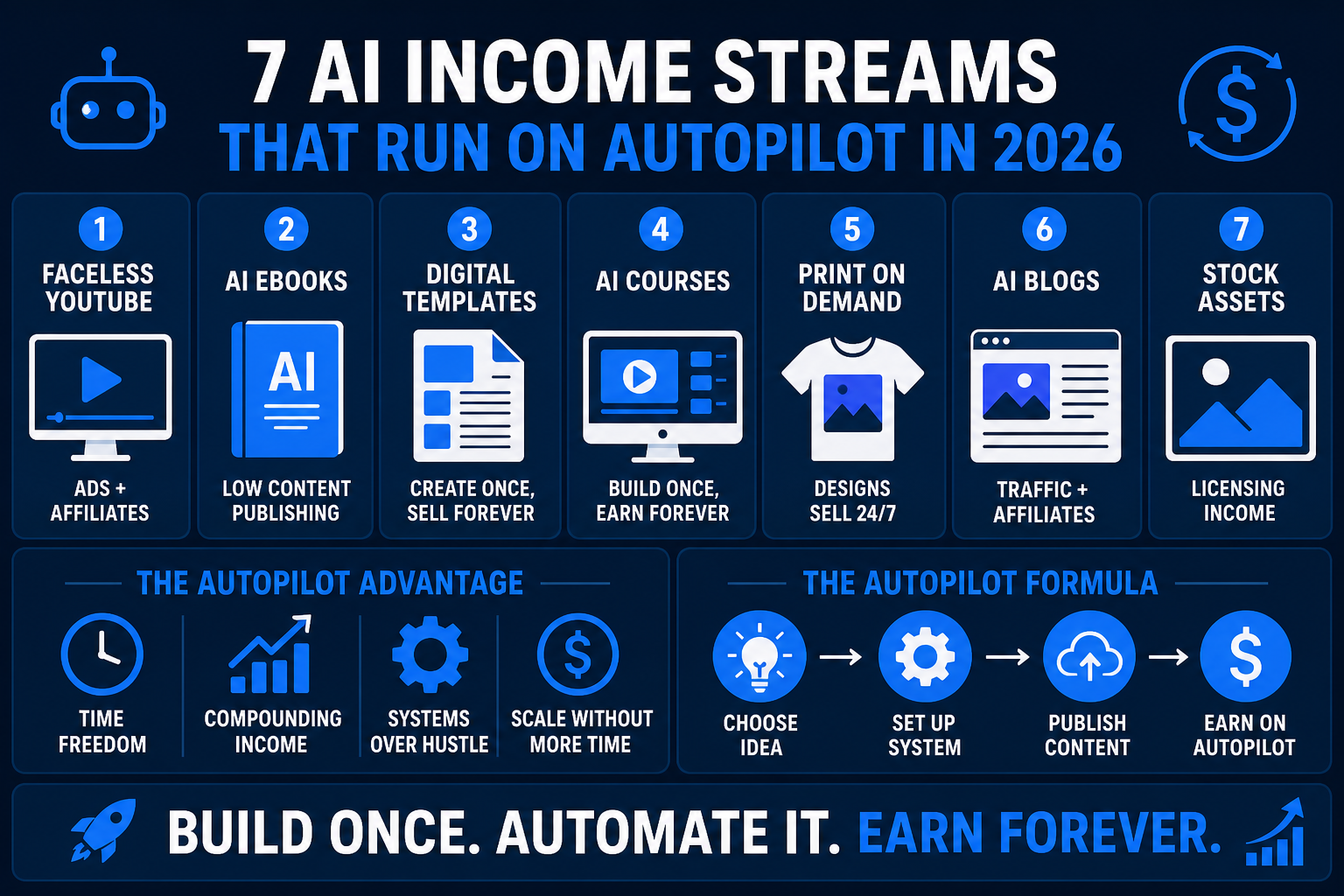
Comparison Table: All 7 Streams at a Glance
| Income Stream | Setup Time | Monthly Income Range | Effort Level | Key Tools |
|---|---|---|---|---|
| Faceless YouTube | 4–8 weeks to monetization | $100–$10,000+ | Medium upfront, low ongoing | Murf.ai, TryHolo |
| Digital Products | 1–2 weeks | $50–$5,000 | Low-Medium | ChatGPT, Canva, Gumroad |
| Niche Blog | 1–2 weeks setup, 6+ months to earn | $300–$20,000+ | Medium upfront, low ongoing | WordPress, ChatGPT |
| CustomGPT SaaS | 1–2 days per bot | $300–$3,000+ | Low after setup | CustomGPT.ai |
| Print-on-Demand | 1–2 weeks | $100–$8,000 | Low | Midjourney, Printful |
| AI Stock Content | 1–2 weeks | $20–$2,000 | Low | Midjourney, Suno.ai |
| Compute Reselling | 1–3 days | $50–$500+ | Low | Ampere.sh |
How to Stack Multiple Streams
The smartest move in 2026 isn't picking one stream and hoping for the best — it's stacking complementary streams so they reinforce each other.
Here's a practical stacking strategy for beginners:
Start with digital products and a niche blog. These have the lowest barrier to entry and build your foundational skills in using AI to create content. The blog also becomes a permanent traffic asset.
Add print-on-demand in month two or three. The design skills you build using Midjourney for your blog carry over directly. You're already creating visuals — now those visuals earn from an additional channel.
Launch a faceless YouTube channel in month three or four. Use your blog content as a script foundation. Your YouTube videos can promote your digital products and link to your blog, creating a traffic loop where each channel feeds the others.
Layer in CustomGPT chatbots or Ampere referrals as you grow an audience. Once you have traffic — from your blog or YouTube — promoting tools like CustomGPT and Ampere becomes straightforward because you have developers, small business owners, or AI enthusiasts already visiting your content.
The key insight is that content you create for one stream often serves multiple streams. A blog post about AI tools promotes Ampere and CustomGPT. A YouTube video about AI income promotes your Murf.ai and TryHolo affiliate links. Your Midjourney designs serve both your POD store and your stock portfolio.
Six to twelve months of consistent building across 2–3 complementary streams puts most committed beginners in the $1,000–$5,000/month range — entirely on automation.
Frequently Asked Questions
Q: Do I need any coding or technical skills to start?
No. Every stream listed here is designed for non-technical beginners. Tools like CustomGPT.ai, Murf.ai, Canva, and Gumroad are built specifically to be user-friendly. If you can use a word processor and follow instructions, you can build these income streams.
Q: How much money do I need to start?
Most of these streams can be started for under $50–$100/month in tool subscriptions. Several have free tiers (ChatGPT's free version, Canva free, Gumroad's free plan). The biggest investment is time, not money.
Q: How long until these streams generate meaningful income?
"Meaningful" is subjective, but a realistic timeline for most beginners is 3–6 months before seeing consistent income, and 6–12 months before that income becomes truly hands-off. CustomGPT chatbots are the fastest — you can have paying clients within weeks if you're proactive in month one.
Q: Is AI-generated content going to get saturated?
Saturation is a valid concern, but it cuts both ways. Yes, more people are using AI tools — but the niches available to target are also expanding faster than ever. The creators who win in 2026 aren't just using AI to produce more content; they're using it to produce better-targeted, more useful content. Quality and niche specificity still win. Start in a focused niche, build genuine value, and saturation becomes much less of a threat.
Final Thoughts
Passive income has always been the goal — but until recently, it was mostly gatekept behind technical skills, large budgets, or luck. AI has genuinely changed the equation in 2026. The tools are mature, accessible, and affordable. The platforms (YouTube, Etsy, Gumroad, Printful) are proven and have built-in audiences.
What's required now isn't technical skill or capital. It's clarity on which stream fits your interests, consistency in the early months, and patience to let compounding do its work.
Pick one stream. Set it up completely. Then add another. That's the path to automated AI income that outlasts the hype.

Alex the Engineer
•Founder & AI ArchitectSenior software engineer turned AI Agency owner. I build massive, scalable AI workflows and share the exact blueprints, financial models, and code I use to generate automated revenue in 2026.
Related Articles
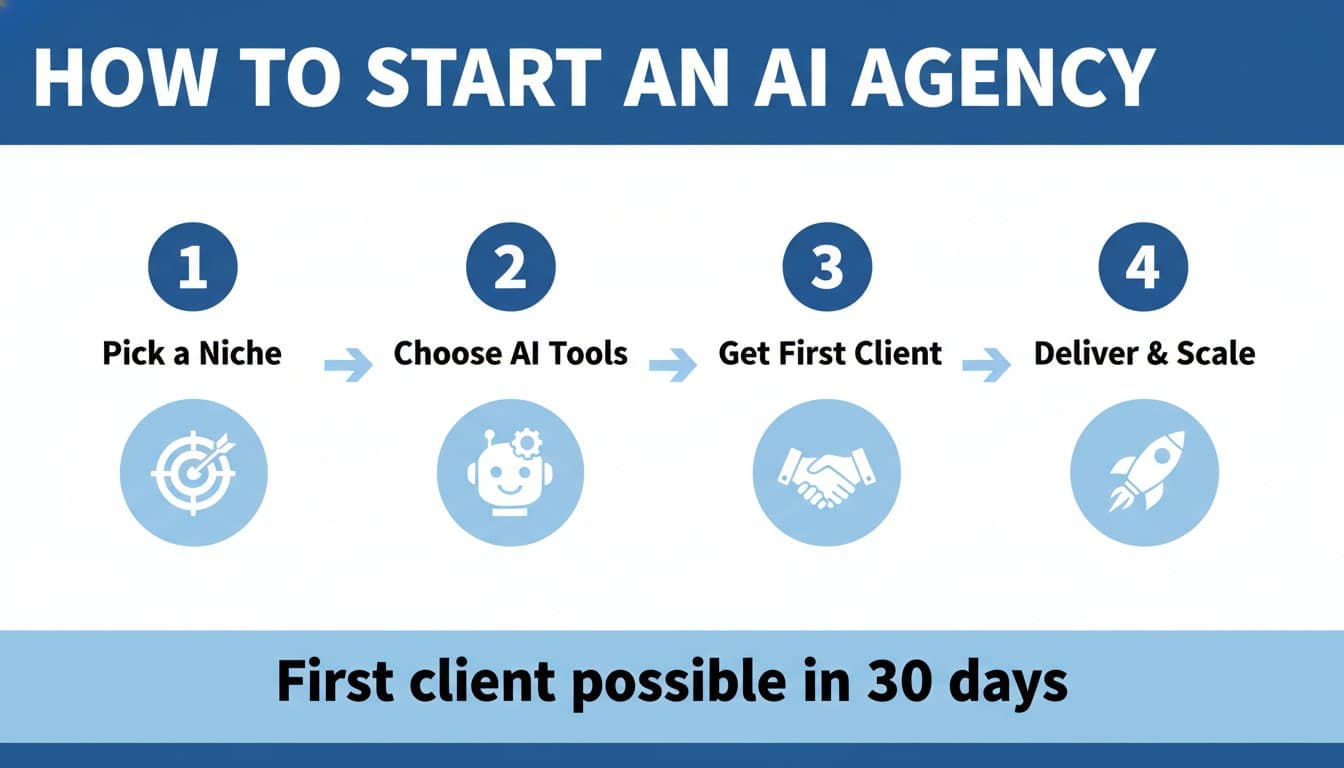
How to Start an AI Agency in 2026: Step-by-Step
How to start an AI agency from scratch in 2026. Discover the exact services to offer, how to find your first clients, and the tools that make delivery fast.
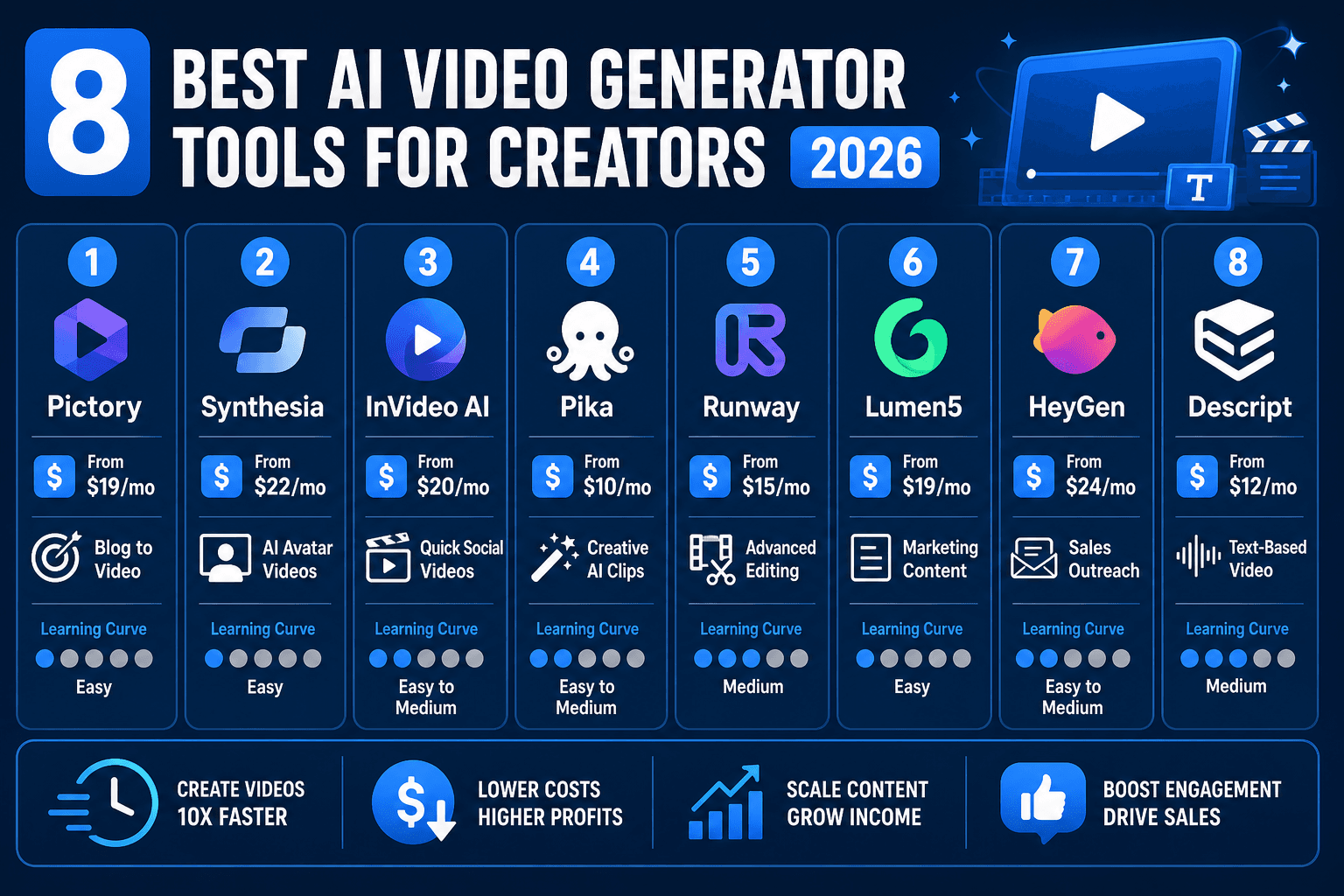
8 Best AI Video Generator Tools for Creators in 2026
Compare the best AI video generator 2026 options. See top picks for marketing, YouTube, and social media to scale your video income fast.